

the magnetic field is always parallel to the electron velocity. The magnetic field force
always vanishes and (2.3.1) leads a solution that the electron rotates with the
velocity:
v c
c
¼ a 0
ð2:3:14Þ
The radius of the electron rotation can be obtained with the balance of the centrifugal
force equal to the force by the electric field:
r c ¼
a 0
k
ð2:3:15Þ
It is noted that the absolute values of v c and r c are the same as v os and x os ,
respectively. It should be noted that as you see below, the electron orbit changes to a
spiral motion in the z-direction in the relativistic case. In addition, note that as far as
a 0 is much smaller than unity, the oscillation amplitude is much shorter than the laser
wavelength.
2.3.1 Antenna and Thomson Scattering
Before leaving this section, let us consider simple effects of an electron oscillation as
emission and scattering of electromagnetic fields suggested in (2.3.10) intuitively.
It is obvious that an oscillating current generated at a certain point with oscillation
frequency ω generates electromagnetic waves to propagate in space with the
wavenumber k ¼ ω/c. This is the basic principle of antenna. Yagi antenna is
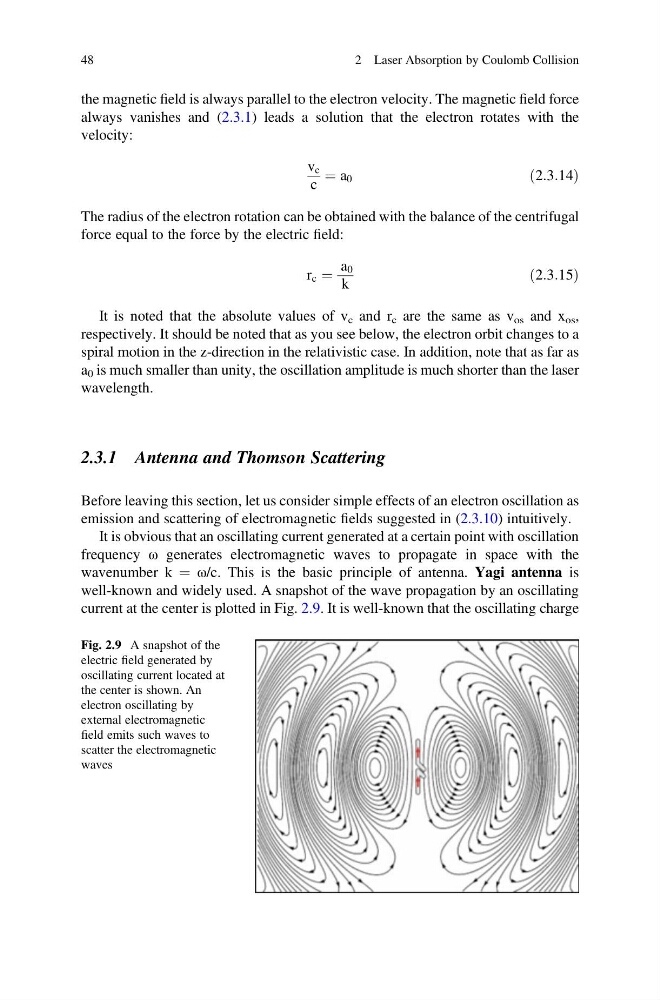
well-known and widely used. A snapshot of the wave propagation by an oscillating
current at the center is plotted in Fig. 2.9. It is well-known that the oscillating charge
Fig. 2.9 A snapshot of the
electric field generated by
oscillating current located at
the center is shown. An
electron oscillating by
external electromagnetic
field emits such waves to
scatter the electromagnetic
waves
48
2 Laser Absorption by Coulomb Collision
always vanishes and (2.3.1) leads a solution that the electron rotates with the
velocity:
v c
c
¼ a 0
ð2:3:14Þ
The radius of the electron rotation can be obtained with the balance of the centrifugal
force equal to the force by the electric field:
r c ¼
a 0
k
ð2:3:15Þ
It is noted that the absolute values of v c and r c are the same as v os and x os ,
respectively. It should be noted that as you see below, the electron orbit changes to a
spiral motion in the z-direction in the relativistic case. In addition, note that as far as
a 0 is much smaller than unity, the oscillation amplitude is much shorter than the laser
wavelength.
2.3.1 Antenna and Thomson Scattering
Before leaving this section, let us consider simple effects of an electron oscillation as
emission and scattering of electromagnetic fields suggested in (2.3.10) intuitively.
It is obvious that an oscillating current generated at a certain point with oscillation
frequency ω generates electromagnetic waves to propagate in space with the
wavenumber k ¼ ω/c. This is the basic principle of antenna. Yagi antenna is
well-known and widely used. A snapshot of the wave propagation by an oscillating
current at the center is plotted in Fig. 2.9. It is well-known that the oscillating charge
Fig. 2.9 A snapshot of the
electric field generated by
oscillating current located at
the center is shown. An
electron oscillating by
external electromagnetic
field emits such waves to
scatter the electromagnetic
waves
48
2 Laser Absorption by Coulomb Collision