

In order to see the relativistic effect on RHS in (2.3.1) for an electron motion in
laser field, assume that the laser field is approximated by an electromagnetic field in
vacuum. Then, (1.3.1) requires the relation of the amplitude ratio of the form:
E
j j ¼ c B
j j
ð2:3:4Þ
This relation means that the magnetic force becomes important only in the case of
relativistic motion. In the non-relativistic case, it is possible to treat the magnetic
force as perturbation and Lorentz factor γ ¼ 1.
Consider an electron motion in non-relativistic case for a linearly polarized laser
in y-direction in (2.2.16), the oscillation motion only by electric field in y-direction is
easily obtained from (2.3.1) as:
v os
c
¼ Àa 0 cos ξ
ð Þ
ð2:3:5Þ
where ξ is the phase of the laser field defined as:
ξ ¼ kx À ωt
ð2:3:6Þ
In (2.3.5), the nondimensional parameter is defined as:
a 0
eE 0
mωc
¼
eA 0
mc
ð2:3:7Þ
In (2.3.7), a 0 is a normalized amplitude of laser electric field and a very important
parameter indicating the importance of relativistic effect in electron motion in strong
laser field. It is called strength parameter. As shown below, non-relativistic
condition is satisfied only for the case with a 0 < < 1.
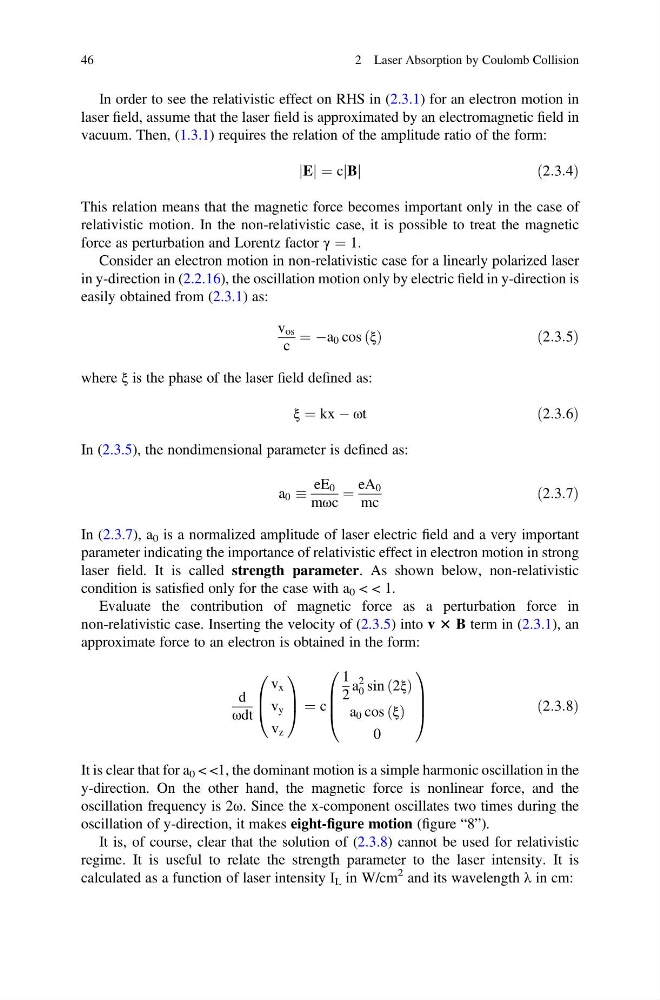
Evaluate the contribution of magnetic force as a perturbation force in
non-relativistic case. Inserting the velocity of (2.3.5) into v 3 B term in (2.3.1), an
approximate force to an electron is obtained in the form:
d
ωdt
v x
v y
v z
0
B
@
1
C
A ¼ c
1
2
a
2
0 sin 2ξ
ð Þ
a 0 cos ξ
ð Þ
0
0
B
B
@
1
C
C
A
ð2:3:8Þ
It is clear that for a 0 < <1, the dominant motion is a simple harmonic oscillation in the
y-direction. On the other hand, the magnetic force is nonlinear force, and the
oscillation frequency is 2ω. Since the x-component oscillates two times during the
oscillation of y-direction, it makes eight-figure motion (figure “8”).
It is, of course, clear that the solution of (2.3.8) cannot be used for relativistic
regime. It is useful to relate the strength parameter to the laser intensity. It is
calculated as a function of laser intensity I L in W/cm
2 and its wavelength λ in cm:
46
2 Laser Absorption by Coulomb Collision
laser field, assume that the laser field is approximated by an electromagnetic field in
vacuum. Then, (1.3.1) requires the relation of the amplitude ratio of the form:
E
j j ¼ c B
j j
ð2:3:4Þ
This relation means that the magnetic force becomes important only in the case of
relativistic motion. In the non-relativistic case, it is possible to treat the magnetic
force as perturbation and Lorentz factor γ ¼ 1.
Consider an electron motion in non-relativistic case for a linearly polarized laser
in y-direction in (2.2.16), the oscillation motion only by electric field in y-direction is
easily obtained from (2.3.1) as:
v os
c
¼ Àa 0 cos ξ
ð Þ
ð2:3:5Þ
where ξ is the phase of the laser field defined as:
ξ ¼ kx À ωt
ð2:3:6Þ
In (2.3.5), the nondimensional parameter is defined as:
a 0
eE 0
mωc
¼
eA 0
mc
ð2:3:7Þ
In (2.3.7), a 0 is a normalized amplitude of laser electric field and a very important
parameter indicating the importance of relativistic effect in electron motion in strong
laser field. It is called strength parameter. As shown below, non-relativistic
condition is satisfied only for the case with a 0 < < 1.
Evaluate the contribution of magnetic force as a perturbation force in
non-relativistic case. Inserting the velocity of (2.3.5) into v 3 B term in (2.3.1), an
approximate force to an electron is obtained in the form:
d
ωdt
v x
v y
v z
0
B
@
1
C
A ¼ c
1
2
a
2
0 sin 2ξ
ð Þ
a 0 cos ξ
ð Þ
0
0
B
B
@
1
C
C
A
ð2:3:8Þ
It is clear that for a 0 < <1, the dominant motion is a simple harmonic oscillation in the
y-direction. On the other hand, the magnetic force is nonlinear force, and the
oscillation frequency is 2ω. Since the x-component oscillates two times during the
oscillation of y-direction, it makes eight-figure motion (figure “8”).
It is, of course, clear that the solution of (2.3.8) cannot be used for relativistic
regime. It is useful to relate the strength parameter to the laser intensity. It is
calculated as a function of laser intensity I L in W/cm
2 and its wavelength λ in cm:
46
2 Laser Absorption by Coulomb Collision