

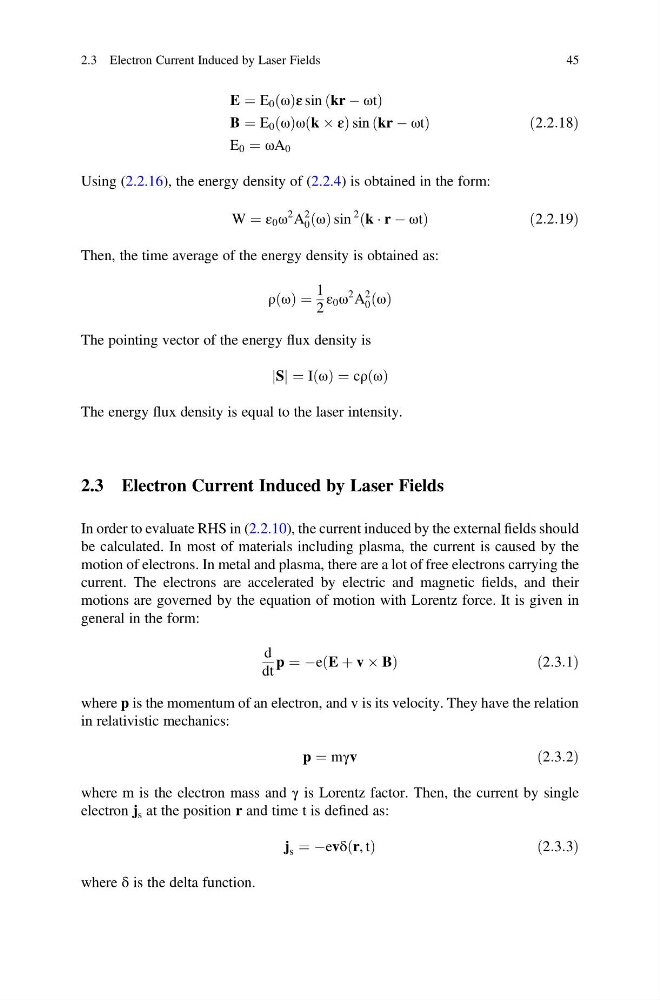
E ¼ E 0 ω
ð Þε sin kr À ωt
ð
Þ
B ¼ E 0 ω
ð Þω k  ε
ð
Þsin kr À ωt
ð
Þ
E 0 ¼ ωA 0
ð2:2:18Þ
Using (2.2.16), the energy density of (2.2.4) is obtained in the form:
W ¼ ε 0 ω
2 A
2
0 ω
ð Þ sin
2 k Á r À ωt
ð
Þ
ð 2:2:19Þ
Then, the time average of the energy density is obtained as:
ρ ω
ð Þ ¼
1
2
ε 0 ω
2 A
2
0 ω
ð Þ
The pointing vector of the energy flux density is
S
j j ¼ I ω
ð Þ ¼ cρ ω
ð Þ
The energy flux density is equal to the laser intensity.
2.3 Electron Current Induced by Laser Fields
In order to evaluate RHS in (2.2.10), the current induced by the external fields should
be calculated. In most of materials including plasma, the current is caused by the
motion of electrons. In metal and plasma, there are a lot of free electrons carrying the
current. The electrons are accelerated by electric and magnetic fields, and their
motions are governed by the equation of motion with Lorentz force. It is given in
general in the form:
d
dt
p ¼ Àe E þ v  B
ð
Þ
ð 2:3:1Þ
where p is the momentum of an electron, and v is its velocity. They have the relation
in relativistic mechanics:
p ¼ mγv
ð2:3:2Þ
where m is the electron mass and γ is Lorentz factor. Then, the current by single
electron j s at the position r and time t is defined as:
j s ¼ Àevδ r, t
ð Þ
ð2:3:3Þ
where δ is the delta function.
2.3 Electron Current Induced by Laser Fields
45
ð Þε sin kr À ωt
ð
Þ
B ¼ E 0 ω
ð Þω k  ε
ð
Þsin kr À ωt
ð
Þ
E 0 ¼ ωA 0
ð2:2:18Þ
Using (2.2.16), the energy density of (2.2.4) is obtained in the form:
W ¼ ε 0 ω
2 A
2
0 ω
ð Þ sin
2 k Á r À ωt
ð
Þ
ð 2:2:19Þ
Then, the time average of the energy density is obtained as:
ρ ω
ð Þ ¼
1
2
ε 0 ω
2 A
2
0 ω
ð Þ
The pointing vector of the energy flux density is
S
j j ¼ I ω
ð Þ ¼ cρ ω
ð Þ
The energy flux density is equal to the laser intensity.
2.3 Electron Current Induced by Laser Fields
In order to evaluate RHS in (2.2.10), the current induced by the external fields should
be calculated. In most of materials including plasma, the current is caused by the
motion of electrons. In metal and plasma, there are a lot of free electrons carrying the
current. The electrons are accelerated by electric and magnetic fields, and their
motions are governed by the equation of motion with Lorentz force. It is given in
general in the form:
d
dt
p ¼ Àe E þ v  B
ð
Þ
ð 2:3:1Þ
where p is the momentum of an electron, and v is its velocity. They have the relation
in relativistic mechanics:
p ¼ mγv
ð2:3:2Þ
where m is the electron mass and γ is Lorentz factor. Then, the current by single
electron j s at the position r and time t is defined as:
j s ¼ Àevδ r, t
ð Þ
ð2:3:3Þ
where δ is the delta function.
2.3 Electron Current Induced by Laser Fields
45