

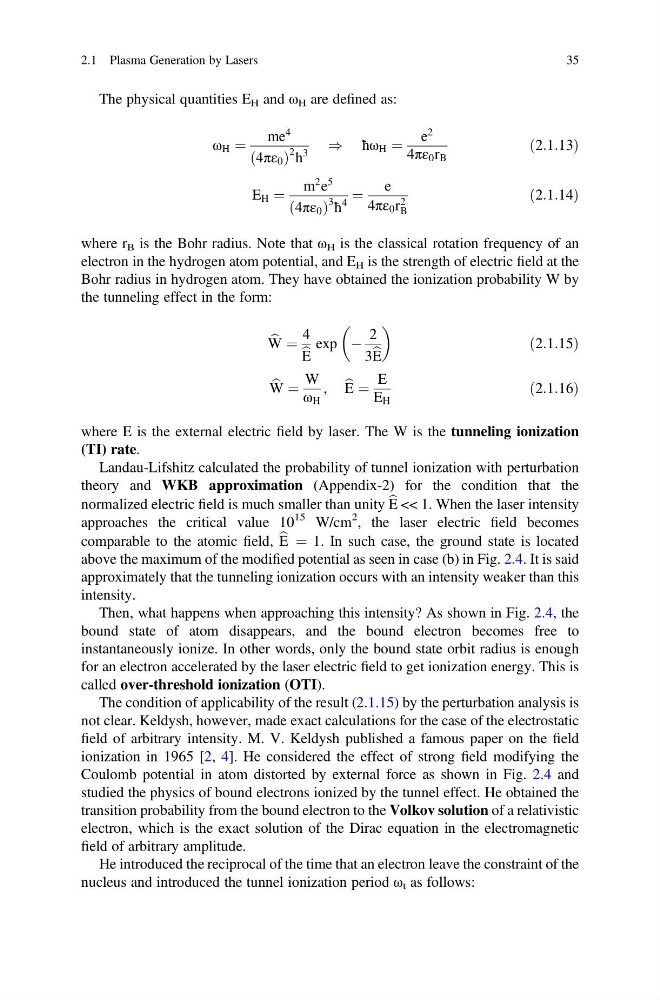
The physical quantities E H and ω H are defined as:
ω H ¼
me
4
4πε 0
ð
Þ
2 ħ
3
) ħω H ¼
e
2
4πε 0 r B
ð2:1:13Þ
E H ¼
m
2 e
5
4πε 0
ð
Þ
3 ħ
4
¼
e
4πε 0 r 2
B
ð2:1:14Þ
where r B is the Bohr radius. Note that ω H is the classical rotation frequency of an
electron in the hydrogen atom potential, and E H is the strength of electric field at the
Bohr radius in hydrogen atom. They have obtained the ionization probability W by
the tunneling effect in the form:
b
W ¼
4
b
E
exp À
2
3 b
E
ð2:1:15Þ
b
W ¼
W
ω H
, b
E ¼
E
E H
ð2:1:16Þ
where E is the external electric field by laser. The W is the tunneling ionization
(TI) rate.
Landau-Lifshitz calculated the probability of tunnel ionization with perturbation
theory and WKB approximation (Appendix-2) for the condition that the
normalized electric field is much smaller than unity b
E << 1. When the laser intensity
approaches the critical value 10
15 W/cm
2 , the laser electric field becomes
comparable to the atomic field, b
E ¼ 1. In such case, the ground state is located
above the maximum of the modified potential as seen in case (b) in Fig. 2.4. It is said
approximately that the tunneling ionization occurs with an intensity weaker than this
intensity.
Then, what happens when approaching this intensity? As shown in Fig. 2.4, the
bound state of atom disappears, and the bound electron becomes free to
instantaneously ionize. In other words, only the bound state orbit radius is enough
for an electron accelerated by the laser electric field to get ionization energy. This is
called over-threshold ionization (OTI).
The condition of applicability of the result (2.1.15) by the perturbation analysis is
not clear. Keldysh, however, made exact calculations for the case of the electrostatic
field of arbitrary intensity. M. V. Keldysh published a famous paper on the field
ionization in 1965 [2, 4]. He considered the effect of strong field modifying the
Coulomb potential in atom distorted by external force as shown in Fig. 2.4 and
studied the physics of bound electrons ionized by the tunnel effect. He obtained the
transition probability from the bound electron to the Volkov solution of a relativistic
electron, which is the exact solution of the Dirac equation in the electromagnetic
field of arbitrary amplitude.
He introduced the reciprocal of the time that an electron leave the constraint of the
nucleus and introduced the tunnel ionization period ω t as follows:
2.1 Plasma Generation by Lasers
35
ω H ¼
me
4
4πε 0
ð
Þ
2 ħ
3
) ħω H ¼
e
2
4πε 0 r B
ð2:1:13Þ
E H ¼
m
2 e
5
4πε 0
ð
Þ
3 ħ
4
¼
e
4πε 0 r 2
B
ð2:1:14Þ
where r B is the Bohr radius. Note that ω H is the classical rotation frequency of an
electron in the hydrogen atom potential, and E H is the strength of electric field at the
Bohr radius in hydrogen atom. They have obtained the ionization probability W by
the tunneling effect in the form:
b
W ¼
4
b
E
exp À
2
3 b
E
ð2:1:15Þ
b
W ¼
W
ω H
, b
E ¼
E
E H
ð2:1:16Þ
where E is the external electric field by laser. The W is the tunneling ionization
(TI) rate.
Landau-Lifshitz calculated the probability of tunnel ionization with perturbation
theory and WKB approximation (Appendix-2) for the condition that the
normalized electric field is much smaller than unity b
E << 1. When the laser intensity
approaches the critical value 10
15 W/cm
2 , the laser electric field becomes
comparable to the atomic field, b
E ¼ 1. In such case, the ground state is located
above the maximum of the modified potential as seen in case (b) in Fig. 2.4. It is said
approximately that the tunneling ionization occurs with an intensity weaker than this
intensity.
Then, what happens when approaching this intensity? As shown in Fig. 2.4, the
bound state of atom disappears, and the bound electron becomes free to
instantaneously ionize. In other words, only the bound state orbit radius is enough
for an electron accelerated by the laser electric field to get ionization energy. This is
called over-threshold ionization (OTI).
The condition of applicability of the result (2.1.15) by the perturbation analysis is
not clear. Keldysh, however, made exact calculations for the case of the electrostatic
field of arbitrary intensity. M. V. Keldysh published a famous paper on the field
ionization in 1965 [2, 4]. He considered the effect of strong field modifying the
Coulomb potential in atom distorted by external force as shown in Fig. 2.4 and
studied the physics of bound electrons ionized by the tunnel effect. He obtained the
transition probability from the bound electron to the Volkov solution of a relativistic
electron, which is the exact solution of the Dirac equation in the electromagnetic
field of arbitrary amplitude.
He introduced the reciprocal of the time that an electron leave the constraint of the
nucleus and introduced the tunnel ionization period ω t as follows:
2.1 Plasma Generation by Lasers
35