

Np ¼ 6:3 Â 10
17
 5  10
À15
¼ 3000
ð2:1:11Þ
The threshold intensity at which multiphoton ionization begins can be roughly
evaluated:
I L >
14
3000
 10
15
% 5 Â 10
12
W=cm
2
Â
Ã
ð2:1:12Þ
Regarding almost any molecular gas, the molecular dissociation by multiphoton
absorption occurs first, and ionization of dissociated atoms occurs as above.
2.1.3 Tunneling and Over-Threshold Ionizations
As seen above, the field-induced emission is due to the tunneling effect of the
quantum mechanics. As long as the ionization time is much smaller than the laser
oscillation period, the stationary condition can be assumed as in the DC field. In
Landau-Lifshitz’s textbook of quantum mechanics (section 77 in [3]), the eigenvalue
problem when the electrostatic field of the external field U ¼ ÀzE is applied to
hydrogen atoms is solved using the parabolic coordinates, since atom is 3 dimension
than 1-dimension in Fig. 1.1. Then, they asked the readers to calculate the
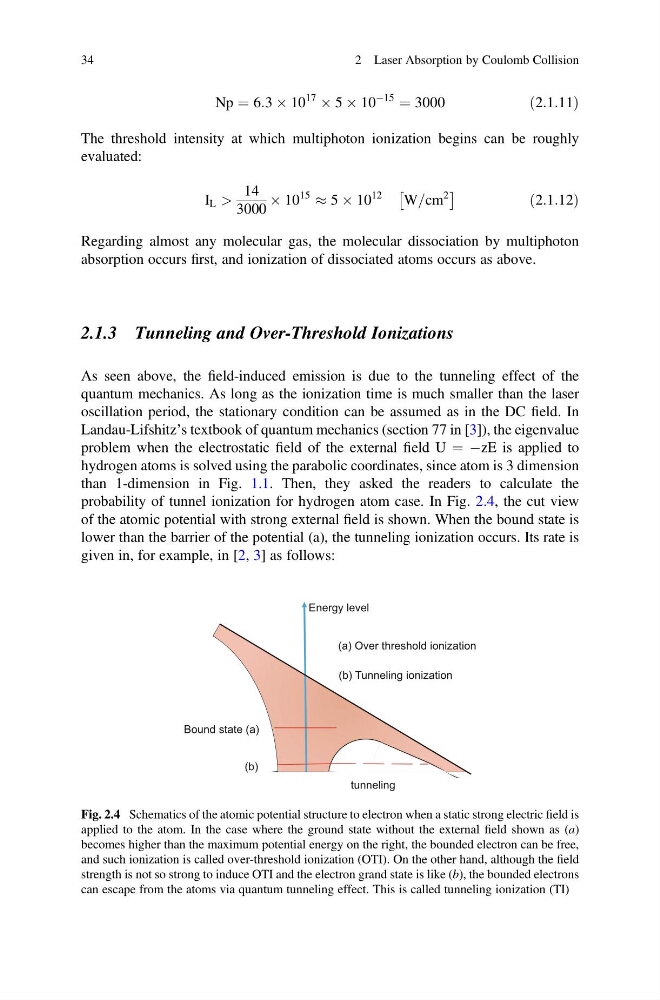
probability of tunnel ionization for hydrogen atom case. In Fig. 2.4, the cut view
of the atomic potential with strong external field is shown. When the bound state is
lower than the barrier of the potential (a), the tunneling ionization occurs. Its rate is
given in, for example, in [2, 3] as follows:
Energy level
Bound state (a)
(b)
tunneling
(a) Over threshold ionization
(b) Tunneling ionization
Fig. 2.4 Schematics of the atomic potential structure to electron when a static strong electric field is
applied to the atom. In the case where the ground state without the external field shown as (a)
becomes higher than the maximum potential energy on the right, the bounded electron can be free,
and such ionization is called over-threshold ionization (OTI). On the other hand, although the field
strength is not so strong to induce OTI and the electron grand state is like (b), the bounded electrons
can escape from the atoms via quantum tunneling effect. This is called tunneling ionization (TI)
34
2 Laser Absorption by Coulomb Collision
17
 5  10
À15
¼ 3000
ð2:1:11Þ
The threshold intensity at which multiphoton ionization begins can be roughly
evaluated:
I L >
14
3000
 10
15
% 5 Â 10
12
W=cm
2
Â
Ã
ð2:1:12Þ
Regarding almost any molecular gas, the molecular dissociation by multiphoton
absorption occurs first, and ionization of dissociated atoms occurs as above.
2.1.3 Tunneling and Over-Threshold Ionizations
As seen above, the field-induced emission is due to the tunneling effect of the
quantum mechanics. As long as the ionization time is much smaller than the laser
oscillation period, the stationary condition can be assumed as in the DC field. In
Landau-Lifshitz’s textbook of quantum mechanics (section 77 in [3]), the eigenvalue
problem when the electrostatic field of the external field U ¼ ÀzE is applied to
hydrogen atoms is solved using the parabolic coordinates, since atom is 3 dimension
than 1-dimension in Fig. 1.1. Then, they asked the readers to calculate the
probability of tunnel ionization for hydrogen atom case. In Fig. 2.4, the cut view
of the atomic potential with strong external field is shown. When the bound state is
lower than the barrier of the potential (a), the tunneling ionization occurs. Its rate is
given in, for example, in [2, 3] as follows:
Energy level
Bound state (a)
(b)
tunneling
(a) Over threshold ionization
(b) Tunneling ionization
Fig. 2.4 Schematics of the atomic potential structure to electron when a static strong electric field is
applied to the atom. In the case where the ground state without the external field shown as (a)
becomes higher than the maximum potential energy on the right, the bounded electron can be free,
and such ionization is called over-threshold ionization (OTI). On the other hand, although the field
strength is not so strong to induce OTI and the electron grand state is like (b), the bounded electrons
can escape from the atoms via quantum tunneling effect. This is called tunneling ionization (TI)
34
2 Laser Absorption by Coulomb Collision