

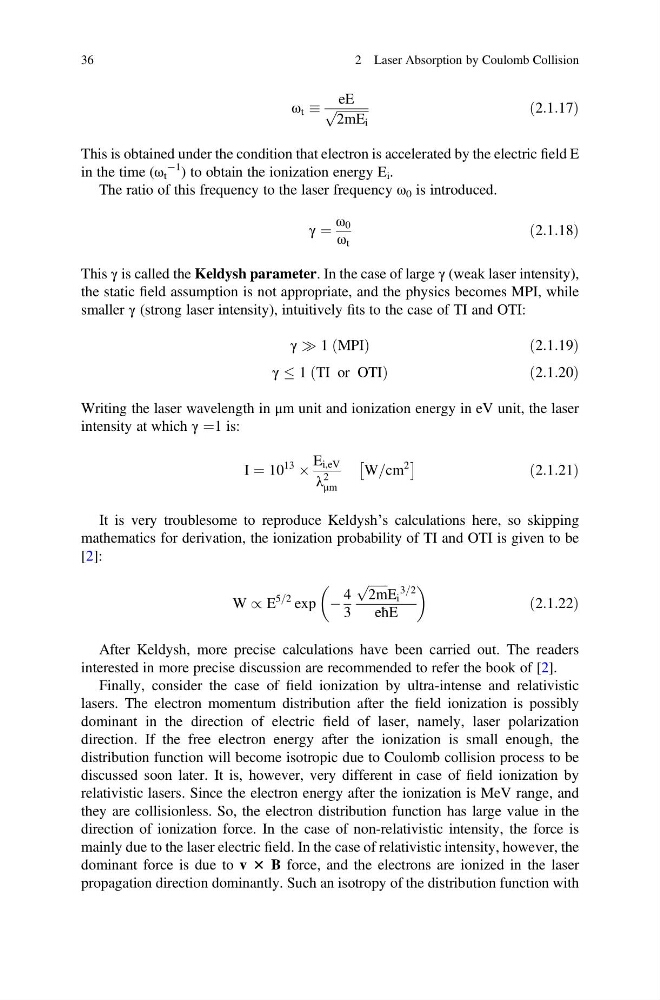
ω t
eE
ffiffiffiffiffiffiffiffiffiffi ffi
2mE i
p
ð2:1:17Þ
This is obtained under the condition that electron is accelerated by the electric field E
in the time (ω t
À1
) to obtain the ionization energy E i .
The ratio of this frequency to the laser frequency ω 0 is introduced.
γ ¼
ω 0
ω t
ð2:1:18Þ
This γ is called the Keldysh parameter. In the case of large γ (weak laser intensity),
the static field assumption is not appropriate, and the physics becomes MPI, while
smaller γ (strong laser intensity), intuitively fits to the case of TI and OTI:
γ ) 1 MPI
ð
Þ
ð2:1:19Þ
γ 1 TI or OTI
ð
Þ
ð 2:1:20Þ
Writing the laser wavelength in μm unit and ionization energy in eV unit, the laser
intensity at which γ ¼1 is:
I ¼ 10
13
Â
E i,eV
λ
2
μm
W=cm
2
Â
Ã
ð2:1:21Þ
It is very troublesome to reproduce Keldysh’s calculations here, so skipping
mathematics for derivation, the ionization probability of TI and OTI is given to be
[2]:
W / E
5=2 exp À
4
3
ffiffiffiffiffiffi ffi
2m
p
E i
3=2
eħE
ð2:1:22Þ
After Keldysh, more precise calculations have been carried out. The readers
interested in more precise discussion are recommended to refer the book of [2].
Finally, consider the case of field ionization by ultra-intense and relativistic
lasers. The electron momentum distribution after the field ionization is possibly
dominant in the direction of electric field of laser, namely, laser polarization
direction. If the free electron energy after the ionization is small enough, the
distribution function will become isotropic due to Coulomb collision process to be
discussed soon later. It is, however, very different in case of field ionization by
relativistic lasers. Since the electron energy after the ionization is MeV range, and
they are collisionless. So, the electron distribution function has large value in the
direction of ionization force. In the case of non-relativistic intensity, the force is
mainly due to the laser electric field. In the case of relativistic intensity, however, the
dominant force is due to v 3 B force, and the electrons are ionized in the laser
propagation direction dominantly. Such an isotropy of the distribution function with
36
2 Laser Absorption by Coulomb Collision
eE
ffiffiffiffiffiffiffiffiffiffi ffi
2mE i
p
ð2:1:17Þ
This is obtained under the condition that electron is accelerated by the electric field E
in the time (ω t
À1
) to obtain the ionization energy E i .
The ratio of this frequency to the laser frequency ω 0 is introduced.
γ ¼
ω 0
ω t
ð2:1:18Þ
This γ is called the Keldysh parameter. In the case of large γ (weak laser intensity),
the static field assumption is not appropriate, and the physics becomes MPI, while
smaller γ (strong laser intensity), intuitively fits to the case of TI and OTI:
γ ) 1 MPI
ð
Þ
ð2:1:19Þ
γ 1 TI or OTI
ð
Þ
ð 2:1:20Þ
Writing the laser wavelength in μm unit and ionization energy in eV unit, the laser
intensity at which γ ¼1 is:
I ¼ 10
13
Â
E i,eV
λ
2
μm
W=cm
2
Â
Ã
ð2:1:21Þ
It is very troublesome to reproduce Keldysh’s calculations here, so skipping
mathematics for derivation, the ionization probability of TI and OTI is given to be
[2]:
W / E
5=2 exp À
4
3
ffiffiffiffiffiffi ffi
2m
p
E i
3=2
eħE
ð2:1:22Þ
After Keldysh, more precise calculations have been carried out. The readers
interested in more precise discussion are recommended to refer the book of [2].
Finally, consider the case of field ionization by ultra-intense and relativistic
lasers. The electron momentum distribution after the field ionization is possibly
dominant in the direction of electric field of laser, namely, laser polarization
direction. If the free electron energy after the ionization is small enough, the
distribution function will become isotropic due to Coulomb collision process to be
discussed soon later. It is, however, very different in case of field ionization by
relativistic lasers. Since the electron energy after the ionization is MeV range, and
they are collisionless. So, the electron distribution function has large value in the
direction of ionization force. In the case of non-relativistic intensity, the force is
mainly due to the laser electric field. In the case of relativistic intensity, however, the
dominant force is due to v 3 B force, and the electrons are ionized in the laser
propagation direction dominantly. Such an isotropy of the distribution function with
36
2 Laser Absorption by Coulomb Collision