

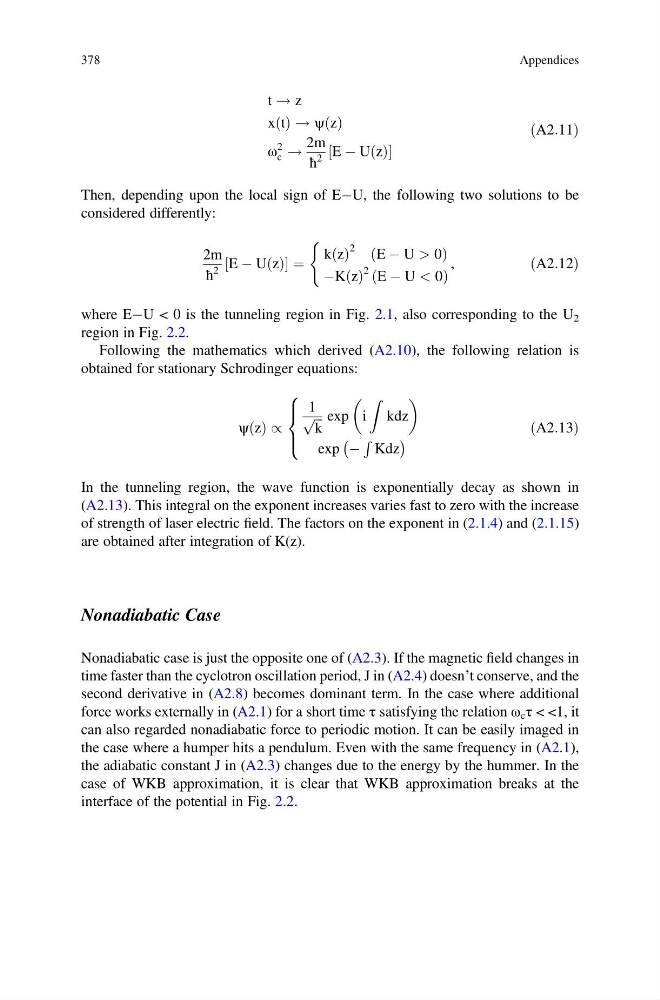
t ! z
x t
ð Þ ! ψ z
ð Þ
ω
2
c !
2m
ħ
2
E À U z
ð Þ
½
ðA2:11Þ
Then, depending upon the local sign of EÀU, the following two solutions to be
considered differently:
2m
ħ
2
E À U z
ð Þ
½
¼
k z
ð Þ
2
E À U > 0
ð
Þ
ÀK z
ð Þ
2 E À U < 0
ð
Þ
,
(
ðA2:12Þ
where EÀU < 0 is the tunneling region in Fig. 2.1, also corresponding to the U 2
region in Fig. 2.2.
Following the mathematics which derived (A2.10), the following relation is
obtained for stationary Schrodinger equations:
ψ z
ð Þ /
1
ffiffi ffi
k
p exp i
Z
kdz
exp À
R
Kdz
À
Á
8
> <
> :
ðA2:13Þ
In the tunneling region, the wave function is exponentially decay as shown in
(A2.13). This integral on the exponent increases varies fast to zero with the increase
of strength of laser electric field. The factors on the exponent in (2.1.4) and (2.1.15)
are obtained after integration of K(z).
Nonadiabatic Case
Nonadiabatic case is just the opposite one of (A2.3). If the magnetic field changes in
time faster than the cyclotron oscillation period, J in (A2.4) doesn’t conserve, and the
second derivative in (A2.8) becomes dominant term. In the case where additional
force works externally in (A2.1) for a short time τ satisfying the relation ω c τ < <1, it
can also regarded nonadiabatic force to periodic motion. It can be easily imaged in
the case where a humper hits a pendulum. Even with the same frequency in (A2.1),
the adiabatic constant J in (A2.3) changes due to the energy by the hummer. In the
case of WKB approximation, it is clear that WKB approximation breaks at the
interface of the potential in Fig. 2.2.
378
Appendices
x t
ð Þ ! ψ z
ð Þ
ω
2
c !
2m
ħ
2
E À U z
ð Þ
½
ðA2:11Þ
Then, depending upon the local sign of EÀU, the following two solutions to be
considered differently:
2m
ħ
2
E À U z
ð Þ
½
¼
k z
ð Þ
2
E À U > 0
ð
Þ
ÀK z
ð Þ
2 E À U < 0
ð
Þ
,
(
ðA2:12Þ
where EÀU < 0 is the tunneling region in Fig. 2.1, also corresponding to the U 2
region in Fig. 2.2.
Following the mathematics which derived (A2.10), the following relation is
obtained for stationary Schrodinger equations:
ψ z
ð Þ /
1
ffiffi ffi
k
p exp i
Z
kdz
exp À
R
Kdz
À
Á
8
> <
> :
ðA2:13Þ
In the tunneling region, the wave function is exponentially decay as shown in
(A2.13). This integral on the exponent increases varies fast to zero with the increase
of strength of laser electric field. The factors on the exponent in (2.1.4) and (2.1.15)
are obtained after integration of K(z).
Nonadiabatic Case
Nonadiabatic case is just the opposite one of (A2.3). If the magnetic field changes in
time faster than the cyclotron oscillation period, J in (A2.4) doesn’t conserve, and the
second derivative in (A2.8) becomes dominant term. In the case where additional
force works externally in (A2.1) for a short time τ satisfying the relation ω c τ < <1, it
can also regarded nonadiabatic force to periodic motion. It can be easily imaged in
the case where a humper hits a pendulum. Even with the same frequency in (A2.1),
the adiabatic constant J in (A2.3) changes due to the energy by the hummer. In the
case of WKB approximation, it is clear that WKB approximation breaks at the
interface of the potential in Fig. 2.2.
378
Appendices