

d
2 x
dt
2
¼ Àω
2
c x,
ðA2:1Þ
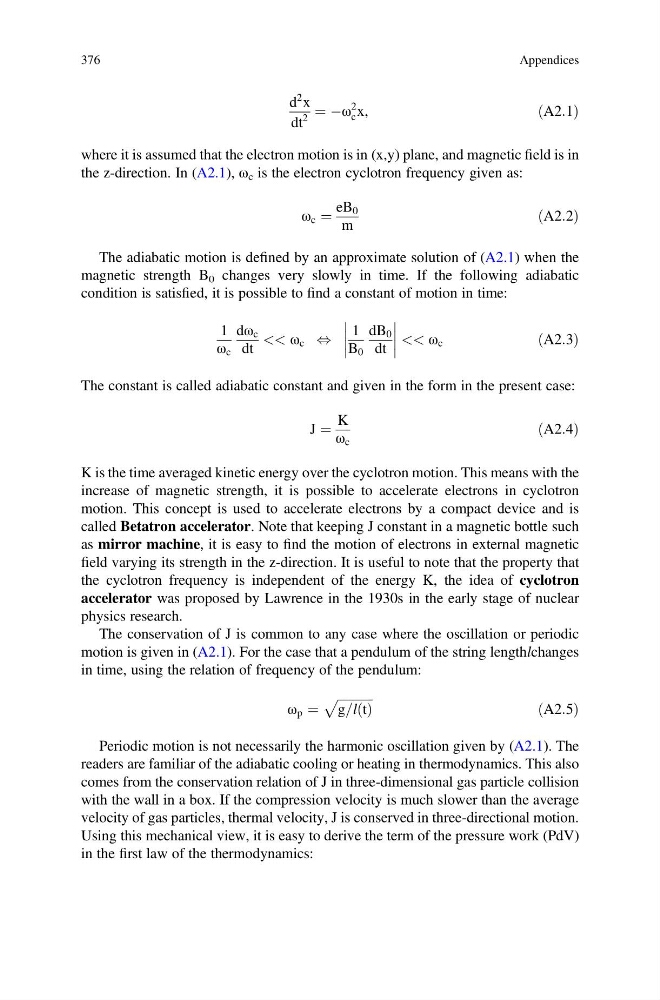
where it is assumed that the electron motion is in (x,y) plane, and magnetic field is in
the z-direction. In (A2.1), ω c is the electron cyclotron frequency given as:
ω c ¼
eB 0
m
ðA2:2Þ
The adiabatic motion is defined by an approximate solution of (A2.1) when the
magnetic strength B 0 changes very slowly in time. If the following adiabatic
condition is satisfied, it is possible to find a constant of motion in time:
1
ω c
dω c
dt
<< ω c ,
1
B 0
dB 0
dt
<< ω c
ðA2:3Þ
The constant is called adiabatic constant and given in the form in the present case:
J ¼
K
ω c
ðA2:4Þ
K is the time averaged kinetic energy over the cyclotron motion. This means with the
increase of magnetic strength, it is possible to accelerate electrons in cyclotron
motion. This concept is used to accelerate electrons by a compact device and is
called Betatron accelerator. Note that keeping J constant in a magnetic bottle such
as mirror machine, it is easy to find the motion of electrons in external magnetic
field varying its strength in the z-direction. It is useful to note that the property that
the cyclotron frequency is independent of the energy K, the idea of cyclotron
accelerator was proposed by Lawrence in the 1930s in the early stage of nuclear
physics research.
The conservation of J is common to any case where the oscillation or periodic
motion is given in (A2.1). For the case that a pendulum of the string lengthlchanges
in time, using the relation of frequency of the pendulum:
ω p ¼
ffiffiffiffiffiffiffiffiffiffiffi ffi
g=l t
ð Þ
p
ðA2:5Þ
Periodic motion is not necessarily the harmonic oscillation given by (A2.1). The
readers are familiar of the adiabatic cooling or heating in thermodynamics. This also
comes from the conservation relation of J in three-dimensional gas particle collision
with the wall in a box. If the compression velocity is much slower than the average
velocity of gas particles, thermal velocity, J is conserved in three-directional motion.
Using this mechanical view, it is easy to derive the term of the pressure work (PdV)
in the first law of the thermodynamics:
376
Appendices
2 x
dt
2
¼ Àω
2
c x,
ðA2:1Þ
where it is assumed that the electron motion is in (x,y) plane, and magnetic field is in
the z-direction. In (A2.1), ω c is the electron cyclotron frequency given as:
ω c ¼
eB 0
m
ðA2:2Þ
The adiabatic motion is defined by an approximate solution of (A2.1) when the
magnetic strength B 0 changes very slowly in time. If the following adiabatic
condition is satisfied, it is possible to find a constant of motion in time:
1
ω c
dω c
dt
<< ω c ,
1
B 0
dB 0
dt
<< ω c
ðA2:3Þ
The constant is called adiabatic constant and given in the form in the present case:
J ¼
K
ω c
ðA2:4Þ
K is the time averaged kinetic energy over the cyclotron motion. This means with the
increase of magnetic strength, it is possible to accelerate electrons in cyclotron
motion. This concept is used to accelerate electrons by a compact device and is
called Betatron accelerator. Note that keeping J constant in a magnetic bottle such
as mirror machine, it is easy to find the motion of electrons in external magnetic
field varying its strength in the z-direction. It is useful to note that the property that
the cyclotron frequency is independent of the energy K, the idea of cyclotron
accelerator was proposed by Lawrence in the 1930s in the early stage of nuclear
physics research.
The conservation of J is common to any case where the oscillation or periodic
motion is given in (A2.1). For the case that a pendulum of the string lengthlchanges
in time, using the relation of frequency of the pendulum:
ω p ¼
ffiffiffiffiffiffiffiffiffiffiffi ffi
g=l t
ð Þ
p
ðA2:5Þ
Periodic motion is not necessarily the harmonic oscillation given by (A2.1). The
readers are familiar of the adiabatic cooling or heating in thermodynamics. This also
comes from the conservation relation of J in three-dimensional gas particle collision
with the wall in a box. If the compression velocity is much slower than the average
velocity of gas particles, thermal velocity, J is conserved in three-directional motion.
Using this mechanical view, it is easy to derive the term of the pressure work (PdV)
in the first law of the thermodynamics:
376
Appendices