

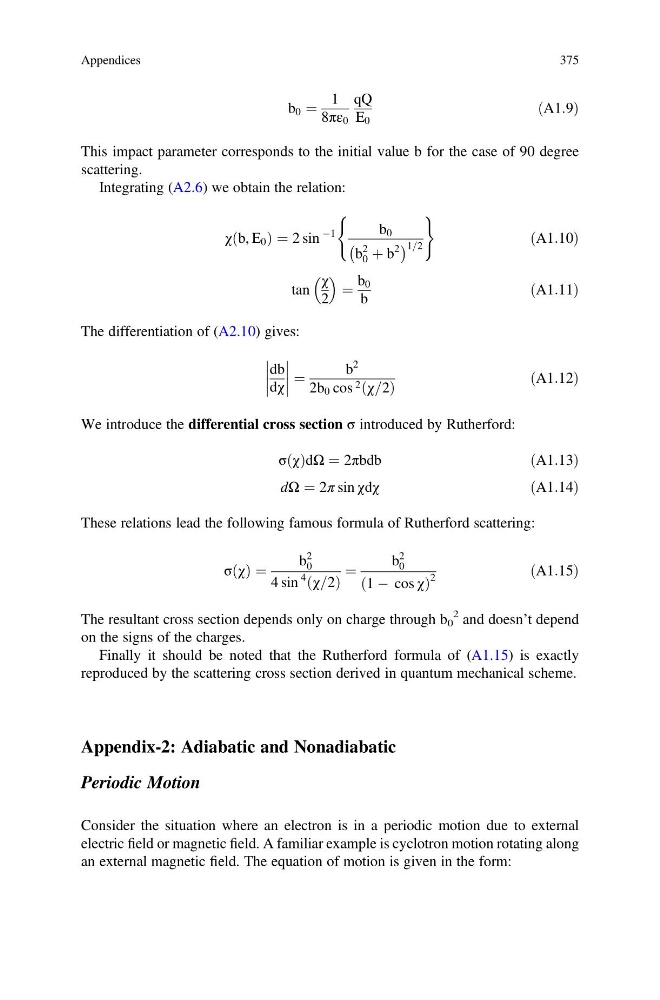
b 0 ¼
1
8πε 0
qQ
E 0
ðA1:9Þ
This impact parameter corresponds to the initial value b for the case of 90 degree
scattering.
Integrating (A2.6) we obtain the relation:
χ b, E 0
ð
Þ¼2 sin
À1
b 0
b
2
0 þ b
2
À
Á 1=2
(
)
ðA1:10Þ
tan
χ
2
¼
b 0
b
ðA1:11Þ
The differentiation of (A2.10) gives:
db
dχ
¼
b
2
2b 0 cos 2 χ=2
ð
Þ
ðA1:12Þ
We introduce the differential cross section σ introduced by Rutherford:
σ χ
ð ÞdΩ ¼ 2πbdb
ðA1:13Þ
dΩ ¼ 2π sin χdχ
ðA1:14Þ
These relations lead the following famous formula of Rutherford scattering:
σ χ
ð Þ ¼
b
2
0
4 sin
4
χ=2
ð
Þ
¼
b
2
0
1 À cos χ
ð
Þ
2
ðA1:15Þ
The resultant cross section depends only on charge through b 0
2 and doesn’t depend
on the signs of the charges.
Finally it should be noted that the Rutherford formula of (A1.15) is exactly
reproduced by the scattering cross section derived in quantum mechanical scheme.
Appendix-2: Adiabatic and Nonadiabatic
Periodic Motion
Consider the situation where an electron is in a periodic motion due to external
electric field or magnetic field. A familiar example is cyclotron motion rotating along
an external magnetic field. The equation of motion is given in the form:
Appendices
375
1
8πε 0
E 0
ðA1:9Þ
This impact parameter corresponds to the initial value b for the case of 90 degree
scattering.
Integrating (A2.6) we obtain the relation:
χ b, E 0
ð
Þ¼2 sin
À1
b 0
b
2
0 þ b
2
À
Á 1=2
(
)
ðA1:10Þ
tan
χ
2
¼
b 0
b
ðA1:11Þ
The differentiation of (A2.10) gives:
db
dχ
¼
b
2
2b 0 cos 2 χ=2
ð
Þ
ðA1:12Þ
We introduce the differential cross section σ introduced by Rutherford:
σ χ
ð ÞdΩ ¼ 2πbdb
ðA1:13Þ
dΩ ¼ 2π sin χdχ
ðA1:14Þ
These relations lead the following famous formula of Rutherford scattering:
σ χ
ð Þ ¼
b
2
0
4 sin
4
χ=2
ð
Þ
¼
b
2
0
1 À cos χ
ð
Þ
2
ðA1:15Þ
The resultant cross section depends only on charge through b 0
2 and doesn’t depend
on the signs of the charges.
Finally it should be noted that the Rutherford formula of (A1.15) is exactly
reproduced by the scattering cross section derived in quantum mechanical scheme.
Appendix-2: Adiabatic and Nonadiabatic
Periodic Motion
Consider the situation where an electron is in a periodic motion due to external
electric field or magnetic field. A familiar example is cyclotron motion rotating along
an external magnetic field. The equation of motion is given in the form:
Appendices
375