

dr
dt
¼
dr
dθ
dθ
dt
ðA1:3Þ
dθ ¼
b
r 2 1 À
b
2
r 2 À
U r
ð Þ
E 0
! À
1
2
dr,
ðA1:4Þ
where E 0 is the kinetic energy of the particle before scattered. The nearest radius of
the scattered particle to the central change r m is obtained by setting dθ ¼ 0 in (A1.4):
r m ¼ b 1 À
U r m
ð Þ
E 0
! À
1
2
ðA1:5Þ
The scattered angle χ is obtained to be the following relation after integration of
(A1.4):
χ b, E 0
ð
Þ¼π À 2
Z 1
r m
b
r 2 1 À
b
2
r 2 À
U r
ð Þ
E 0
! À
1
2
dr
ðA1:6Þ
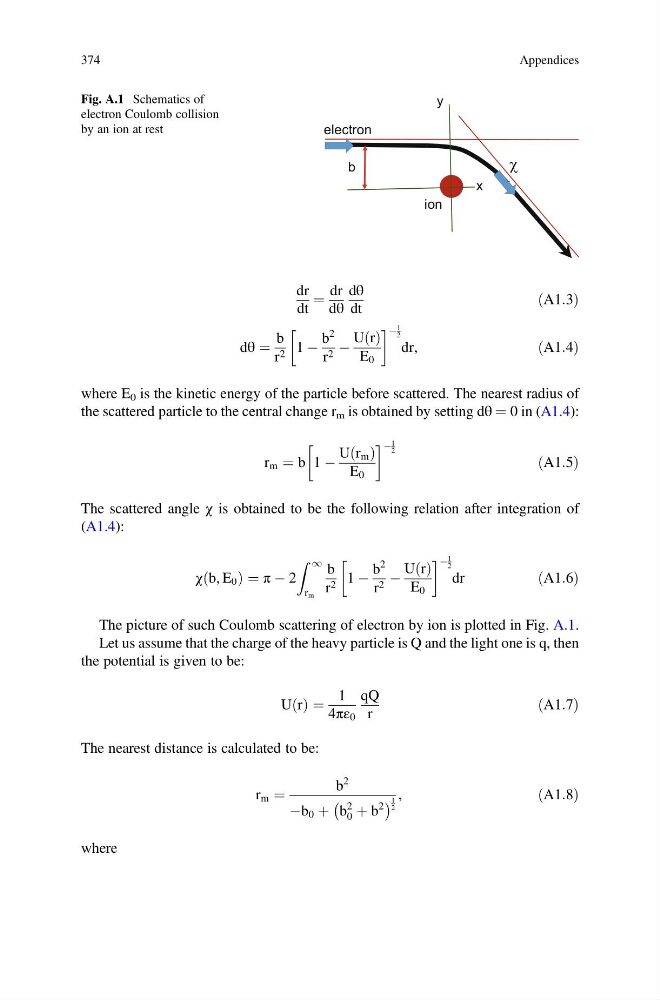
The picture of such Coulomb scattering of electron by ion is plotted in Fig. A.1.
Let us assume that the charge of the heavy particle is Q and the light one is q, then
the potential is given to be:
U r
ð Þ ¼
1
4πε 0
qQ
r
ðA1:7Þ
The nearest distance is calculated to be:
r m ¼
b
2
Àb 0 þ b
2
0 þ b
2
À
Á 1
2
,
ðA1:8Þ
where
ion
x
y
b
electron
c
Fig. A.1 Schematics of
electron Coulomb collision
by an ion at rest
374
Appendices
dt
¼
dr
dθ
dθ
dt
ðA1:3Þ
dθ ¼
b
r 2 1 À
b
2
r 2 À
U r
ð Þ
E 0
! À
1
2
dr,
ðA1:4Þ
where E 0 is the kinetic energy of the particle before scattered. The nearest radius of
the scattered particle to the central change r m is obtained by setting dθ ¼ 0 in (A1.4):
r m ¼ b 1 À
U r m
ð Þ
E 0
! À
1
2
ðA1:5Þ
The scattered angle χ is obtained to be the following relation after integration of
(A1.4):
χ b, E 0
ð
Þ¼π À 2
Z 1
r m
b
r 2 1 À
b
2
r 2 À
U r
ð Þ
E 0
! À
1
2
dr
ðA1:6Þ
The picture of such Coulomb scattering of electron by ion is plotted in Fig. A.1.
Let us assume that the charge of the heavy particle is Q and the light one is q, then
the potential is given to be:
U r
ð Þ ¼
1
4πε 0
r
ðA1:7Þ
The nearest distance is calculated to be:
r m ¼
b
2
Àb 0 þ b
2
0 þ b
2
À
Á 1
2
,
ðA1:8Þ
where
ion
x
y
b
electron
c
Fig. A.1 Schematics of
electron Coulomb collision
by an ion at rest
374
Appendices