

Appendices
Appendix-1: Rutherford Scatterings
It is essential in studying plasma physics to know the Coulomb interaction between
charged particles. The fundamental of the problem is well-known as Rutherford
scattering, and its mathematics is well explained in a textbook on classical
mechanics. Historically, it was studied by Rutherford to identify the existence of
nuclear charge at the center of atom. He demonstrated this fact from the angle
dependence of alpha particle scattering, when the particles are impinged to a thin
gold foil. The Coulomb repulsive force scatters the injected alpha particles.
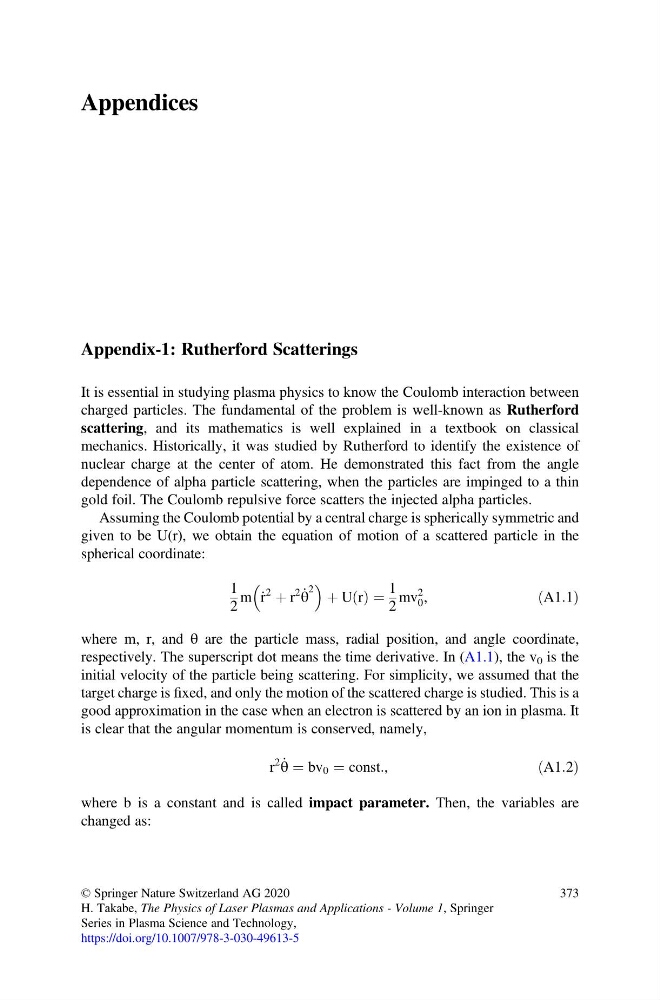
Assuming the Coulomb potential by a central charge is spherically symmetric and
given to be U(r), we obtain the equation of motion of a scattered particle in the
spherical coordinate:
1
2
m _
r
2
þ r
2 _
θ
2
þ U r
ð Þ ¼
1
2
mv
2
0 ,
ðA1:1Þ
where m, r, and θ are the particle mass, radial position, and angle coordinate,
respectively. The superscript dot means the time derivative. In (A1.1), the v 0 is the
initial velocity of the particle being scattering. For simplicity, we assumed that the
target charge is fixed, and only the motion of the scattered charge is studied. This is a
good approximation in the case when an electron is scattered by an ion in plasma. It
is clear that the angular momentum is conserved, namely,
r
2 _
θ ¼ bv 0 ¼ const:,
ðA1:2Þ
where b is a constant and is called impact parameter. Then, the variables are
changed as:
© Springer Nature Switzerland AG 2020
H. Takabe, The Physics of Laser Plasmas and Applications - Volume 1, Springer
Series in Plasma Science and Technology,
https://doi.org/10.1007/978-3-030-49613-5
373
Appendix-1: Rutherford Scatterings
It is essential in studying plasma physics to know the Coulomb interaction between
charged particles. The fundamental of the problem is well-known as Rutherford
scattering, and its mathematics is well explained in a textbook on classical
mechanics. Historically, it was studied by Rutherford to identify the existence of
nuclear charge at the center of atom. He demonstrated this fact from the angle
dependence of alpha particle scattering, when the particles are impinged to a thin
gold foil. The Coulomb repulsive force scatters the injected alpha particles.
Assuming the Coulomb potential by a central charge is spherically symmetric and
given to be U(r), we obtain the equation of motion of a scattered particle in the
spherical coordinate:
1
2
m _
r
2
þ r
2 _
θ
2
þ U r
ð Þ ¼
1
2
mv
2
0 ,
ðA1:1Þ
where m, r, and θ are the particle mass, radial position, and angle coordinate,
respectively. The superscript dot means the time derivative. In (A1.1), the v 0 is the
initial velocity of the particle being scattering. For simplicity, we assumed that the
target charge is fixed, and only the motion of the scattered charge is studied. This is a
good approximation in the case when an electron is scattered by an ion in plasma. It
is clear that the angular momentum is conserved, namely,
r
2 _
θ ¼ bv 0 ¼ const:,
ðA1:2Þ
where b is a constant and is called impact parameter. Then, the variables are
changed as:
© Springer Nature Switzerland AG 2020
H. Takabe, The Physics of Laser Plasmas and Applications - Volume 1, Springer
Series in Plasma Science and Technology,
https://doi.org/10.1007/978-3-030-49613-5
373