

a 1
j j ( a 0
j j
ð9:8:24Þ
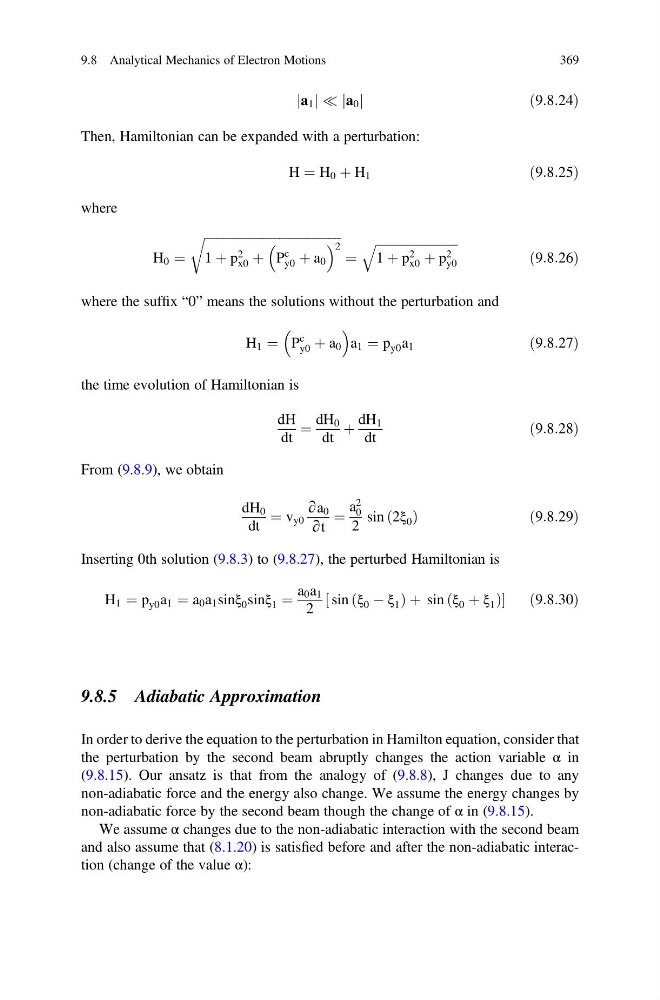
Then, Hamiltonian can be expanded with a perturbation:
H ¼ H 0 þ H 1
ð9:8:25Þ
where
H 0 ¼
ffiffiffiffiffiffiffiffiffiffiffiffiffiffiffiffiffiffiffiffiffiffiffiffiffiffiffiffiffiffiffiffiffiffiffiffiffiffiffiffiffiffiffiffi
1 þ p 2
x0 þ P
c
y0 þ a 0
2
r
¼
ffiffiffiffiffiffiffiffiffiffiffiffiffiffiffiffiffiffiffiffiffiffiffiffiffiffi ffi
1 þ p 2
x0 þ p 2
y0
q
ð9:8:26Þ
where the suffix “0” means the solutions without the perturbation and
H 1 ¼ P
c
y0 þ a 0
a 1 ¼ p y0 a 1
ð9:8:27Þ
the time evolution of Hamiltonian is
dH
dt
¼
dH 0
dt
þ
dH 1
dt
ð9:8:28Þ
From (9.8.9), we obtain
dH 0
dt
¼ v y0
∂a 0
∂t
¼
a
2
0
2
sin 2ξ 0
ð Þ
ð9:8:29Þ
Inserting 0th solution (9.8.3) to (9.8.27), the perturbed Hamiltonian is
H 1 ¼ p y0 a 1 ¼ a 0 a 1 sinξ 0 sinξ 1 ¼
a 0 a 1
2
sin ξ 0 À ξ 1
ð
Þþ sin ξ 0 þ ξ 1
ð
Þ
½
ð 9:8:30Þ
9.8.5 Adiabatic Approximation
In order to derive the equation to the perturbation in Hamilton equation, consider that
the perturbation by the second beam abruptly changes the action variable α in
(9.8.15). Our ansatz is that from the analogy of (9.8.8), J changes due to any
non-adiabatic force and the energy also change. We assume the energy changes by
non-adiabatic force by the second beam though the change of α in (9.8.15).
We assume α changes due to the non-adiabatic interaction with the second beam
and also assume that (8.1.20) is satisfied before and after the non-adiabatic interaction (change of the value α):
9.8 Analytical Mechanics of Electron Motions
369
j j ( a 0
j j
ð9:8:24Þ
Then, Hamiltonian can be expanded with a perturbation:
H ¼ H 0 þ H 1
ð9:8:25Þ
where
H 0 ¼
ffiffiffiffiffiffiffiffiffiffiffiffiffiffiffiffiffiffiffiffiffiffiffiffiffiffiffiffiffiffiffiffiffiffiffiffiffiffiffiffiffiffiffiffi
1 þ p 2
x0 þ P
c
y0 þ a 0
2
r
¼
ffiffiffiffiffiffiffiffiffiffiffiffiffiffiffiffiffiffiffiffiffiffiffiffiffiffi ffi
1 þ p 2
x0 þ p 2
y0
q
ð9:8:26Þ
where the suffix “0” means the solutions without the perturbation and
H 1 ¼ P
c
y0 þ a 0
a 1 ¼ p y0 a 1
ð9:8:27Þ
the time evolution of Hamiltonian is
dH
dt
¼
dH 0
dt
þ
dH 1
dt
ð9:8:28Þ
From (9.8.9), we obtain
dH 0
dt
¼ v y0
∂a 0
∂t
¼
a
2
0
2
sin 2ξ 0
ð Þ
ð9:8:29Þ
Inserting 0th solution (9.8.3) to (9.8.27), the perturbed Hamiltonian is
H 1 ¼ p y0 a 1 ¼ a 0 a 1 sinξ 0 sinξ 1 ¼
a 0 a 1
2
sin ξ 0 À ξ 1
ð
Þþ sin ξ 0 þ ξ 1
ð
Þ
½
ð 9:8:30Þ
9.8.5 Adiabatic Approximation
In order to derive the equation to the perturbation in Hamilton equation, consider that
the perturbation by the second beam abruptly changes the action variable α in
(9.8.15). Our ansatz is that from the analogy of (9.8.8), J changes due to any
non-adiabatic force and the energy also change. We assume the energy changes by
non-adiabatic force by the second beam though the change of α in (9.8.15).
We assume α changes due to the non-adiabatic interaction with the second beam
and also assume that (8.1.20) is satisfied before and after the non-adiabatic interaction (change of the value α):
9.8 Analytical Mechanics of Electron Motions
369