

H ¼ γ ¼ p x þ α
ð9:8:31Þ
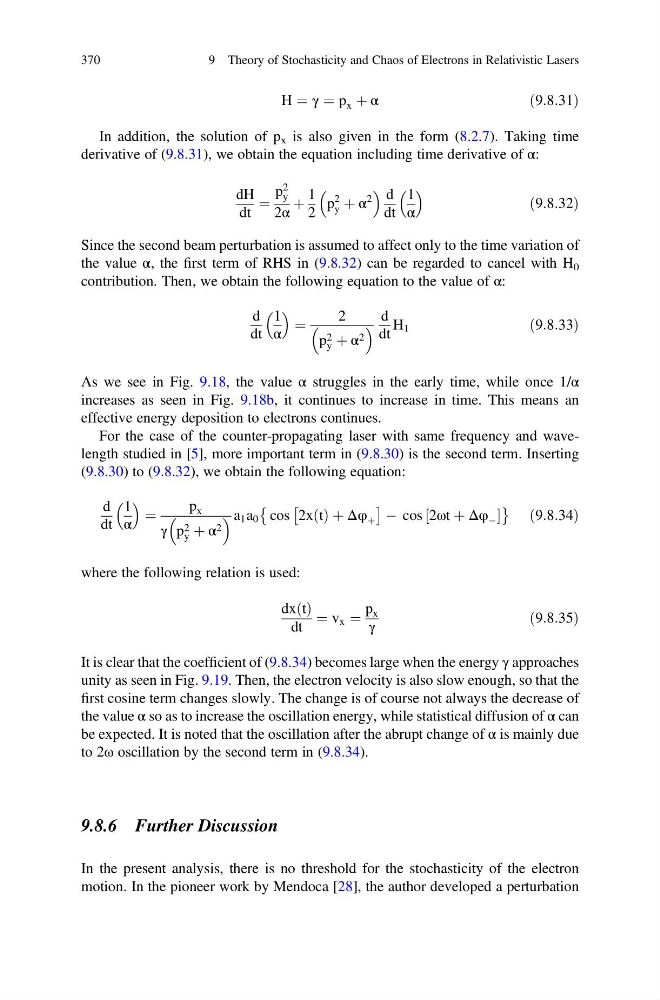
In addition, the solution of p x is also given in the form (8.2.7). Taking time
derivative of (9.8.31), we obtain the equation including time derivative of α:
dH
dt
¼
p
2
y
2α
þ
1
2
p
2
y þ α
2
d
dt
1
α
ð9:8:32Þ
Since the second beam perturbation is assumed to affect only to the time variation of
the value α, the first term of RHS in (9.8.32) can be regarded to cancel with H 0
contribution. Then, we obtain the following equation to the value of α:
d
dt
1
α
¼
2
p 2
y þ α 2
d
dt
H 1
ð9:8:33Þ
As we see in Fig. 9.18, the value α struggles in the early time, while once 1/α
increases as seen in Fig. 9.18b, it continues to increase in time. This means an
effective energy deposition to electrons continues.
For the case of the counter-propagating laser with same frequency and wavelength studied in [5], more important term in (9.8.30) is the second term. Inserting
(9.8.30) to (9.8.32), we obtain the following equation:
d
dt
1
α
¼
p x
γ p 2
y þ α 2
a 1 a 0 cos 2x t
ð Þ þ Δφ þ
Â
à À cos 2ωt þ Δφ À
½
È
É ð9:8:34Þ
where the following relation is used:
dx t
ð Þ
dt
¼ v x ¼
p x
γ
ð9:8:35Þ
It is clear that the coefficient of (9.8.34) becomes large when the energy γ approaches
unity as seen in Fig. 9.19. Then, the electron velocity is also slow enough, so that the
first cosine term changes slowly. The change is of course not always the decrease of
the value α so as to increase the oscillation energy, while statistical diffusion of α can
be expected. It is noted that the oscillation after the abrupt change of α is mainly due
to 2ω oscillation by the second term in (9.8.34).
9.8.6 Further Discussion
In the present analysis, there is no threshold for the stochasticity of the electron
motion. In the pioneer work by Mendoca [28], the author developed a perturbation
370
9 Theory of Stochasticity and Chaos of Electrons in Relativistic Lasers
ð9:8:31Þ
In addition, the solution of p x is also given in the form (8.2.7). Taking time
derivative of (9.8.31), we obtain the equation including time derivative of α:
dH
dt
¼
p
2
y
2α
þ
1
2
p
2
y þ α
2
d
dt
1
α
ð9:8:32Þ
Since the second beam perturbation is assumed to affect only to the time variation of
the value α, the first term of RHS in (9.8.32) can be regarded to cancel with H 0
contribution. Then, we obtain the following equation to the value of α:
d
dt
1
α
¼
2
p 2
y þ α 2
d
dt
H 1
ð9:8:33Þ
As we see in Fig. 9.18, the value α struggles in the early time, while once 1/α
increases as seen in Fig. 9.18b, it continues to increase in time. This means an
effective energy deposition to electrons continues.
For the case of the counter-propagating laser with same frequency and wavelength studied in [5], more important term in (9.8.30) is the second term. Inserting
(9.8.30) to (9.8.32), we obtain the following equation:
d
dt
1
α
¼
p x
γ p 2
y þ α 2
a 1 a 0 cos 2x t
ð Þ þ Δφ þ
Â
à À cos 2ωt þ Δφ À
½
È
É ð9:8:34Þ
where the following relation is used:
dx t
ð Þ
dt
¼ v x ¼
p x
γ
ð9:8:35Þ
It is clear that the coefficient of (9.8.34) becomes large when the energy γ approaches
unity as seen in Fig. 9.19. Then, the electron velocity is also slow enough, so that the
first cosine term changes slowly. The change is of course not always the decrease of
the value α so as to increase the oscillation energy, while statistical diffusion of α can
be expected. It is noted that the oscillation after the abrupt change of α is mainly due
to 2ω oscillation by the second term in (9.8.34).
9.8.6 Further Discussion
In the present analysis, there is no threshold for the stochasticity of the electron
motion. In the pioneer work by Mendoca [28], the author developed a perturbation
370
9 Theory of Stochasticity and Chaos of Electrons in Relativistic Lasers