

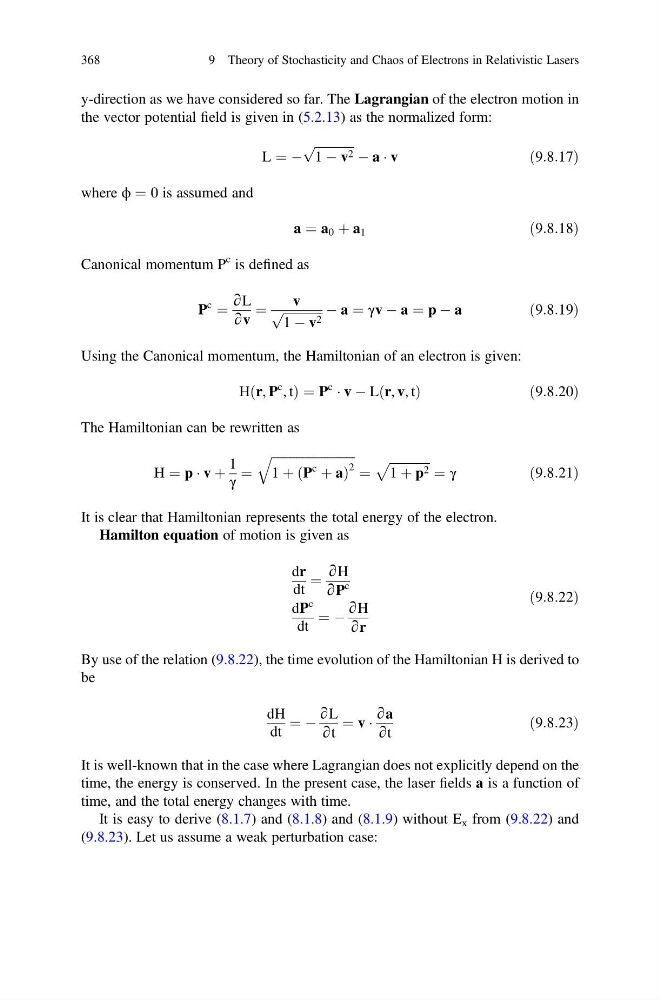
y-direction as we have considered so far. The Lagrangian of the electron motion in
the vector potential field is given in (5.2.13) as the normalized form:
L ¼ À
ffiffiffiffiffiffiffiffiffiffiffiffiffi
1 À v 2
p
À a Á v
ð9:8:17Þ
where ϕ ¼ 0 is assumed and
a ¼ a 0 þ a 1
ð9:8:18Þ
Canonical momentum P
c is defined as
P
c
¼
∂L
∂v
¼
v
ffiffiffiffiffiffiffiffiffiffiffiffiffi
1 À v 2
p
À a ¼ γv À a ¼ p À a
ð9:8:19Þ
Using the Canonical momentum, the Hamiltonian of an electron is given:
H r, P
c , t
ð
Þ¼P
c
Á v À L r, v, t
ð
Þ
ð9:8:20Þ
The Hamiltonian can be rewritten as
H ¼ p Á v þ
1
γ
¼
ffiffiffiffiffiffiffiffiffiffiffiffiffiffiffiffiffiffiffiffiffiffiffiffiffiffiffi
1 þ P
c
þ a
ð
Þ
2
q
¼
ffiffiffiffiffiffiffiffiffiffiffiffiffi
1 þ p 2
p
¼ γ
ð9:8:21Þ
It is clear that Hamiltonian represents the total energy of the electron.
Hamilton equation of motion is given as
dr
dt
¼
∂H
∂P
c
dP
c
dt
¼ À
∂H
∂r
ð9:8:22Þ
By use of the relation (9.8.22), the time evolution of the Hamiltonian H is derived to
be
dH
dt
¼ À
∂L
∂t
¼ v Á
∂a
∂t
ð9:8:23Þ
It is well-known that in the case where Lagrangian does not explicitly depend on the
time, the energy is conserved. In the present case, the laser fields a is a function of
time, and the total energy changes with time.
It is easy to derive (8.1.7) and (8.1.8) and (8.1.9) without E x from (9.8.22) and
(9.8.23). Let us assume a weak perturbation case:
368
9 Theory of Stochasticity and Chaos of Electrons in Relativistic Lasers
the vector potential field is given in (5.2.13) as the normalized form:
L ¼ À
ffiffiffiffiffiffiffiffiffiffiffiffiffi
1 À v 2
p
À a Á v
ð9:8:17Þ
where ϕ ¼ 0 is assumed and
a ¼ a 0 þ a 1
ð9:8:18Þ
Canonical momentum P
c is defined as
P
c
¼
∂L
∂v
¼
v
ffiffiffiffiffiffiffiffiffiffiffiffiffi
1 À v 2
p
À a ¼ γv À a ¼ p À a
ð9:8:19Þ
Using the Canonical momentum, the Hamiltonian of an electron is given:
H r, P
c , t
ð
Þ¼P
c
Á v À L r, v, t
ð
Þ
ð9:8:20Þ
The Hamiltonian can be rewritten as
H ¼ p Á v þ
1
γ
¼
ffiffiffiffiffiffiffiffiffiffiffiffiffiffiffiffiffiffiffiffiffiffiffiffiffiffiffi
1 þ P
c
þ a
ð
Þ
2
q
¼
ffiffiffiffiffiffiffiffiffiffiffiffiffi
1 þ p 2
p
¼ γ
ð9:8:21Þ
It is clear that Hamiltonian represents the total energy of the electron.
Hamilton equation of motion is given as
dr
dt
¼
∂H
∂P
c
dP
c
dt
¼ À
∂H
∂r
ð9:8:22Þ
By use of the relation (9.8.22), the time evolution of the Hamiltonian H is derived to
be
dH
dt
¼ À
∂L
∂t
¼ v Á
∂a
∂t
ð9:8:23Þ
It is well-known that in the case where Lagrangian does not explicitly depend on the
time, the energy is conserved. In the present case, the laser fields a is a function of
time, and the total energy changes with time.
It is easy to derive (8.1.7) and (8.1.8) and (8.1.9) without E x from (9.8.22) and
(9.8.23). Let us assume a weak perturbation case:
368
9 Theory of Stochasticity and Chaos of Electrons in Relativistic Lasers