

In order to see the change of the property of the energy increase from the diffusion
type to the nonlocal Levy jump type, the intensity of the second laser is increased to
25% of the incident laser as
a 0 ¼ 3, a 1 ¼ 1:5
t max ¼ 2:6 ps
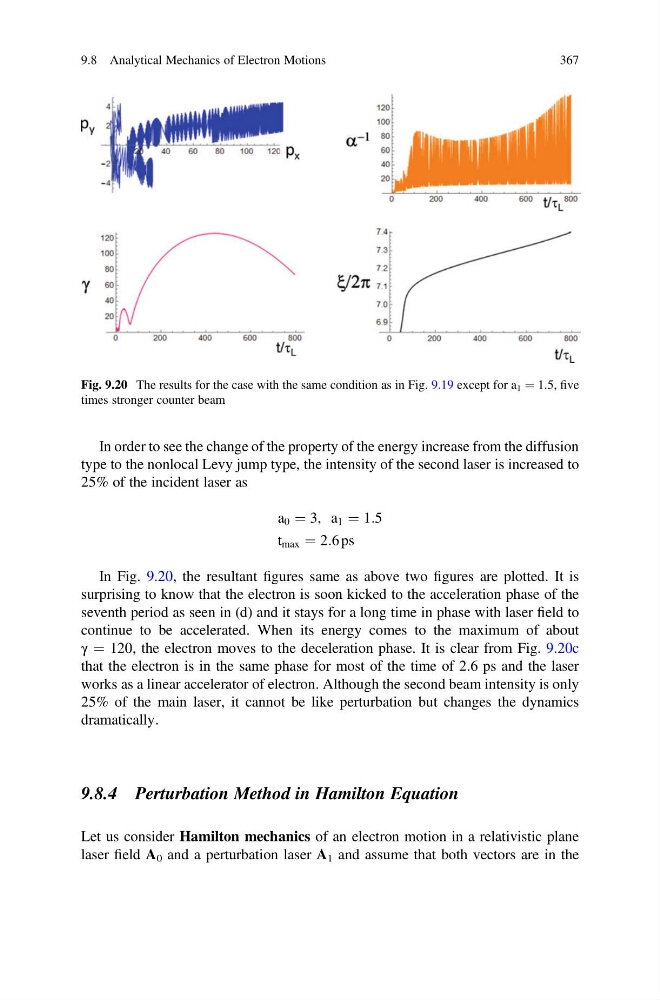
In Fig. 9.20, the resultant figures same as above two figures are plotted. It is
surprising to know that the electron is soon kicked to the acceleration phase of the
seventh period as seen in (d) and it stays for a long time in phase with laser field to
continue to be accelerated. When its energy comes to the maximum of about
γ ¼ 120, the electron moves to the deceleration phase. It is clear from Fig. 9.20c
that the electron is in the same phase for most of the time of 2.6 ps and the laser
works as a linear accelerator of electron. Although the second beam intensity is only
25% of the main laser, it cannot be like perturbation but changes the dynamics
dramatically.
9.8.4 Perturbation Method in Hamilton Equation
Let us consider Hamilton mechanics of an electron motion in a relativistic plane
laser field A 0 and a perturbation laser A 1 and assume that both vectors are in the
Fig. 9.20 The results for the case with the same condition as in Fig. 9.19 except for a 1 ¼ 1.5, five
times stronger counter beam
9.8 Analytical Mechanics of Electron Motions
367
type to the nonlocal Levy jump type, the intensity of the second laser is increased to
25% of the incident laser as
a 0 ¼ 3, a 1 ¼ 1:5
t max ¼ 2:6 ps
In Fig. 9.20, the resultant figures same as above two figures are plotted. It is
surprising to know that the electron is soon kicked to the acceleration phase of the
seventh period as seen in (d) and it stays for a long time in phase with laser field to
continue to be accelerated. When its energy comes to the maximum of about
γ ¼ 120, the electron moves to the deceleration phase. It is clear from Fig. 9.20c
that the electron is in the same phase for most of the time of 2.6 ps and the laser
works as a linear accelerator of electron. Although the second beam intensity is only
25% of the main laser, it cannot be like perturbation but changes the dynamics
dramatically.
9.8.4 Perturbation Method in Hamilton Equation
Let us consider Hamilton mechanics of an electron motion in a relativistic plane
laser field A 0 and a perturbation laser A 1 and assume that both vectors are in the
Fig. 9.20 The results for the case with the same condition as in Fig. 9.19 except for a 1 ¼ 1.5, five
times stronger counter beam
9.8 Analytical Mechanics of Electron Motions
367