

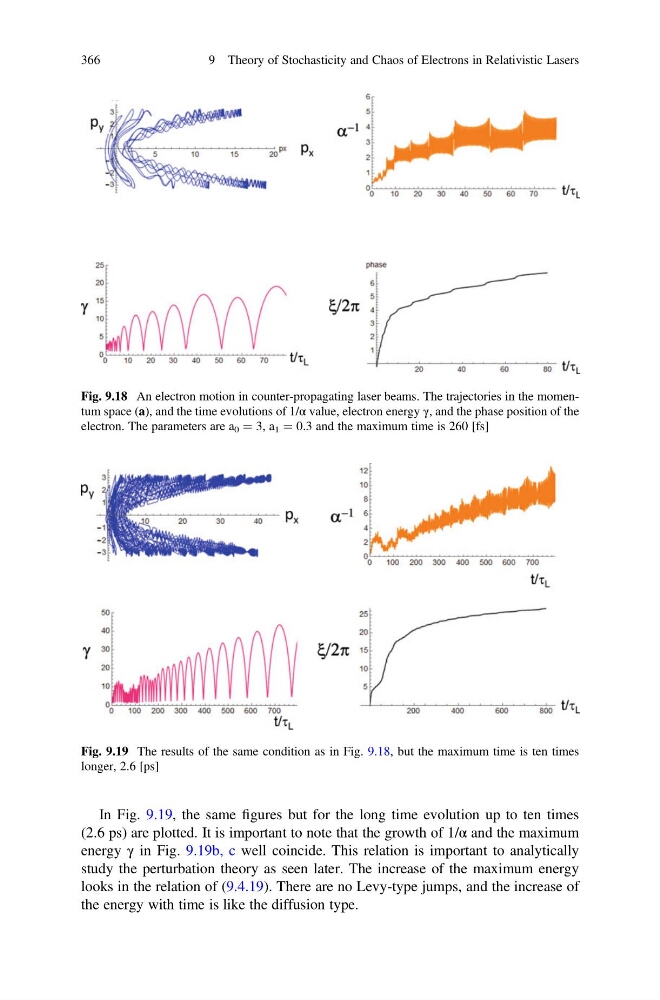
In Fig. 9.19, the same figures but for the long time evolution up to ten times
(2.6 ps) are plotted. It is important to note that the growth of 1/α and the maximum
energy γ in Fig. 9.19b, c well coincide. This relation is important to analytically
study the perturbation theory as seen later. The increase of the maximum energy
looks in the relation of (9.4.19). There are no Levy-type jumps, and the increase of
the energy with time is like the diffusion type.
Fig. 9.18 An electron motion in counter-propagating laser beams. The trajectories in the momentum space (a), and the time evolutions of 1/α value, electron energy γ, and the phase position of the
electron. The parameters are a 0 ¼ 3, a 1 ¼ 0.3 and the maximum time is 260 [fs]
Fig. 9.19 The results of the same condition as in Fig. 9.18, but the maximum time is ten times
longer, 2.6 [ps]
366
9 Theory of Stochasticity and Chaos of Electrons in Relativistic Lasers
(2.6 ps) are plotted. It is important to note that the growth of 1/α and the maximum
energy γ in Fig. 9.19b, c well coincide. This relation is important to analytically
study the perturbation theory as seen later. The increase of the maximum energy
looks in the relation of (9.4.19). There are no Levy-type jumps, and the increase of
the energy with time is like the diffusion type.
Fig. 9.18 An electron motion in counter-propagating laser beams. The trajectories in the momentum space (a), and the time evolutions of 1/α value, electron energy γ, and the phase position of the
electron. The parameters are a 0 ¼ 3, a 1 ¼ 0.3 and the maximum time is 260 [fs]
Fig. 9.19 The results of the same condition as in Fig. 9.18, but the maximum time is ten times
longer, 2.6 [ps]
366
9 Theory of Stochasticity and Chaos of Electrons in Relativistic Lasers