

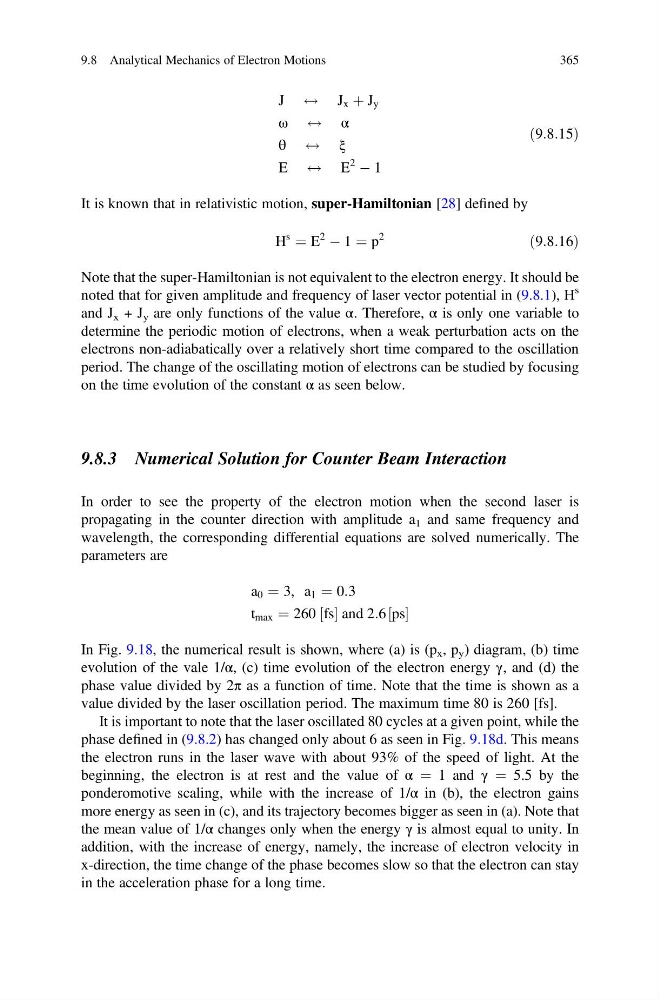
J $ J x þ J y
ω $ α
θ $ ξ
E $ E
2
À 1
ð9:8:15Þ
It is known that in relativistic motion, super-Hamiltonian [28] defined by
H
s
¼ E
2
À 1 ¼ p
2
ð9:8:16Þ
Note that the super-Hamiltonian is not equivalent to the electron energy. It should be
noted that for given amplitude and frequency of laser vector potential in (9.8.1), H
s
and J x + J y are only functions of the value α. Therefore, α is only one variable to
determine the periodic motion of electrons, when a weak perturbation acts on the
electrons non-adiabatically over a relatively short time compared to the oscillation
period. The change of the oscillating motion of electrons can be studied by focusing
on the time evolution of the constant α as seen below.
9.8.3 Numerical Solution for Counter Beam Interaction
In order to see the property of the electron motion when the second laser is
propagating in the counter direction with amplitude a 1 and same frequency and
wavelength, the corresponding differential equations are solved numerically. The
parameters are
a 0 ¼ 3, a 1 ¼ 0:3
t max ¼ 260 fs
½ and 2:6 ps
½
In Fig. 9.18, the numerical result is shown, where (a) is (p x , p y ) diagram, (b) time
evolution of the vale 1/α, (c) time evolution of the electron energy γ, and (d) the
phase value divided by 2π as a function of time. Note that the time is shown as a
value divided by the laser oscillation period. The maximum time 80 is 260 [fs].
It is important to note that the laser oscillated 80 cycles at a given point, while the
phase defined in (9.8.2) has changed only about 6 as seen in Fig. 9.18d. This means
the electron runs in the laser wave with about 93% of the speed of light. At the
beginning, the electron is at rest and the value of α ¼ 1 and γ ¼ 5.5 by the
ponderomotive scaling, while with the increase of 1/α in (b), the electron gains
more energy as seen in (c), and its trajectory becomes bigger as seen in (a). Note that
the mean value of 1/α changes only when the energy γ is almost equal to unity. In
addition, with the increase of energy, namely, the increase of electron velocity in
x-direction, the time change of the phase becomes slow so that the electron can stay
in the acceleration phase for a long time.
9.8 Analytical Mechanics of Electron Motions
365
ω $ α
θ $ ξ
E $ E
2
À 1
ð9:8:15Þ
It is known that in relativistic motion, super-Hamiltonian [28] defined by
H
s
¼ E
2
À 1 ¼ p
2
ð9:8:16Þ
Note that the super-Hamiltonian is not equivalent to the electron energy. It should be
noted that for given amplitude and frequency of laser vector potential in (9.8.1), H
s
and J x + J y are only functions of the value α. Therefore, α is only one variable to
determine the periodic motion of electrons, when a weak perturbation acts on the
electrons non-adiabatically over a relatively short time compared to the oscillation
period. The change of the oscillating motion of electrons can be studied by focusing
on the time evolution of the constant α as seen below.
9.8.3 Numerical Solution for Counter Beam Interaction
In order to see the property of the electron motion when the second laser is
propagating in the counter direction with amplitude a 1 and same frequency and
wavelength, the corresponding differential equations are solved numerically. The
parameters are
a 0 ¼ 3, a 1 ¼ 0:3
t max ¼ 260 fs
½ and 2:6 ps
½
In Fig. 9.18, the numerical result is shown, where (a) is (p x , p y ) diagram, (b) time
evolution of the vale 1/α, (c) time evolution of the electron energy γ, and (d) the
phase value divided by 2π as a function of time. Note that the time is shown as a
value divided by the laser oscillation period. The maximum time 80 is 260 [fs].
It is important to note that the laser oscillated 80 cycles at a given point, while the
phase defined in (9.8.2) has changed only about 6 as seen in Fig. 9.18d. This means
the electron runs in the laser wave with about 93% of the speed of light. At the
beginning, the electron is at rest and the value of α ¼ 1 and γ ¼ 5.5 by the
ponderomotive scaling, while with the increase of 1/α in (b), the electron gains
more energy as seen in (c), and its trajectory becomes bigger as seen in (a). Note that
the mean value of 1/α changes only when the energy γ is almost equal to unity. In
addition, with the increase of energy, namely, the increase of electron velocity in
x-direction, the time change of the phase becomes slow so that the electron can stay
in the acceleration phase for a long time.
9.8 Analytical Mechanics of Electron Motions
365