

9.7 Chaos in Standard Map Model
So far we have assumed that the laser interacts with the electrons in low-density
plasma, namely, the plasma effect has been neglected. In the case of very short pulse,
the vacuum heating becomes important at the beginning as shown in Sect. 3.10 and
in the discussion on Figs. 7.3 and 7.4. In such an ultra-short pulse without the
pedestal pulse, the ions are at rest, and their density has the profile with sharp density
jump at the solid surface. Then, the most of electrons accelerated toward the vacuum
by laser field are affected by the electrostatic field generated by the charge separation
as schematically shown in Fig. 6.1.
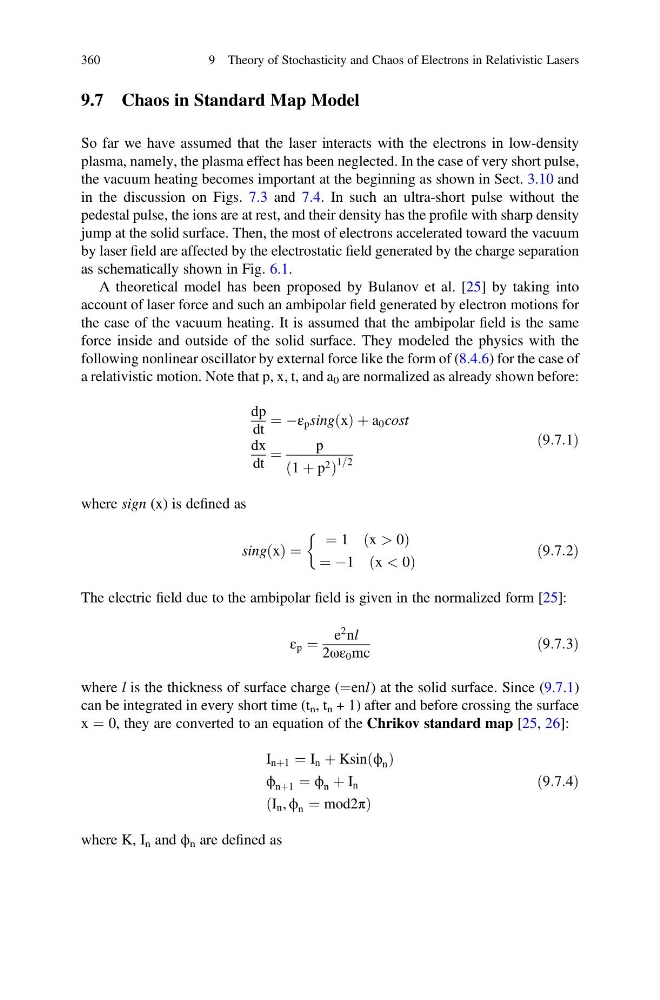
A theoretical model has been proposed by Bulanov et al. [25] by taking into
account of laser force and such an ambipolar field generated by electron motions for
the case of the vacuum heating. It is assumed that the ambipolar field is the same
force inside and outside of the solid surface. They modeled the physics with the
following nonlinear oscillator by external force like the form of (8.4.6) for the case of
a relativistic motion. Note that p, x, t, and a 0 are normalized as already shown before:
dp
dt
¼ Àε p sing x
ð Þ þ a 0 cost
dx
dt
¼
p
1 þ p 2
ð
Þ
1=2
ð9:7:1Þ
where sign (x) is defined as
sing x
ð Þ ¼
¼ 1 x > 0
ð
Þ
¼ À1 x < 0
ð
Þ
&
ð9:7:2Þ
The electric field due to the ambipolar field is given in the normalized form [25]:
ε p ¼
e
2 nl
2ωε 0 mc
ð9:7:3Þ
where l is the thickness of surface charge (¼enl ) at the solid surface. Since (9.7.1)
can be integrated in every short time (t n , t n + 1) after and before crossing the surface
x ¼ 0, they are converted to an equation of the Chrikov standard map [25, 26]:
I nþ1 ¼ I n þ Ksin ϕ n
ð Þ
ϕ nþ1 ¼ ϕ n þ I n
I n , ϕ n ¼ mod2π
ð
Þ
ð9:7:4Þ
where K, I n and ϕ n are defined as
360
9 Theory of Stochasticity and Chaos of Electrons in Relativistic Lasers
So far we have assumed that the laser interacts with the electrons in low-density
plasma, namely, the plasma effect has been neglected. In the case of very short pulse,
the vacuum heating becomes important at the beginning as shown in Sect. 3.10 and
in the discussion on Figs. 7.3 and 7.4. In such an ultra-short pulse without the
pedestal pulse, the ions are at rest, and their density has the profile with sharp density
jump at the solid surface. Then, the most of electrons accelerated toward the vacuum
by laser field are affected by the electrostatic field generated by the charge separation
as schematically shown in Fig. 6.1.
A theoretical model has been proposed by Bulanov et al. [25] by taking into
account of laser force and such an ambipolar field generated by electron motions for
the case of the vacuum heating. It is assumed that the ambipolar field is the same
force inside and outside of the solid surface. They modeled the physics with the
following nonlinear oscillator by external force like the form of (8.4.6) for the case of
a relativistic motion. Note that p, x, t, and a 0 are normalized as already shown before:
dp
dt
¼ Àε p sing x
ð Þ þ a 0 cost
dx
dt
¼
p
1 þ p 2
ð
Þ
1=2
ð9:7:1Þ
where sign (x) is defined as
sing x
ð Þ ¼
¼ 1 x > 0
ð
Þ
¼ À1 x < 0
ð
Þ
&
ð9:7:2Þ
The electric field due to the ambipolar field is given in the normalized form [25]:
ε p ¼
e
2 nl
2ωε 0 mc
ð9:7:3Þ
where l is the thickness of surface charge (¼enl ) at the solid surface. Since (9.7.1)
can be integrated in every short time (t n , t n + 1) after and before crossing the surface
x ¼ 0, they are converted to an equation of the Chrikov standard map [25, 26]:
I nþ1 ¼ I n þ Ksin ϕ n
ð Þ
ϕ nþ1 ¼ ϕ n þ I n
I n , ϕ n ¼ mod2π
ð
Þ
ð9:7:4Þ
where K, I n and ϕ n are defined as
360
9 Theory of Stochasticity and Chaos of Electrons in Relativistic Lasers