

computationally, we can evaluate the effective diffusion coefficient D and fractal
index α.
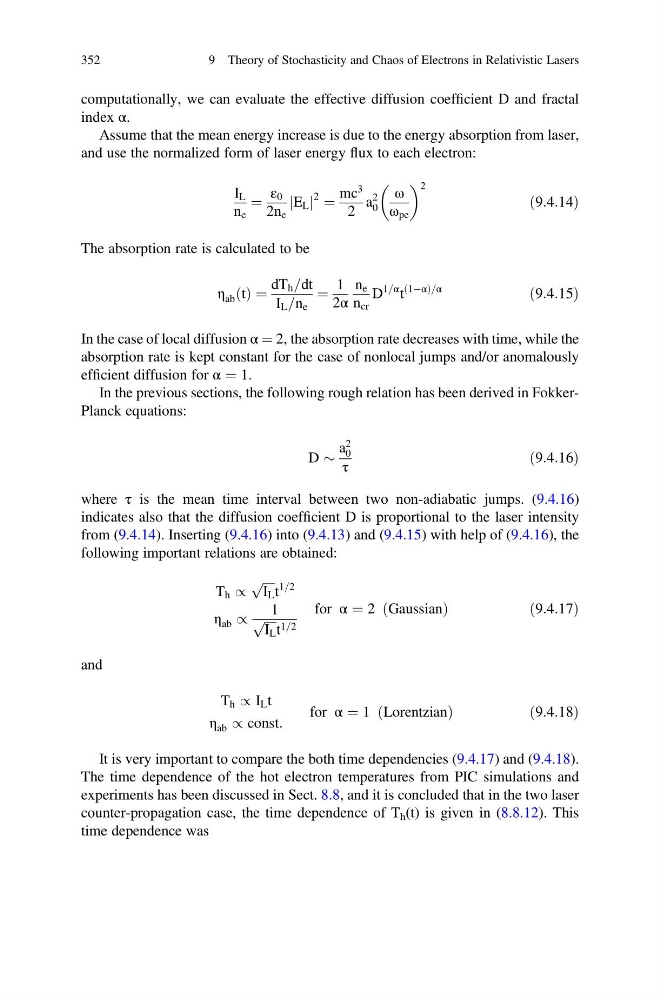
Assume that the mean energy increase is due to the energy absorption from laser,
and use the normalized form of laser energy flux to each electron:
I L
n e
¼
ε 0
2n e
E L
j j
2 ¼
mc
3
2
a
2
0
ω
ω pe
2
ð9:4:14Þ
The absorption rate is calculated to be
η ab t
ð Þ ¼
dT h =dt
I L =n e
¼
1
2α
n e
n cr
D
1=α t
1Àα
ð
Þ=α
ð9:4:15Þ
In the case of local diffusion α ¼ 2, the absorption rate decreases with time, while the
absorption rate is kept constant for the case of nonlocal jumps and/or anomalously
efficient diffusion for α ¼ 1.
In the previous sections, the following rough relation has been derived in FokkerPlanck equations:
D $
a
2
0
τ
ð9:4:16Þ
where τ is the mean time interval between two non-adiabatic jumps. (9.4.16)
indicates also that the diffusion coefficient D is proportional to the laser intensity
from (9.4.14). Inserting (9.4.16) into (9.4.13) and (9.4.15) with help of (9.4.16), the
following important relations are obtained:
T h /
ffiffiffiffi
I L
p
t
1=2
η ab /
1
ffiffiffiffi
I L
p
t 1=2
for α ¼ 2 Gaussian
ð
Þ
ð 9:4:17Þ
and
T h / I L t
η ab / const:
for α ¼ 1 Lorentzian
ð
Þ
ð 9:4:18Þ
It is very important to compare the both time dependencies (9.4.17) and (9.4.18).
The time dependence of the hot electron temperatures from PIC simulations and
experiments has been discussed in Sect. 8.8, and it is concluded that in the two laser
counter-propagation case, the time dependence of T h (t) is given in (8.8.12). This
time dependence was
352
9 Theory of Stochasticity and Chaos of Electrons in Relativistic Lasers
index α.
Assume that the mean energy increase is due to the energy absorption from laser,
and use the normalized form of laser energy flux to each electron:
I L
n e
¼
ε 0
2n e
E L
j j
2 ¼
mc
3
2
a
2
0
ω
ω pe
2
ð9:4:14Þ
The absorption rate is calculated to be
η ab t
ð Þ ¼
dT h =dt
I L =n e
¼
1
2α
n e
n cr
D
1=α t
1Àα
ð
Þ=α
ð9:4:15Þ
In the case of local diffusion α ¼ 2, the absorption rate decreases with time, while the
absorption rate is kept constant for the case of nonlocal jumps and/or anomalously
efficient diffusion for α ¼ 1.
In the previous sections, the following rough relation has been derived in FokkerPlanck equations:
D $
a
2
0
τ
ð9:4:16Þ
where τ is the mean time interval between two non-adiabatic jumps. (9.4.16)
indicates also that the diffusion coefficient D is proportional to the laser intensity
from (9.4.14). Inserting (9.4.16) into (9.4.13) and (9.4.15) with help of (9.4.16), the
following important relations are obtained:
T h /
ffiffiffiffi
I L
p
t
1=2
η ab /
1
ffiffiffiffi
I L
p
t 1=2
for α ¼ 2 Gaussian
ð
Þ
ð 9:4:17Þ
and
T h / I L t
η ab / const:
for α ¼ 1 Lorentzian
ð
Þ
ð 9:4:18Þ
It is very important to compare the both time dependencies (9.4.17) and (9.4.18).
The time dependence of the hot electron temperatures from PIC simulations and
experiments has been discussed in Sect. 8.8, and it is concluded that in the two laser
counter-propagation case, the time dependence of T h (t) is given in (8.8.12). This
time dependence was
352
9 Theory of Stochasticity and Chaos of Electrons in Relativistic Lasers