

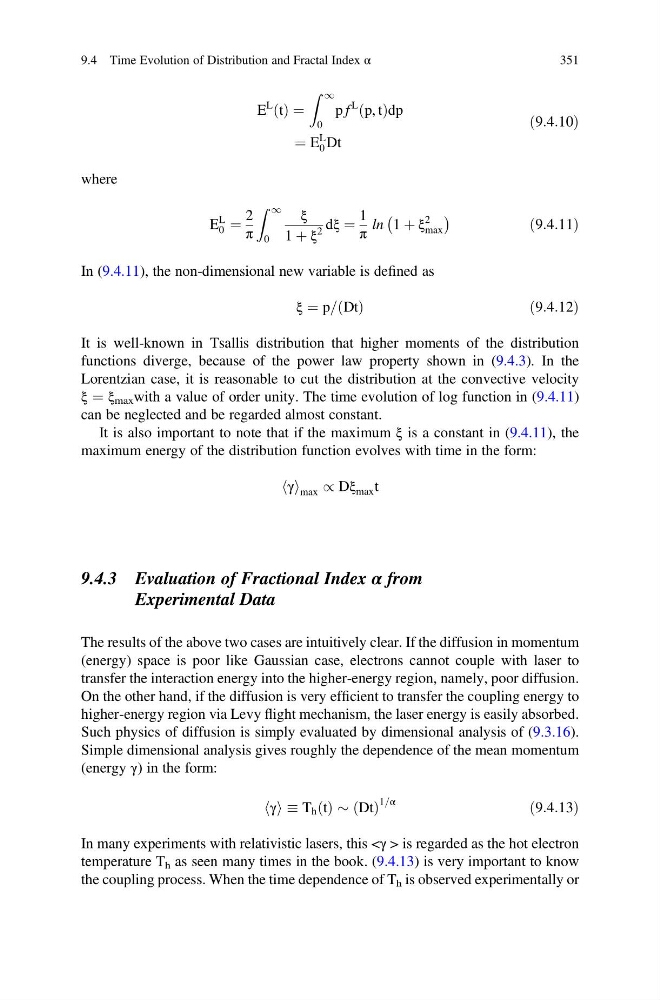
E
L t
ð Þ ¼
Z 1
0
p f
L p, t
ð Þdp
¼ E
L
0 Dt
ð9:4:10Þ
where
E
L
0 ¼
2
π
Z 1
0
ξ
1 þ ξ
2
dξ ¼
1
π
ln 1 þ ξ
2
max
À
Á
ð9:4:11Þ
In (9.4.11), the non-dimensional new variable is defined as
ξ ¼ p= Dt
ð Þ
ð9:4:12Þ
It is well-known in Tsallis distribution that higher moments of the distribution
functions diverge, because of the power law property shown in (9.4.3). In the
Lorentzian case, it is reasonable to cut the distribution at the convective velocity
ξ ¼ ξ max with a value of order unity. The time evolution of log function in (9.4.11)
can be neglected and be regarded almost constant.
It is also important to note that if the maximum ξ is a constant in (9.4.11), the
maximum energy of the distribution function evolves with time in the form:
γ
h i max / Dξ max t
9.4.3 Evaluation of Fractional Index α from
Experimental Data
The results of the above two cases are intuitively clear. If the diffusion in momentum
(energy) space is poor like Gaussian case, electrons cannot couple with laser to
transfer the interaction energy into the higher-energy region, namely, poor diffusion.
On the other hand, if the diffusion is very efficient to transfer the coupling energy to
higher-energy region via Levy flight mechanism, the laser energy is easily absorbed.
Such physics of diffusion is simply evaluated by dimensional analysis of (9.3.16).
Simple dimensional analysis gives roughly the dependence of the mean momentum
(energy γ) in the form:
γ
h i T h t
ð Þ $ Dt
ð Þ
1=α
ð9:4:13Þ
In many experiments with relativistic lasers, this <γ > is regarded as the hot electron
temperature T h as seen many times in the book. (9.4.13) is very important to know
the coupling process. When the time dependence of T h is observed experimentally or
9.4 Time Evolution of Distribution and Fractal Index α
351
L t
ð Þ ¼
Z 1
0
p f
L p, t
ð Þdp
¼ E
L
0 Dt
ð9:4:10Þ
where
E
L
0 ¼
2
π
Z 1
0
ξ
1 þ ξ
2
dξ ¼
1
π
ln 1 þ ξ
2
max
À
Á
ð9:4:11Þ
In (9.4.11), the non-dimensional new variable is defined as
ξ ¼ p= Dt
ð Þ
ð9:4:12Þ
It is well-known in Tsallis distribution that higher moments of the distribution
functions diverge, because of the power law property shown in (9.4.3). In the
Lorentzian case, it is reasonable to cut the distribution at the convective velocity
ξ ¼ ξ max with a value of order unity. The time evolution of log function in (9.4.11)
can be neglected and be regarded almost constant.
It is also important to note that if the maximum ξ is a constant in (9.4.11), the
maximum energy of the distribution function evolves with time in the form:
γ
h i max / Dξ max t
9.4.3 Evaluation of Fractional Index α from
Experimental Data
The results of the above two cases are intuitively clear. If the diffusion in momentum
(energy) space is poor like Gaussian case, electrons cannot couple with laser to
transfer the interaction energy into the higher-energy region, namely, poor diffusion.
On the other hand, if the diffusion is very efficient to transfer the coupling energy to
higher-energy region via Levy flight mechanism, the laser energy is easily absorbed.
Such physics of diffusion is simply evaluated by dimensional analysis of (9.3.16).
Simple dimensional analysis gives roughly the dependence of the mean momentum
(energy γ) in the form:
γ
h i T h t
ð Þ $ Dt
ð Þ
1=α
ð9:4:13Þ
In many experiments with relativistic lasers, this <γ > is regarded as the hot electron
temperature T h as seen many times in the book. (9.4.13) is very important to know
the coupling process. When the time dependence of T h is observed experimentally or
9.4 Time Evolution of Distribution and Fractal Index α
351