

Consider the hot electron scaling law to the laser pulse length and the diffusion
coefficients for Gaussian case (α ¼ 2) and Lorentzian case (α ¼ 1). It is clear that the
distribution functions of (9.4.1) and (9.4.6) are normalized so that the p-integrals of
both distributions are unity. Assume that p > > 1 and the normalized particle energy
γ ¼ p. The time evolution of the normalized energies of (9.4.1) and (9.4.6) is
calculated as follows.
The Gaussian case is
E
G t
ð Þ ¼
Z 1
0
p f
G p, t
ð Þdp
¼ E
G
0
ffiffiffiffiffiffiffi
D
à t
p
ð9:4:7Þ
where E
G
0 is a numerical constant given as
E
G
0 ¼
2
ffiffi ffi
π
p
Z 1
0
ξe
Àξ
2
dξ ¼
1
ffiffi ffi
π
p
ð9:4:8Þ
where the new valuable ξ has been introduced:
ξ ¼ p=
ffiffiffiffiffiffiffiffiffi ffi
D Ã t
p
ð9:4:9Þ
On the other hand, the Lorentzian case is
10
-1
10
-2
10
-3
10
-4
10
-5
10
-6
E imp = 1.9 kJ
E imp = 2.0 kJ
E imp = 2.3 kJ
10 -7
f(γ)
10
-8
10
100
γ
~ γ -2
8 9
2
3
4 5 6 7 8 9
1000
2
2
3
3
4 5 6 7 89
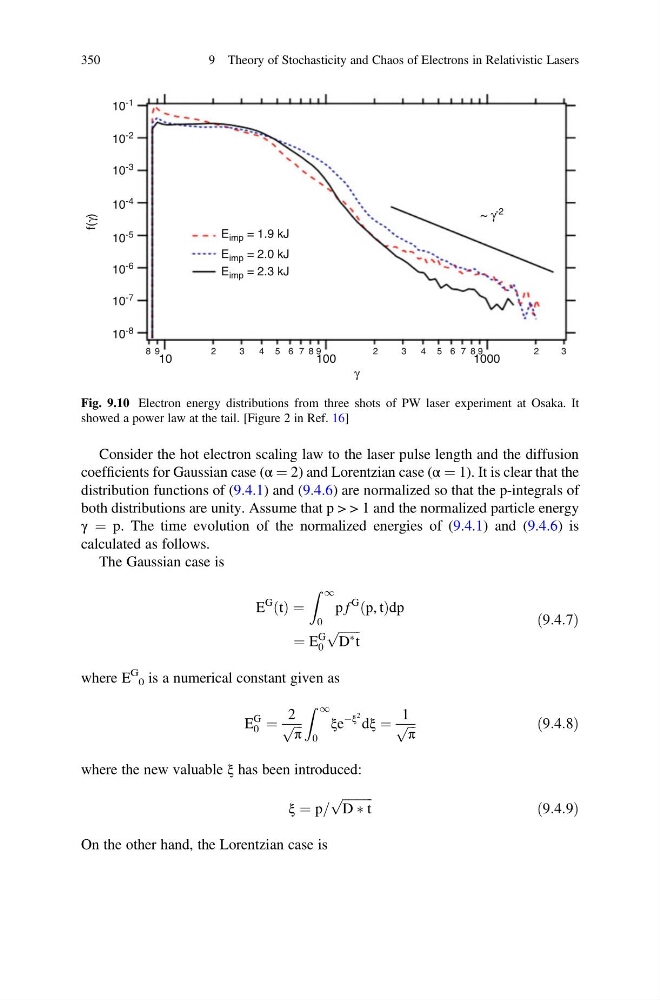
Fig. 9.10 Electron energy distributions from three shots of PW laser experiment at Osaka. It
showed a power law at the tail. [Figure 2 in Ref. 16]
350
9 Theory of Stochasticity and Chaos of Electrons in Relativistic Lasers
coefficients for Gaussian case (α ¼ 2) and Lorentzian case (α ¼ 1). It is clear that the
distribution functions of (9.4.1) and (9.4.6) are normalized so that the p-integrals of
both distributions are unity. Assume that p > > 1 and the normalized particle energy
γ ¼ p. The time evolution of the normalized energies of (9.4.1) and (9.4.6) is
calculated as follows.
The Gaussian case is
E
G t
ð Þ ¼
Z 1
0
p f
G p, t
ð Þdp
¼ E
G
0
ffiffiffiffiffiffiffi
D
à t
p
ð9:4:7Þ
where E
G
0 is a numerical constant given as
E
G
0 ¼
2
ffiffi ffi
π
p
Z 1
0
ξe
Àξ
2
dξ ¼
1
ffiffi ffi
π
p
ð9:4:8Þ
where the new valuable ξ has been introduced:
ξ ¼ p=
ffiffiffiffiffiffiffiffiffi ffi
D Ã t
p
ð9:4:9Þ
On the other hand, the Lorentzian case is
10
-1
10
-2
10
-3
10
-4
10
-5
10
-6
E imp = 1.9 kJ
E imp = 2.0 kJ
E imp = 2.3 kJ
10 -7
f(γ)
10
-8
10
100
γ
~ γ -2
8 9
2
3
4 5 6 7 8 9
1000
2
2
3
3
4 5 6 7 89
Fig. 9.10 Electron energy distributions from three shots of PW laser experiment at Osaka. It
showed a power law at the tail. [Figure 2 in Ref. 16]
350
9 Theory of Stochasticity and Chaos of Electrons in Relativistic Lasers