

∂
∂t
f p, t
ð Þ ¼ D
∂
2
∂p 2 f p, t
ð Þ, D ¼
Δp
ð Þ
2
2Δt
(
)
ð9:3:5Þ
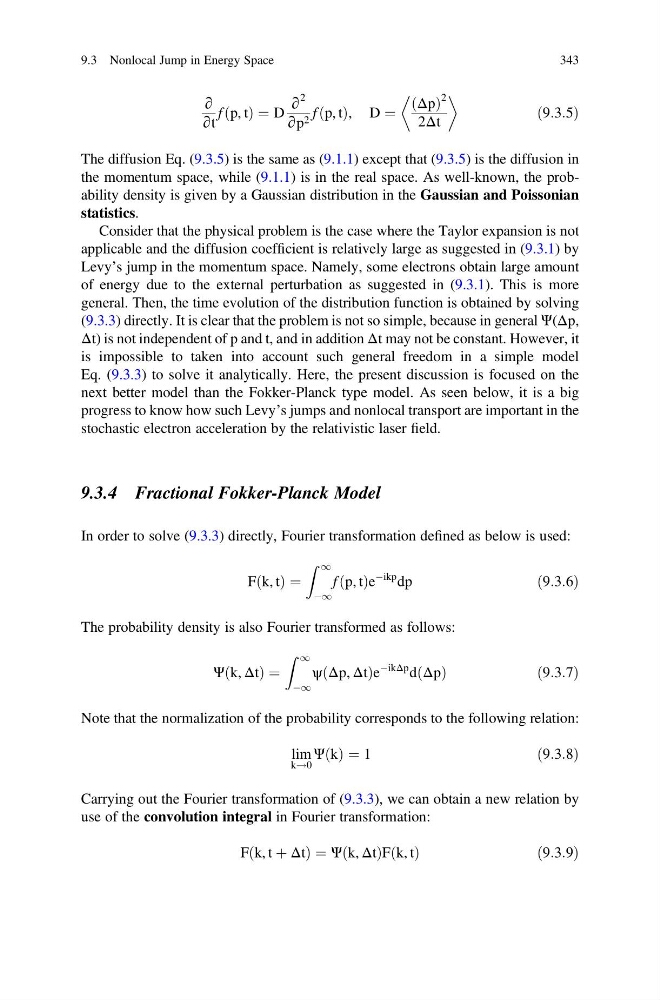
The diffusion Eq. (9.3.5) is the same as (9.1.1) except that (9.3.5) is the diffusion in
the momentum space, while (9.1.1) is in the real space. As well-known, the probability density is given by a Gaussian distribution in the Gaussian and Poissonian
statistics.
Consider that the physical problem is the case where the Taylor expansion is not
applicable and the diffusion coefficient is relatively large as suggested in (9.3.1) by
Levy’s jump in the momentum space. Namely, some electrons obtain large amount
of energy due to the external perturbation as suggested in (9.3.1). This is more
general. Then, the time evolution of the distribution function is obtained by solving
(9.3.3) directly. It is clear that the problem is not so simple, because in general Ψ(Δp,
Δt) is not independent of p and t, and in addition Δt may not be constant. However, it
is impossible to taken into account such general freedom in a simple model
Eq. (9.3.3) to solve it analytically. Here, the present discussion is focused on the
next better model than the Fokker-Planck type model. As seen below, it is a big
progress to know how such Levy’s jumps and nonlocal transport are important in the
stochastic electron acceleration by the relativistic laser field.
9.3.4 Fractional Fokker-Planck Model
In order to solve (9.3.3) directly, Fourier transformation defined as below is used:
F k, t
ð Þ ¼
Z 1
À1
f p, t
ð Þe
Àikp dp
ð9:3:6Þ
The probability density is also Fourier transformed as follows:
Ψ k, Δt
ð
Þ¼
Z 1
À1
ψ Δp, Δt
ð
Þe
ÀikΔp d Δp
ð Þ
ð9:3:7Þ
Note that the normalization of the probability corresponds to the following relation:
lim
k!0
Ψ k
ð Þ ¼ 1
ð9:3:8Þ
Carrying out the Fourier transformation of (9.3.3), we can obtain a new relation by
use of the convolution integral in Fourier transformation:
F k, t þ Δt
ð
Þ¼Ψ k, Δt
ð
ÞF k, t
ð Þ
ð9:3:9Þ
9.3 Nonlocal Jump in Energy Space
343
∂t
f p, t
ð Þ ¼ D
∂
2
∂p 2 f p, t
ð Þ, D ¼
Δp
ð Þ
2
2Δt
(
)
ð9:3:5Þ
The diffusion Eq. (9.3.5) is the same as (9.1.1) except that (9.3.5) is the diffusion in
the momentum space, while (9.1.1) is in the real space. As well-known, the probability density is given by a Gaussian distribution in the Gaussian and Poissonian
statistics.
Consider that the physical problem is the case where the Taylor expansion is not
applicable and the diffusion coefficient is relatively large as suggested in (9.3.1) by
Levy’s jump in the momentum space. Namely, some electrons obtain large amount
of energy due to the external perturbation as suggested in (9.3.1). This is more
general. Then, the time evolution of the distribution function is obtained by solving
(9.3.3) directly. It is clear that the problem is not so simple, because in general Ψ(Δp,
Δt) is not independent of p and t, and in addition Δt may not be constant. However, it
is impossible to taken into account such general freedom in a simple model
Eq. (9.3.3) to solve it analytically. Here, the present discussion is focused on the
next better model than the Fokker-Planck type model. As seen below, it is a big
progress to know how such Levy’s jumps and nonlocal transport are important in the
stochastic electron acceleration by the relativistic laser field.
9.3.4 Fractional Fokker-Planck Model
In order to solve (9.3.3) directly, Fourier transformation defined as below is used:
F k, t
ð Þ ¼
Z 1
À1
f p, t
ð Þe
Àikp dp
ð9:3:6Þ
The probability density is also Fourier transformed as follows:
Ψ k, Δt
ð
Þ¼
Z 1
À1
ψ Δp, Δt
ð
Þe
ÀikΔp d Δp
ð Þ
ð9:3:7Þ
Note that the normalization of the probability corresponds to the following relation:
lim
k!0
Ψ k
ð Þ ¼ 1
ð9:3:8Þ
Carrying out the Fourier transformation of (9.3.3), we can obtain a new relation by
use of the convolution integral in Fourier transformation:
F k, t þ Δt
ð
Þ¼Ψ k, Δt
ð
ÞF k, t
ð Þ
ð9:3:9Þ
9.3 Nonlocal Jump in Energy Space
343