

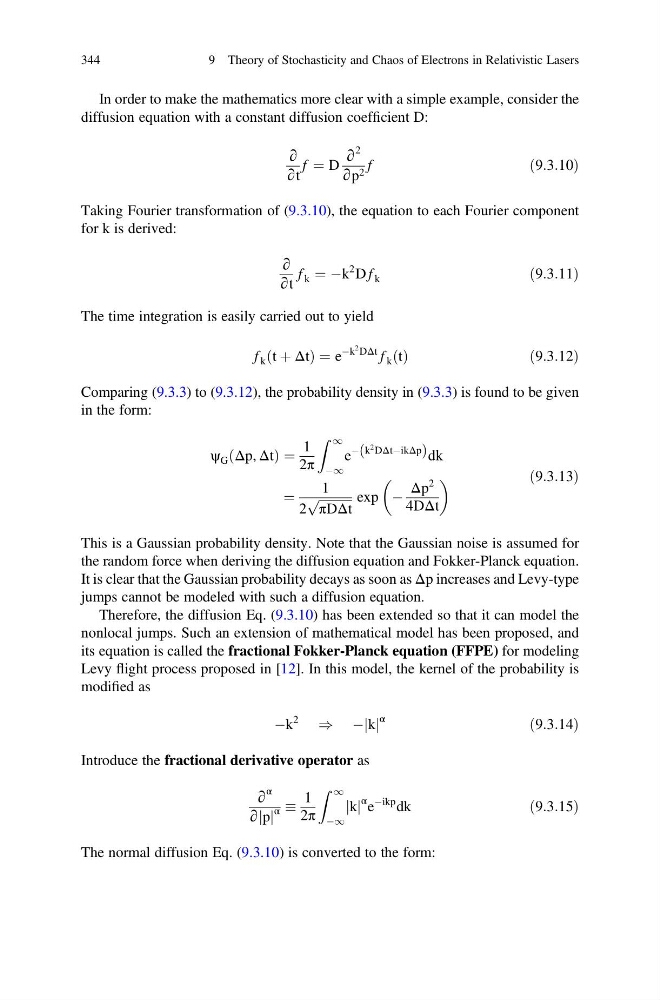
In order to make the mathematics more clear with a simple example, consider the
diffusion equation with a constant diffusion coefficient D:
∂
∂t
f ¼ D
∂
2
∂p 2 f
ð9:3:10Þ
Taking Fourier transformation of (9.3.10), the equation to each Fourier component
for k is derived:
∂
∂t
f k ¼ Àk
2 D f k
ð9:3:11Þ
The time integration is easily carried out to yield
f k t þ Δt
ð
Þ¼e
Àk
2 DΔt f k t
ð Þ
ð9:3:12Þ
Comparing (9.3.3) to (9.3.12), the probability density in (9.3.3) is found to be given
in the form:
ψ G Δp, Δt
ð
Þ¼
1
2π
Z 1
À1
e
À k
2 DΔtÀikΔp
ð
Þ dk
¼
1
2
ffiffiffiffiffiffiffiffiffiffiffi
πDΔt
p
exp À
Δp
2
4DΔt
ð9:3:13Þ
This is a Gaussian probability density. Note that the Gaussian noise is assumed for
the random force when deriving the diffusion equation and Fokker-Planck equation.
It is clear that the Gaussian probability decays as soon as Δp increases and Levy-type
jumps cannot be modeled with such a diffusion equation.
Therefore, the diffusion Eq. (9.3.10) has been extended so that it can model the
nonlocal jumps. Such an extension of mathematical model has been proposed, and
its equation is called the fractional Fokker-Planck equation (FFPE) for modeling
Levy flight process proposed in [12]. In this model, the kernel of the probability is
modified as
Àk
2
) À k
j j
α
ð9:3:14Þ
Introduce the fractional derivative operator as
∂
α
∂ p
j j
α
1
2π
Z 1
À1
k
j j
α e
Àikp dk
ð9:3:15Þ
The normal diffusion Eq. (9.3.10) is converted to the form:
344
9 Theory of Stochasticity and Chaos of Electrons in Relativistic Lasers
diffusion equation with a constant diffusion coefficient D:
∂
∂t
f ¼ D
∂
2
∂p 2 f
ð9:3:10Þ
Taking Fourier transformation of (9.3.10), the equation to each Fourier component
for k is derived:
∂
∂t
f k ¼ Àk
2 D f k
ð9:3:11Þ
The time integration is easily carried out to yield
f k t þ Δt
ð
Þ¼e
Àk
2 DΔt f k t
ð Þ
ð9:3:12Þ
Comparing (9.3.3) to (9.3.12), the probability density in (9.3.3) is found to be given
in the form:
ψ G Δp, Δt
ð
Þ¼
1
2π
Z 1
À1
e
À k
2 DΔtÀikΔp
ð
Þ dk
¼
1
2
ffiffiffiffiffiffiffiffiffiffiffi
πDΔt
p
exp À
Δp
2
4DΔt
ð9:3:13Þ
This is a Gaussian probability density. Note that the Gaussian noise is assumed for
the random force when deriving the diffusion equation and Fokker-Planck equation.
It is clear that the Gaussian probability decays as soon as Δp increases and Levy-type
jumps cannot be modeled with such a diffusion equation.
Therefore, the diffusion Eq. (9.3.10) has been extended so that it can model the
nonlocal jumps. Such an extension of mathematical model has been proposed, and
its equation is called the fractional Fokker-Planck equation (FFPE) for modeling
Levy flight process proposed in [12]. In this model, the kernel of the probability is
modified as
Àk
2
) À k
j j
α
ð9:3:14Þ
Introduce the fractional derivative operator as
∂
α
∂ p
j j
α
1
2π
Z 1
À1
k
j j
α e
Àikp dk
ð9:3:15Þ
The normal diffusion Eq. (9.3.10) is converted to the form:
344
9 Theory of Stochasticity and Chaos of Electrons in Relativistic Lasers