

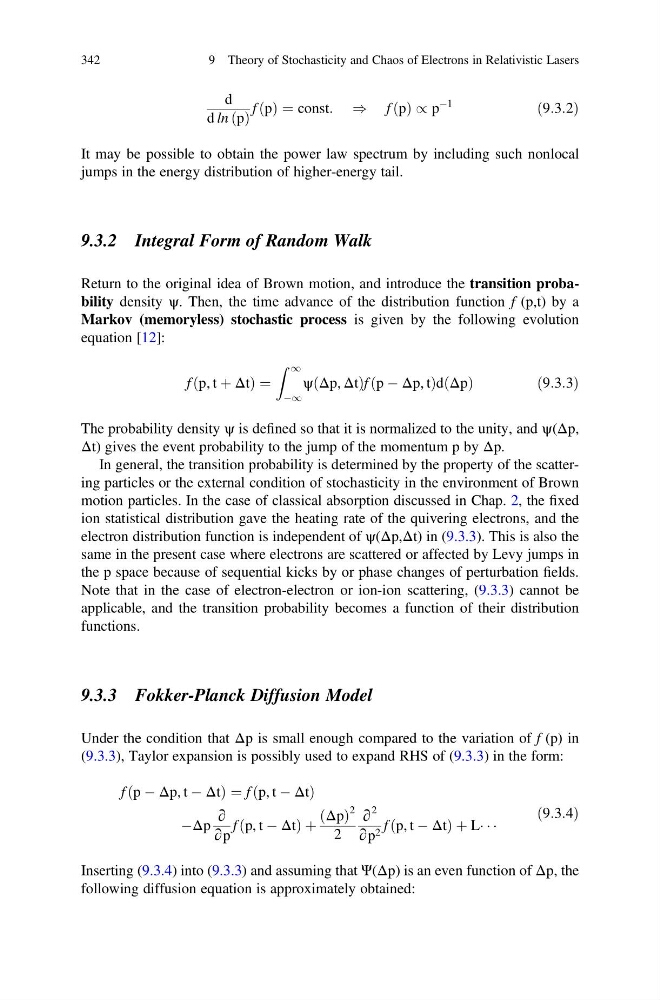
d
d ln p
ð Þ
f p
ð Þ ¼ const: ) f p
ð Þ / p
À1
ð9:3:2Þ
It may be possible to obtain the power law spectrum by including such nonlocal
jumps in the energy distribution of higher-energy tail.
9.3.2 Integral Form of Random Walk
Return to the original idea of Brown motion, and introduce the transition probability density ψ. Then, the time advance of the distribution function f (p,t) by a
Markov (memoryless) stochastic process is given by the following evolution
equation [12]:
f p, t þ Δt
ð
Þ¼
Z 1
À1
ψ Δp, Δt
ð
Þf p À Δp, t
ð
Þ d Δp
ð Þ
ð9:3:3Þ
The probability density ψ is defined so that it is normalized to the unity, and ψ(Δp,
Δt) gives the event probability to the jump of the momentum p by Δp.
In general, the transition probability is determined by the property of the scattering particles or the external condition of stochasticity in the environment of Brown
motion particles. In the case of classical absorption discussed in Chap. 2, the fixed
ion statistical distribution gave the heating rate of the quivering electrons, and the
electron distribution function is independent of ψ(Δp,Δt) in (9.3.3). This is also the
same in the present case where electrons are scattered or affected by Levy jumps in
the p space because of sequential kicks by or phase changes of perturbation fields.
Note that in the case of electron-electron or ion-ion scattering, (9.3.3) cannot be
applicable, and the transition probability becomes a function of their distribution
functions.
9.3.3 Fokker-Planck Diffusion Model
Under the condition that Δp is small enough compared to the variation of f (p) in
(9.3.3), Taylor expansion is possibly used to expand RHS of (9.3.3) in the form:
f p À Δp, t À Δt
ð
Þ ¼ f p, t À Δt
ð
Þ
ÀΔp
∂
∂p
f p, t À Δt
ð
Þþ
Δp
ð Þ
2
2
∂
2
∂p 2 f p, t À Δt
ð
ÞþLÁ Á Á
ð9:3:4Þ
Inserting (9.3.4) into (9.3.3) and assuming that Ψ(Δp) is an even function of Δp, the
following diffusion equation is approximately obtained:
342
9 Theory of Stochasticity and Chaos of Electrons in Relativistic Lasers
d ln p
ð Þ
f p
ð Þ ¼ const: ) f p
ð Þ / p
À1
ð9:3:2Þ
It may be possible to obtain the power law spectrum by including such nonlocal
jumps in the energy distribution of higher-energy tail.
9.3.2 Integral Form of Random Walk
Return to the original idea of Brown motion, and introduce the transition probability density ψ. Then, the time advance of the distribution function f (p,t) by a
Markov (memoryless) stochastic process is given by the following evolution
equation [12]:
f p, t þ Δt
ð
Þ¼
Z 1
À1
ψ Δp, Δt
ð
Þf p À Δp, t
ð
Þ d Δp
ð Þ
ð9:3:3Þ
The probability density ψ is defined so that it is normalized to the unity, and ψ(Δp,
Δt) gives the event probability to the jump of the momentum p by Δp.
In general, the transition probability is determined by the property of the scattering particles or the external condition of stochasticity in the environment of Brown
motion particles. In the case of classical absorption discussed in Chap. 2, the fixed
ion statistical distribution gave the heating rate of the quivering electrons, and the
electron distribution function is independent of ψ(Δp,Δt) in (9.3.3). This is also the
same in the present case where electrons are scattered or affected by Levy jumps in
the p space because of sequential kicks by or phase changes of perturbation fields.
Note that in the case of electron-electron or ion-ion scattering, (9.3.3) cannot be
applicable, and the transition probability becomes a function of their distribution
functions.
9.3.3 Fokker-Planck Diffusion Model
Under the condition that Δp is small enough compared to the variation of f (p) in
(9.3.3), Taylor expansion is possibly used to expand RHS of (9.3.3) in the form:
f p À Δp, t À Δt
ð
Þ ¼ f p, t À Δt
ð
Þ
ÀΔp
∂
∂p
f p, t À Δt
ð
Þþ
Δp
ð Þ
2
2
∂
2
∂p 2 f p, t À Δt
ð
ÞþLÁ Á Á
ð9:3:4Þ
Inserting (9.3.4) into (9.3.3) and assuming that Ψ(Δp) is an even function of Δp, the
following diffusion equation is approximately obtained:
342
9 Theory of Stochasticity and Chaos of Electrons in Relativistic Lasers