

Vol. 2. Successful application to the anomalous transport in a large magnetic plasma
is shown later by use of the Levy flights.
The Levy flights are composed of self-similar jumps as well-known in the
fractal theory [9, 10]. It should be noted that the importance of the Levy flights
was pointed out in [11] in the range of the laser strength a 0 ~ 10
3 relating to the better
confinement of electron-positron pair particles generated by the vacuum breakdown
in multi-colliding laser field. In the present book, the study is limited to the case
where the theory can be compared to the experimental data, so that the typical value
a 0 ¼ 1 ~ 10 is assumed. Before the formulation of the Levy jumps instead of FokkerPlanck type model, it is informative to see how the self-similar jump is possible
intuitively in the present relativistic laser electron interaction.
It is already derived that the maximum p x over a laser oscillation period is give as
(8.2.15). For simplicity, consider only the x-momentum in what follows and write p x
as p. If we assume there is a case where after each period the electron jumps into
acceleration phase again from time n to the time n + 1. Then, the following similarity
relation is obtained:
p
nþ1
¼ a
2
0 p
n
) p
n
¼ a
2
0
À Á n p 0
ð9:3:1Þ
Of course, this is for a very lucky electron the phase of laser field of which jumps
from π/2 to π in Fig. 8.2 due to a drift of the electron into the next filament or the laser
phase changes abruptly in time. The almost continuous increase of p x in Fig. 8.16 is
that the change of p y by external kick keeps the electron in an acceleration phase of
the incident laser for a long time.
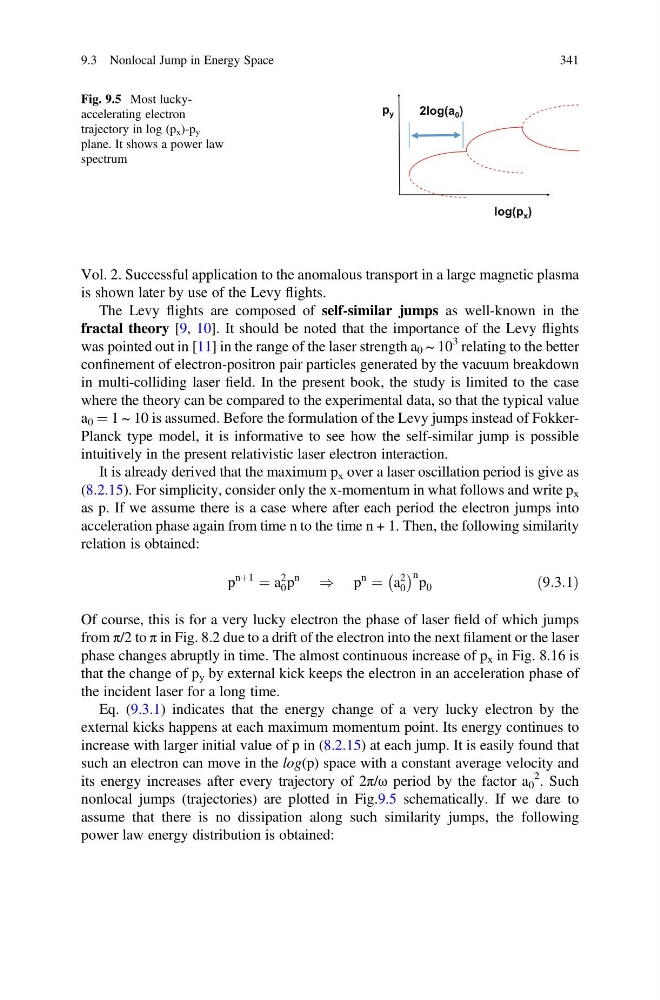
Eq. (9.3.1) indicates that the energy change of a very lucky electron by the
external kicks happens at each maximum momentum point. Its energy continues to
increase with larger initial value of p in (8.2.15) at each jump. It is easily found that
such an electron can move in the log(p) space with a constant average velocity and
its energy increases after every trajectory of 2π/ω period by the factor a 0
2 . Such
nonlocal jumps (trajectories) are plotted in Fig.9.5 schematically. If we dare to
assume that there is no dissipation along such similarity jumps, the following
power law energy distribution is obtained:
log(p x )
p y
2log(a 0 )
Fig. 9.5 Most luckyaccelerating electron
trajectory in log (p x )-p y
plane. It shows a power law
spectrum
9.3 Nonlocal Jump in Energy Space
341
is shown later by use of the Levy flights.
The Levy flights are composed of self-similar jumps as well-known in the
fractal theory [9, 10]. It should be noted that the importance of the Levy flights
was pointed out in [11] in the range of the laser strength a 0 ~ 10
3 relating to the better
confinement of electron-positron pair particles generated by the vacuum breakdown
in multi-colliding laser field. In the present book, the study is limited to the case
where the theory can be compared to the experimental data, so that the typical value
a 0 ¼ 1 ~ 10 is assumed. Before the formulation of the Levy jumps instead of FokkerPlanck type model, it is informative to see how the self-similar jump is possible
intuitively in the present relativistic laser electron interaction.
It is already derived that the maximum p x over a laser oscillation period is give as
(8.2.15). For simplicity, consider only the x-momentum in what follows and write p x
as p. If we assume there is a case where after each period the electron jumps into
acceleration phase again from time n to the time n + 1. Then, the following similarity
relation is obtained:
p
nþ1
¼ a
2
0 p
n
) p
n
¼ a
2
0
À Á n p 0
ð9:3:1Þ
Of course, this is for a very lucky electron the phase of laser field of which jumps
from π/2 to π in Fig. 8.2 due to a drift of the electron into the next filament or the laser
phase changes abruptly in time. The almost continuous increase of p x in Fig. 8.16 is
that the change of p y by external kick keeps the electron in an acceleration phase of
the incident laser for a long time.
Eq. (9.3.1) indicates that the energy change of a very lucky electron by the
external kicks happens at each maximum momentum point. Its energy continues to
increase with larger initial value of p in (8.2.15) at each jump. It is easily found that
such an electron can move in the log(p) space with a constant average velocity and
its energy increases after every trajectory of 2π/ω period by the factor a 0
2 . Such
nonlocal jumps (trajectories) are plotted in Fig.9.5 schematically. If we dare to
assume that there is no dissipation along such similarity jumps, the following
power law energy distribution is obtained:
log(p x )
p y
2log(a 0 )
Fig. 9.5 Most luckyaccelerating electron
trajectory in log (p x )-p y
plane. It shows a power law
spectrum
9.3 Nonlocal Jump in Energy Space
341