

9.3 Nonlocal Jump in Energy Space
In deriving Fokker-Planck equation to take into account the effect of stochastic
motions from the perturbation force, it is assumed that the momentum change Δp is
small enough and Taylor expansion can be used for modeling the stochastic effect in
Vlasov equation. In general, it is seen that such a diffusion-type model equation
provides exponential function of the electron distribution function. It is well-known
in modern statistical physics that Gibbs-Boltzmann statistics assumes the correlation of particles is local with a Gaussian probability of momentum change. Consequently it yields Maxwell distribution in the equilibrium state. On the other hand,
Tsallis statistics [7] based on nonlocal correlation of particles is found to result a
non-Maxwell distributions. The distribution is the Cauchy-Lorentz form which has
a Lorentzian distribution as one of the solutions in the equilibrium state. The
equilibrium distribution of the Tsallis statistics is shown in Appendix A.4.
9.3.1 Levy’s Flights
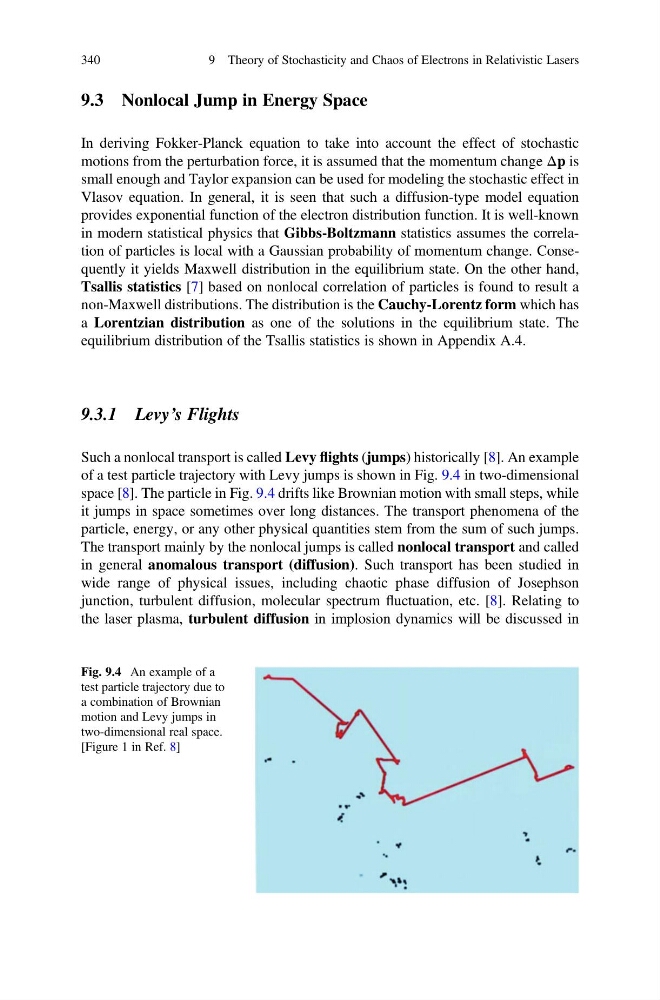
Such a nonlocal transport is called Levy flights (jumps) historically [8]. An example
of a test particle trajectory with Levy jumps is shown in Fig. 9.4 in two-dimensional
space [8]. The particle in Fig. 9.4 drifts like Brownian motion with small steps, while
it jumps in space sometimes over long distances. The transport phenomena of the
particle, energy, or any other physical quantities stem from the sum of such jumps.
The transport mainly by the nonlocal jumps is called nonlocal transport and called
in general anomalous transport (diffusion). Such transport has been studied in
wide range of physical issues, including chaotic phase diffusion of Josephson
junction, turbulent diffusion, molecular spectrum fluctuation, etc. [8]. Relating to
the laser plasma, turbulent diffusion in implosion dynamics will be discussed in
Fig. 9.4 An example of a
test particle trajectory due to
a combination of Brownian
motion and Levy jumps in
two-dimensional real space.
[Figure 1 in Ref. 8]
340
9 Theory of Stochasticity and Chaos of Electrons in Relativistic Lasers
In deriving Fokker-Planck equation to take into account the effect of stochastic
motions from the perturbation force, it is assumed that the momentum change Δp is
small enough and Taylor expansion can be used for modeling the stochastic effect in
Vlasov equation. In general, it is seen that such a diffusion-type model equation
provides exponential function of the electron distribution function. It is well-known
in modern statistical physics that Gibbs-Boltzmann statistics assumes the correlation of particles is local with a Gaussian probability of momentum change. Consequently it yields Maxwell distribution in the equilibrium state. On the other hand,
Tsallis statistics [7] based on nonlocal correlation of particles is found to result a
non-Maxwell distributions. The distribution is the Cauchy-Lorentz form which has
a Lorentzian distribution as one of the solutions in the equilibrium state. The
equilibrium distribution of the Tsallis statistics is shown in Appendix A.4.
9.3.1 Levy’s Flights
Such a nonlocal transport is called Levy flights (jumps) historically [8]. An example
of a test particle trajectory with Levy jumps is shown in Fig. 9.4 in two-dimensional
space [8]. The particle in Fig. 9.4 drifts like Brownian motion with small steps, while
it jumps in space sometimes over long distances. The transport phenomena of the
particle, energy, or any other physical quantities stem from the sum of such jumps.
The transport mainly by the nonlocal jumps is called nonlocal transport and called
in general anomalous transport (diffusion). Such transport has been studied in
wide range of physical issues, including chaotic phase diffusion of Josephson
junction, turbulent diffusion, molecular spectrum fluctuation, etc. [8]. Relating to
the laser plasma, turbulent diffusion in implosion dynamics will be discussed in
Fig. 9.4 An example of a
test particle trajectory due to
a combination of Brownian
motion and Levy jumps in
two-dimensional real space.
[Figure 1 in Ref. 8]
340
9 Theory of Stochasticity and Chaos of Electrons in Relativistic Lasers