

where k is found to be k ¼ 3. The characteristic energy E 0 is proportional to the
average number of the phase change “m” in the interaction region. This
m-dependence in (9.2.18) is important to obtain the strong enhancement of the hot
electron temperature by the randomness of laser phase.
9.2.2 PIC Simulation of Stochastic Diffusion
As mentioned in Sect. 8.7, counter-propagating two beams makes an electron motion
stochastic. In general, such stochastic motion can be approximated with a VFP
equation such as (9.2.16), as long as the second beam intensity is much weaker
than the main laser intensity. The LHS in (9.2.16) allows the periodic electron
motion shown in Fig. 8.1. The RHS with a small diffusion coefficient induces the
spread of an electron trajectory along the orbit in Fig. 8.1. This is first demonstrated
in [5] (see Fig. 2) with test particle calculations.
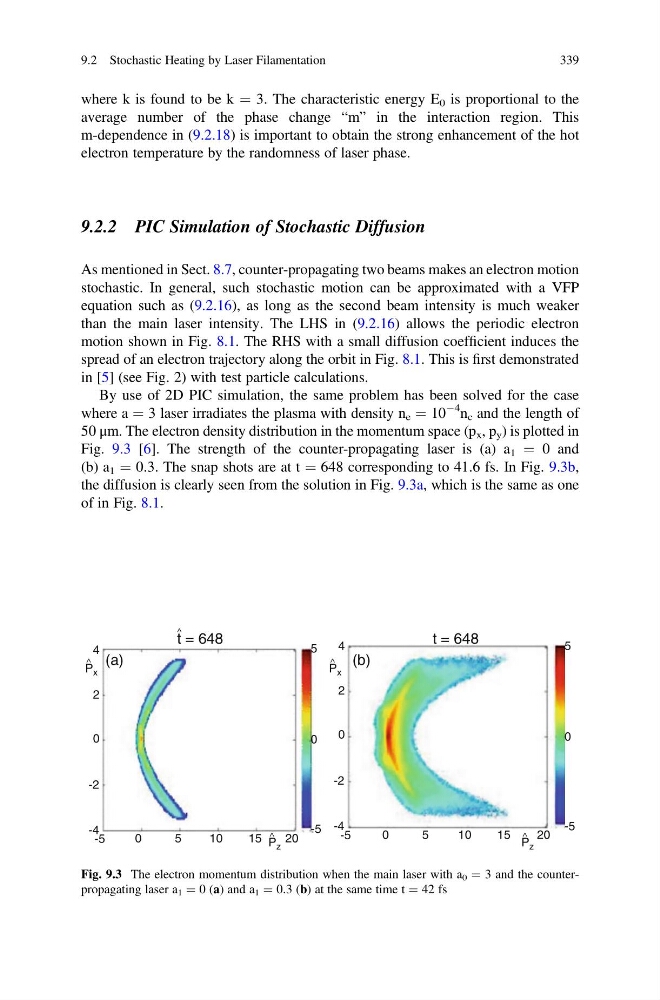
By use of 2D PIC simulation, the same problem has been solved for the case
where a ¼ 3 laser irradiates the plasma with density n e ¼ 10
À4 n c and the length of
50 μm. The electron density distribution in the momentum space (p x , p y ) is plotted in
Fig. 9.3 [6]. The strength of the counter-propagating laser is (a) a 1 ¼ 0 and
(b) a 1 ¼ 0.3. The snap shots are at t ¼ 648 corresponding to 41.6 fs. In Fig. 9.3b,
the diffusion is clearly seen from the solution in Fig. 9.3a, which is the same as one
of in Fig. 8.1.
4
5
0
-5
5
0
-5
2
P x
(a)
(b)
t = 648
t = 648
^
^
P x
^
P z
^
P z
^
0
-2
-4
4
2
0
-2
-4
-5
0
5
10
15
20
-5
0
5
10
15
20
Fig. 9.3 The electron momentum distribution when the main laser with a 0 ¼ 3 and the counterpropagating laser a 1 ¼ 0 (a) and a 1 ¼ 0.3 (b) at the same time t ¼ 42 fs
9.2 Stochastic Heating by Laser Filamentation
339
average number of the phase change “m” in the interaction region. This
m-dependence in (9.2.18) is important to obtain the strong enhancement of the hot
electron temperature by the randomness of laser phase.
9.2.2 PIC Simulation of Stochastic Diffusion
As mentioned in Sect. 8.7, counter-propagating two beams makes an electron motion
stochastic. In general, such stochastic motion can be approximated with a VFP
equation such as (9.2.16), as long as the second beam intensity is much weaker
than the main laser intensity. The LHS in (9.2.16) allows the periodic electron
motion shown in Fig. 8.1. The RHS with a small diffusion coefficient induces the
spread of an electron trajectory along the orbit in Fig. 8.1. This is first demonstrated
in [5] (see Fig. 2) with test particle calculations.
By use of 2D PIC simulation, the same problem has been solved for the case
where a ¼ 3 laser irradiates the plasma with density n e ¼ 10
À4 n c and the length of
50 μm. The electron density distribution in the momentum space (p x , p y ) is plotted in
Fig. 9.3 [6]. The strength of the counter-propagating laser is (a) a 1 ¼ 0 and
(b) a 1 ¼ 0.3. The snap shots are at t ¼ 648 corresponding to 41.6 fs. In Fig. 9.3b,
the diffusion is clearly seen from the solution in Fig. 9.3a, which is the same as one
of in Fig. 8.1.
4
5
0
-5
5
0
-5
2
P x
(a)
(b)
t = 648
t = 648
^
^
P x
^
P z
^
P z
^
0
-2
-4
4
2
0
-2
-4
-5
0
5
10
15
20
-5
0
5
10
15
20
Fig. 9.3 The electron momentum distribution when the main laser with a 0 ¼ 3 and the counterpropagating laser a 1 ¼ 0 (a) and a 1 ¼ 0.3 (b) at the same time t ¼ 42 fs
9.2 Stochastic Heating by Laser Filamentation
339