

azimuthal direction is important to confine the electrons in the laser-focused region.
The magnetic field is calculated by taking account of the current induced by the drift
velocity of electrons in (5.3.27).
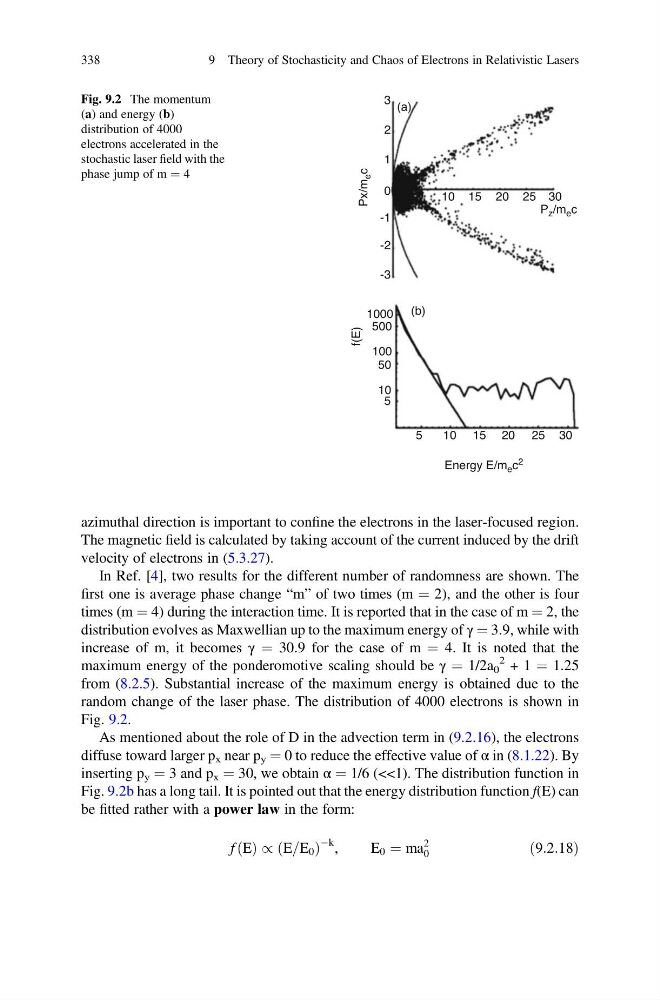
In Ref. [4], two results for the different number of randomness are shown. The
first one is average phase change “m” of two times (m ¼ 2), and the other is four
times (m ¼ 4) during the interaction time. It is reported that in the case of m ¼ 2, the
distribution evolves as Maxwellian up to the maximum energy of γ ¼ 3.9, while with
increase of m, it becomes γ ¼ 30.9 for the case of m ¼ 4. It is noted that the
maximum energy of the ponderomotive scaling should be γ ¼ 1/2a 0
2 + 1 ¼ 1.25
from (8.2.5). Substantial increase of the maximum energy is obtained due to the
random change of the laser phase. The distribution of 4000 electrons is shown in
Fig. 9.2.
As mentioned about the role of D in the advection term in (9.2.16), the electrons
diffuse toward larger p x near p y ¼ 0 to reduce the effective value of α in (8.1.22). By
inserting p y ¼ 3 and p x ¼ 30, we obtain α ¼ 1/6 (<<1). The distribution function in
Fig. 9.2b has a long tail. It is pointed out that the energy distribution function f(E) can
be fitted rather with a power law in the form:
f E
ð Þ / E=E 0
ð
Þ
Àk ,
E 0 ¼ ma
2
0
ð9:2:18Þ
3
2
1
0
10
(a)
Px/m
e c
15
f(E)
20 25
P z /m e c
30
10
10
50
100
500
1000 (b)
5
5
15
Energy E/m e c
2
20 25 30
-1
-2
-3
Fig. 9.2 The momentum
(a) and energy (b)
distribution of 4000
electrons accelerated in the
stochastic laser field with the
phase jump of m ¼ 4
338
9 Theory of Stochasticity and Chaos of Electrons in Relativistic Lasers
The magnetic field is calculated by taking account of the current induced by the drift
velocity of electrons in (5.3.27).
In Ref. [4], two results for the different number of randomness are shown. The
first one is average phase change “m” of two times (m ¼ 2), and the other is four
times (m ¼ 4) during the interaction time. It is reported that in the case of m ¼ 2, the
distribution evolves as Maxwellian up to the maximum energy of γ ¼ 3.9, while with
increase of m, it becomes γ ¼ 30.9 for the case of m ¼ 4. It is noted that the
maximum energy of the ponderomotive scaling should be γ ¼ 1/2a 0
2 + 1 ¼ 1.25
from (8.2.5). Substantial increase of the maximum energy is obtained due to the
random change of the laser phase. The distribution of 4000 electrons is shown in
Fig. 9.2.
As mentioned about the role of D in the advection term in (9.2.16), the electrons
diffuse toward larger p x near p y ¼ 0 to reduce the effective value of α in (8.1.22). By
inserting p y ¼ 3 and p x ¼ 30, we obtain α ¼ 1/6 (<<1). The distribution function in
Fig. 9.2b has a long tail. It is pointed out that the energy distribution function f(E) can
be fitted rather with a power law in the form:
f E
ð Þ / E=E 0
ð
Þ
Àk ,
E 0 ¼ ma
2
0
ð9:2:18Þ
3
2
1
0
10
(a)
Px/m
e c
15
f(E)
20 25
P z /m e c
30
10
10
50
100
500
1000 (b)
5
5
15
Energy E/m e c
2
20 25 30
-1
-2
-3
Fig. 9.2 The momentum
(a) and energy (b)
distribution of 4000
electrons accelerated in the
stochastic laser field with the
phase jump of m ¼ 4
338
9 Theory of Stochasticity and Chaos of Electrons in Relativistic Lasers