

ÀB Δ
2
∂
∂p x
f þ
Ap y
2
2
Δ
2
∂
2
∂p 2
x
f
ð9:2:15Þ
Only the second derivative remains in the expansion to the y-momentum. Finally,
for a weak randomness of the laser filaments, the following Vlasov-Fokker-Planck
equation is obtained:
∂f
∂τ
þ
a
2
0
2
sin 2ξ
ð Þ þ D
! ∂f
∂p x
þ a 0 γ sin ξ
∂f
∂p y
¼ D
∂
2
∂p 2
x
p
2
y
α
f
!
þ D
∂
2
∂p 2
y
αf
ð Þ
ð9:2:16Þ
D ¼
a
2
0
2τ c
Δ
2
ð9:2:17Þ
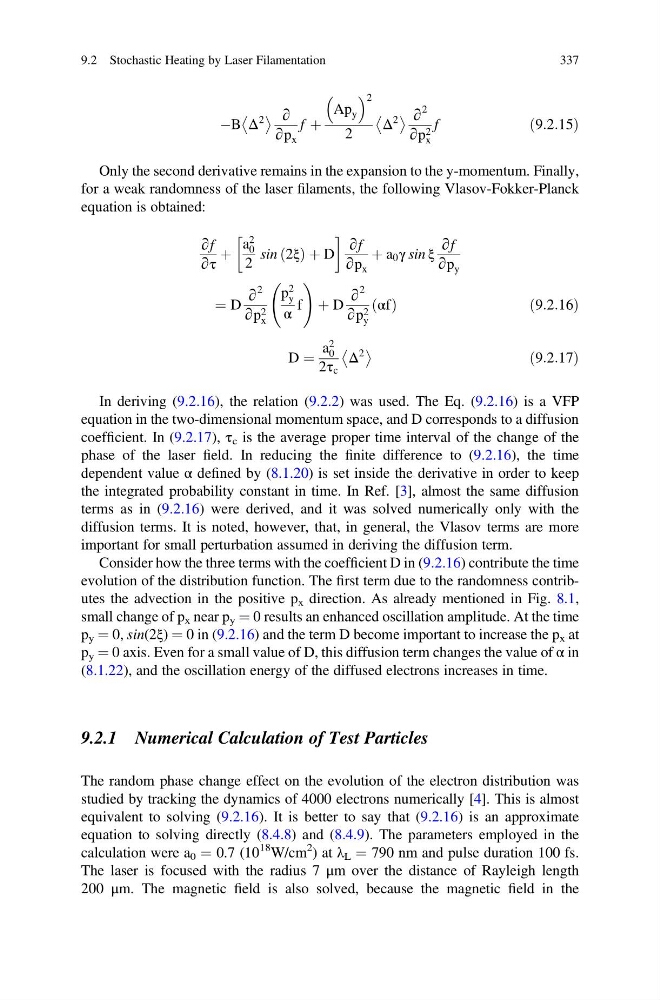
In deriving (9.2.16), the relation (9.2.2) was used. The Eq. (9.2.16) is a VFP
equation in the two-dimensional momentum space, and D corresponds to a diffusion
coefficient. In (9.2.17), τ c is the average proper time interval of the change of the
phase of the laser field. In reducing the finite difference to (9.2.16), the time
dependent value α defined by (8.1.20) is set inside the derivative in order to keep
the integrated probability constant in time. In Ref. [3], almost the same diffusion
terms as in (9.2.16) were derived, and it was solved numerically only with the
diffusion terms. It is noted, however, that, in general, the Vlasov terms are more
important for small perturbation assumed in deriving the diffusion term.
Consider how the three terms with the coefficient D in (9.2.16) contribute the time
evolution of the distribution function. The first term due to the randomness contributes the advection in the positive p x direction. As already mentioned in Fig. 8.1,
small change of p x near p y ¼ 0 results an enhanced oscillation amplitude. At the time
p y ¼ 0, sin(2ξ) ¼ 0 in (9.2.16) and the term D become important to increase the p x at
p y ¼ 0 axis. Even for a small value of D, this diffusion term changes the value of α in
(8.1.22), and the oscillation energy of the diffused electrons increases in time.
9.2.1 Numerical Calculation of Test Particles
The random phase change effect on the evolution of the electron distribution was
studied by tracking the dynamics of 4000 electrons numerically [4]. This is almost
equivalent to solving (9.2.16). It is better to say that (9.2.16) is an approximate
equation to solving directly (8.4.8) and (8.4.9). The parameters employed in the
calculation were a 0 ¼ 0.7 (10
18 W/cm
2 ) at λ L ¼ 790 nm and pulse duration 100 fs.
The laser is focused with the radius 7 μm over the distance of Rayleigh length
200 μm. The magnetic field is also solved, because the magnetic field in the
9.2 Stochastic Heating by Laser Filamentation
337
2
∂
∂p x
f þ
Ap y
2
2
Δ
2
∂
2
∂p 2
x
f
ð9:2:15Þ
Only the second derivative remains in the expansion to the y-momentum. Finally,
for a weak randomness of the laser filaments, the following Vlasov-Fokker-Planck
equation is obtained:
∂f
∂τ
þ
a
2
0
2
sin 2ξ
ð Þ þ D
! ∂f
∂p x
þ a 0 γ sin ξ
∂f
∂p y
¼ D
∂
2
∂p 2
x
p
2
y
α
f
!
þ D
∂
2
∂p 2
y
αf
ð Þ
ð9:2:16Þ
D ¼
a
2
0
2τ c
Δ
2
ð9:2:17Þ
In deriving (9.2.16), the relation (9.2.2) was used. The Eq. (9.2.16) is a VFP
equation in the two-dimensional momentum space, and D corresponds to a diffusion
coefficient. In (9.2.17), τ c is the average proper time interval of the change of the
phase of the laser field. In reducing the finite difference to (9.2.16), the time
dependent value α defined by (8.1.20) is set inside the derivative in order to keep
the integrated probability constant in time. In Ref. [3], almost the same diffusion
terms as in (9.2.16) were derived, and it was solved numerically only with the
diffusion terms. It is noted, however, that, in general, the Vlasov terms are more
important for small perturbation assumed in deriving the diffusion term.
Consider how the three terms with the coefficient D in (9.2.16) contribute the time
evolution of the distribution function. The first term due to the randomness contributes the advection in the positive p x direction. As already mentioned in Fig. 8.1,
small change of p x near p y ¼ 0 results an enhanced oscillation amplitude. At the time
p y ¼ 0, sin(2ξ) ¼ 0 in (9.2.16) and the term D become important to increase the p x at
p y ¼ 0 axis. Even for a small value of D, this diffusion term changes the value of α in
(8.1.22), and the oscillation energy of the diffused electrons increases in time.
9.2.1 Numerical Calculation of Test Particles
The random phase change effect on the evolution of the electron distribution was
studied by tracking the dynamics of 4000 electrons numerically [4]. This is almost
equivalent to solving (9.2.16). It is better to say that (9.2.16) is an approximate
equation to solving directly (8.4.8) and (8.4.9). The parameters employed in the
calculation were a 0 ¼ 0.7 (10
18 W/cm
2 ) at λ L ¼ 790 nm and pulse duration 100 fs.
The laser is focused with the radius 7 μm over the distance of Rayleigh length
200 μm. The magnetic field is also solved, because the magnetic field in the
9.2 Stochastic Heating by Laser Filamentation
337