

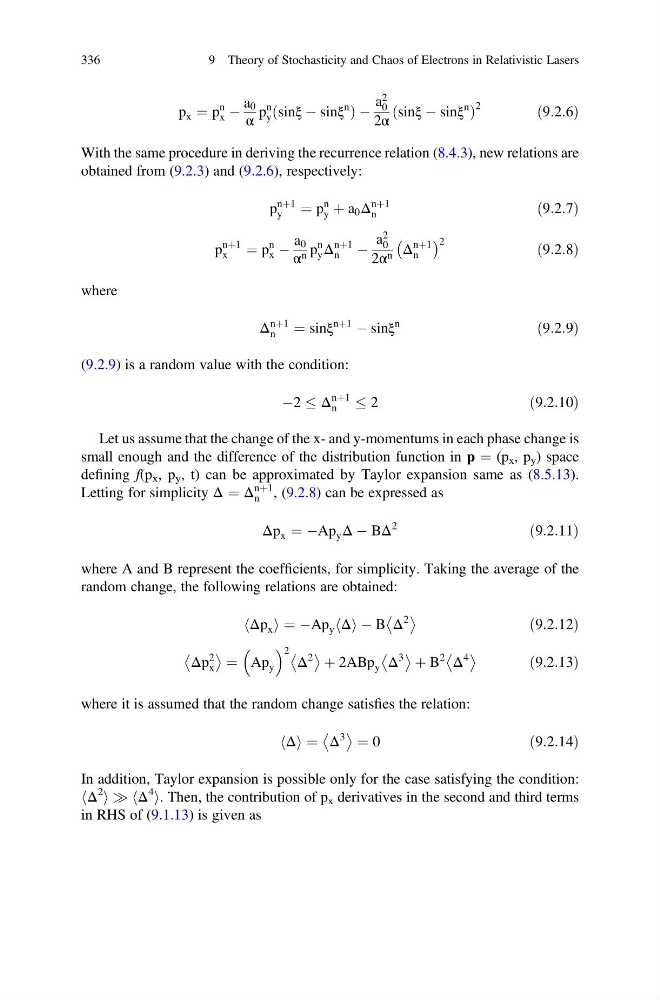
p x ¼ p
n
x À
a 0
α
p
n
y sinξ À sinξ
n
ð
ÞÀ
a
2
0
2α
sinξ À sinξ
n
ð
Þ
2
ð9:2:6Þ
With the same procedure in deriving the recurrence relation (8.4.3), new relations are
obtained from (9.2.3) and (9.2.6), respectively:
p
nþ1
y
¼ p
n
y þ a 0 Δ
nþ1
n
ð9:2:7Þ
p
nþ1
x
¼ p
n
x À
a 0
α n p
n
y Δ
nþ1
n
À
a
2
0
2α n Δ
nþ1
n
À
Á 2
ð9:2:8Þ
where
Δ
nþ1
n
¼ sinξ
nþ1
À sinξ
n
ð9:2:9Þ
(9.2.9) is a random value with the condition:
À2 Δ
nþ1
n
2
ð9:2:10Þ
Let us assume that the change of the x- and y-momentums in each phase change is
small enough and the difference of the distribution function in p ¼ (p x , p y ) space
defining f(p x , p y , t) can be approximated by Taylor expansion same as (8.5.13).
Letting for simplicity Δ ¼ Δ
nþ1
n , (9.2.8) can be expressed as
Δp x ¼ ÀAp y Δ À BΔ
2
ð9:2:11Þ
where A and B represent the coefficients, for simplicity. Taking the average of the
random change, the following relations are obtained:
Δp x
h
i ¼ ÀAp y Δ
h i À B Δ
2
ð9:2:12Þ
Δp
2
x
¼ Ap y
2 Δ
2
þ 2ABp y Δ
3
þ B
2
Δ
4
ð9:2:13Þ
where it is assumed that the random change satisfies the relation:
Δ
h i ¼ Δ
3
¼ 0
ð9:2:14Þ
In addition, Taylor expansion is possible only for the case satisfying the condition:
hΔ
2 i ) hΔ
4 i. Then, the contribution of p x derivatives in the second and third terms
in RHS of (9.1.13) is given as
336
9 Theory of Stochasticity and Chaos of Electrons in Relativistic Lasers
n
x À
a 0
α
p
n
y sinξ À sinξ
n
ð
ÞÀ
a
2
0
2α
sinξ À sinξ
n
ð
Þ
2
ð9:2:6Þ
With the same procedure in deriving the recurrence relation (8.4.3), new relations are
obtained from (9.2.3) and (9.2.6), respectively:
p
nþ1
y
¼ p
n
y þ a 0 Δ
nþ1
n
ð9:2:7Þ
p
nþ1
x
¼ p
n
x À
a 0
α n p
n
y Δ
nþ1
n
À
a
2
0
2α n Δ
nþ1
n
À
Á 2
ð9:2:8Þ
where
Δ
nþ1
n
¼ sinξ
nþ1
À sinξ
n
ð9:2:9Þ
(9.2.9) is a random value with the condition:
À2 Δ
nþ1
n
2
ð9:2:10Þ
Let us assume that the change of the x- and y-momentums in each phase change is
small enough and the difference of the distribution function in p ¼ (p x , p y ) space
defining f(p x , p y , t) can be approximated by Taylor expansion same as (8.5.13).
Letting for simplicity Δ ¼ Δ
nþ1
n , (9.2.8) can be expressed as
Δp x ¼ ÀAp y Δ À BΔ
2
ð9:2:11Þ
where A and B represent the coefficients, for simplicity. Taking the average of the
random change, the following relations are obtained:
Δp x
h
i ¼ ÀAp y Δ
h i À B Δ
2
ð9:2:12Þ
Δp
2
x
¼ Ap y
2 Δ
2
þ 2ABp y Δ
3
þ B
2
Δ
4
ð9:2:13Þ
where it is assumed that the random change satisfies the relation:
Δ
h i ¼ Δ
3
¼ 0
ð9:2:14Þ
In addition, Taylor expansion is possible only for the case satisfying the condition:
hΔ
2 i ) hΔ
4 i. Then, the contribution of p x derivatives in the second and third terms
in RHS of (9.1.13) is given as
336
9 Theory of Stochasticity and Chaos of Electrons in Relativistic Lasers