

is clear that the red trajectories are parabolic as average and oscillating due to the
field by a 1 . Its oscillation period is fast at large p x and gets slowly near p x ¼ 0.
This result suggests how the perturbation laser changes the motion of electron.
When the electron energy is small enough, the perturbation field affects the electron
motion so that α changes stochastically at any chance. This is because the electron
velocity is low as discussed with a simple model in Fig. 8.13. Once the velocity and
energy increase, however, the perturbation field cannot couple the motion of electron
moving with almost speed of light in the positive x-direction. As a result, the value of
α is changed by the impact of the perturbation field when the electron almost stops at
ξ ¼ nπ (n: integer).
8.7.3 Lyapunov Exponent
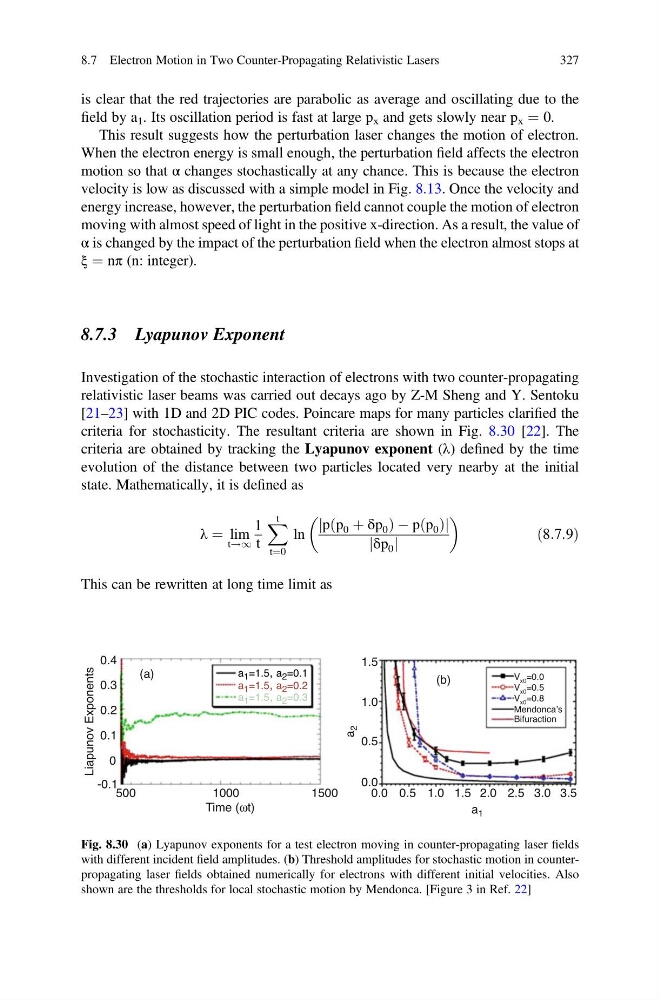
Investigation of the stochastic interaction of electrons with two counter-propagating
relativistic laser beams was carried out decays ago by Z-M Sheng and Y. Sentoku
[21–23] with 1D and 2D PIC codes. Poincare maps for many particles clarified the
criteria for stochasticity. The resultant criteria are shown in Fig. 8.30 [22]. The
criteria are obtained by tracking the Lyapunov exponent (λ) defined by the time
evolution of the distance between two particles located very nearby at the initial
state. Mathematically, it is defined as
λ ¼ lim
t!1
1
t
X t
t¼0
ln
p p 0 þ δp 0
ð
ÞÀp p 0
ð Þ
j
j
δp 0
j j
ð8:7:9Þ
This can be rewritten at long time limit as
0.4
1.5
1.0
0.5
0.0
0.0 0.5 1.0 1.5 2.0 2.5 3.0 3.5
a 1
a 1 =1.5, a 2 =0.1
a 1 =1.5, a 2 =0.2
a 1 =1.5, a 2 =0.3
a
2
0.3
(a)
(b)
V x0 =0.0
V x0 =0.5
V x0 =0.8
Mendonca’s
Bifuraction
0.2
Liapunov Exponents
0.1
-0.1
0
500
1000
Time (ωt)
1500
Fig. 8.30 (a) Lyapunov exponents for a test electron moving in counter-propagating laser fields
with different incident field amplitudes. (b) Threshold amplitudes for stochastic motion in counterpropagating laser fields obtained numerically for electrons with different initial velocities. Also
shown are the thresholds for local stochastic motion by Mendonca. [Figure 3 in Ref. 22]
8.7 Electron Motion in Two Counter-Propagating Relativistic Lasers
327
field by a 1 . Its oscillation period is fast at large p x and gets slowly near p x ¼ 0.
This result suggests how the perturbation laser changes the motion of electron.
When the electron energy is small enough, the perturbation field affects the electron
motion so that α changes stochastically at any chance. This is because the electron
velocity is low as discussed with a simple model in Fig. 8.13. Once the velocity and
energy increase, however, the perturbation field cannot couple the motion of electron
moving with almost speed of light in the positive x-direction. As a result, the value of
α is changed by the impact of the perturbation field when the electron almost stops at
ξ ¼ nπ (n: integer).
8.7.3 Lyapunov Exponent
Investigation of the stochastic interaction of electrons with two counter-propagating
relativistic laser beams was carried out decays ago by Z-M Sheng and Y. Sentoku
[21–23] with 1D and 2D PIC codes. Poincare maps for many particles clarified the
criteria for stochasticity. The resultant criteria are shown in Fig. 8.30 [22]. The
criteria are obtained by tracking the Lyapunov exponent (λ) defined by the time
evolution of the distance between two particles located very nearby at the initial
state. Mathematically, it is defined as
λ ¼ lim
t!1
1
t
X t
t¼0
ln
p p 0 þ δp 0
ð
ÞÀp p 0
ð Þ
j
j
δp 0
j j
ð8:7:9Þ
This can be rewritten at long time limit as
0.4
1.5
1.0
0.5
0.0
0.0 0.5 1.0 1.5 2.0 2.5 3.0 3.5
a 1
a 1 =1.5, a 2 =0.1
a 1 =1.5, a 2 =0.2
a 1 =1.5, a 2 =0.3
a
2
0.3
(a)
(b)
V x0 =0.0
V x0 =0.5
V x0 =0.8
Mendonca’s
Bifuraction
0.2
Liapunov Exponents
0.1
-0.1
0
500
1000
Time (ωt)
1500
Fig. 8.30 (a) Lyapunov exponents for a test electron moving in counter-propagating laser fields
with different incident field amplitudes. (b) Threshold amplitudes for stochastic motion in counterpropagating laser fields obtained numerically for electrons with different initial velocities. Also
shown are the thresholds for local stochastic motion by Mendonca. [Figure 3 in Ref. 22]
8.7 Electron Motion in Two Counter-Propagating Relativistic Lasers
327