

8.7.1 Counter-Propagating Two Laser Systems
When relativistic laser is irradiated on a target surface, reflected laser also interacts
with the electrons in low-density plasma. This is also the case when strong reflection
is induced by the backward Raman scattering as shown in Sect. 4.9. Since the
incident and reflected lasers both interact with electrons, it is clear that an electron
orbit becomes non-integrable. As mentioned regarding the chaos in (8.4.6), the basic
equation becomes three with the reflected component. Assume in what follows, for
simplicity, that two lasers are counter-propagating in the x-direction and both have
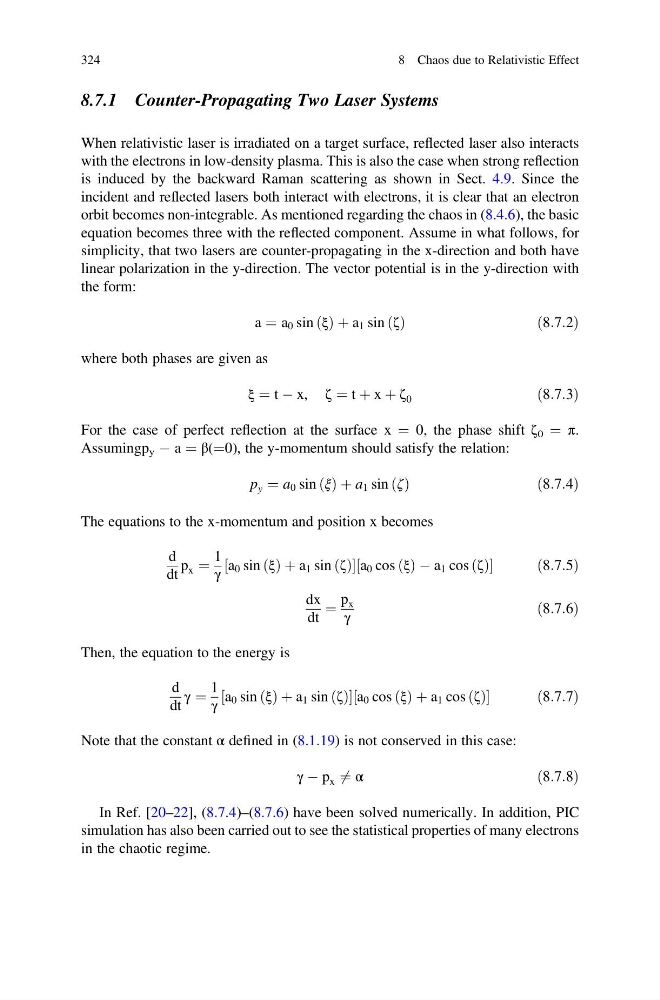
linear polarization in the y-direction. The vector potential is in the y-direction with
the form:
a ¼ a 0 sin ξ
ð Þ þ a 1 sin ζ
ð Þ
ð8:7:2Þ
where both phases are given as
ξ ¼ t À x, ζ ¼ t þ x þ ζ 0
ð8:7:3Þ
For the case of perfect reflection at the surface x ¼ 0, the phase shift ζ 0 ¼ π.
Assumingp y À a ¼ β(¼0), the y-momentum should satisfy the relation:
p y ¼ a 0 sin ξ
ð Þ þ a 1 sin ζ
ð Þ
ð8:7:4Þ
The equations to the x-momentum and position x becomes
d
dt
p x ¼
1
γ
a 0 sin ξ
ð Þ þ a 1 sin ζ
ð Þ
½
a 0 cos ξ
ð Þ À a 1 cos ζ
ð Þ
½
ð 8:7:5Þ
dx
dt
¼
p x
γ
ð8:7:6Þ
Then, the equation to the energy is
d
dt
γ ¼
1
γ
a 0 sin ξ
ð Þ þ a 1 sin ζ
ð Þ
½
a 0 cos ξ
ð Þ þ a 1 cos ζ
ð Þ
½
ð 8:7:7Þ
Note that the constant α defined in (8.1.19) is not conserved in this case:
γ À p x 6 ¼ α
ð8:7:8Þ
In Ref. [20–22], (8.7.4)–(8.7.6) have been solved numerically. In addition, PIC
simulation has also been carried out to see the statistical properties of many electrons
in the chaotic regime.
324
8 Chaos due to Relativistic Effect
When relativistic laser is irradiated on a target surface, reflected laser also interacts
with the electrons in low-density plasma. This is also the case when strong reflection
is induced by the backward Raman scattering as shown in Sect. 4.9. Since the
incident and reflected lasers both interact with electrons, it is clear that an electron
orbit becomes non-integrable. As mentioned regarding the chaos in (8.4.6), the basic
equation becomes three with the reflected component. Assume in what follows, for
simplicity, that two lasers are counter-propagating in the x-direction and both have
linear polarization in the y-direction. The vector potential is in the y-direction with
the form:
a ¼ a 0 sin ξ
ð Þ þ a 1 sin ζ
ð Þ
ð8:7:2Þ
where both phases are given as
ξ ¼ t À x, ζ ¼ t þ x þ ζ 0
ð8:7:3Þ
For the case of perfect reflection at the surface x ¼ 0, the phase shift ζ 0 ¼ π.
Assumingp y À a ¼ β(¼0), the y-momentum should satisfy the relation:
p y ¼ a 0 sin ξ
ð Þ þ a 1 sin ζ
ð Þ
ð8:7:4Þ
The equations to the x-momentum and position x becomes
d
dt
p x ¼
1
γ
a 0 sin ξ
ð Þ þ a 1 sin ζ
ð Þ
½
a 0 cos ξ
ð Þ À a 1 cos ζ
ð Þ
½
ð 8:7:5Þ
dx
dt
¼
p x
γ
ð8:7:6Þ
Then, the equation to the energy is
d
dt
γ ¼
1
γ
a 0 sin ξ
ð Þ þ a 1 sin ζ
ð Þ
½
a 0 cos ξ
ð Þ þ a 1 cos ζ
ð Þ
½
ð 8:7:7Þ
Note that the constant α defined in (8.1.19) is not conserved in this case:
γ À p x 6 ¼ α
ð8:7:8Þ
In Ref. [20–22], (8.7.4)–(8.7.6) have been solved numerically. In addition, PIC
simulation has also been carried out to see the statistical properties of many electrons
in the chaotic regime.
324
8 Chaos due to Relativistic Effect