

stochastic nature in relativistic regime, a model experiment to study the physics of
stochastic and nonthermal acceleration of cosmic rays has been done [18]. In a series
of experiment, non-Maxwellian and power law energy spectra of electrons are
observed. It is under research in what condition the power law acceleration probably
happens.
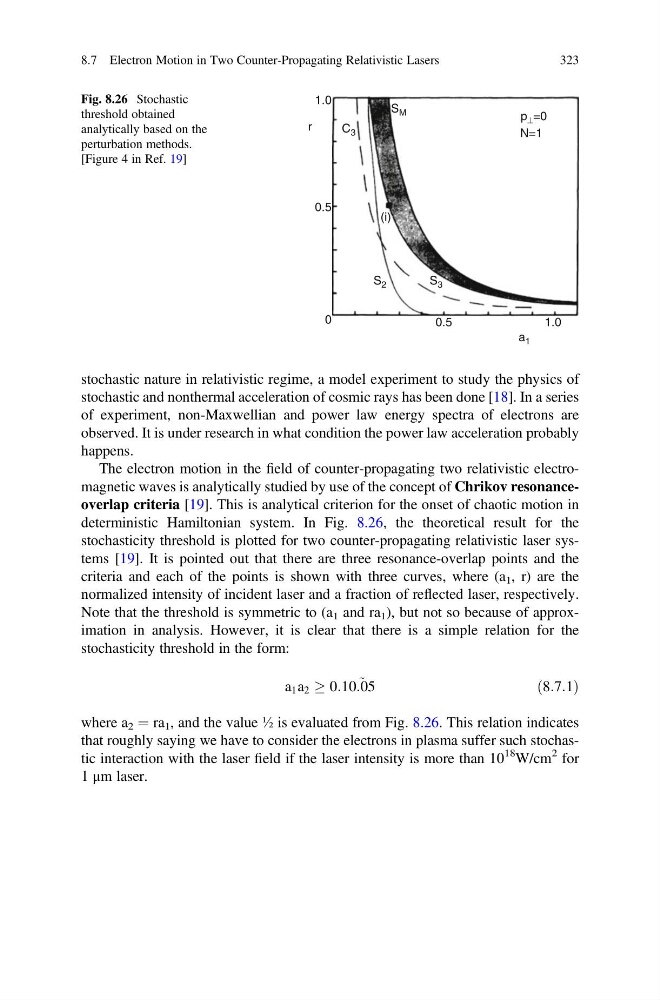
The electron motion in the field of counter-propagating two relativistic electromagnetic waves is analytically studied by use of the concept of Chrikov resonanceoverlap criteria [19]. This is analytical criterion for the onset of chaotic motion in
deterministic Hamiltonian system. In Fig. 8.26, the theoretical result for the
stochasticity threshold is plotted for two counter-propagating relativistic laser systems [19]. It is pointed out that there are three resonance-overlap points and the
criteria and each of the points is shown with three curves, where (a 1 , r) are the
normalized intensity of incident laser and a fraction of reflected laser, respectively.
Note that the threshold is symmetric to (a 1 and ra 1 ), but not so because of approximation in analysis. However, it is clear that there is a simple relation for the
stochasticity threshold in the form:
a 1 a 2 ! 0:1 ~
0:05
ð8:7:1Þ
where a 2 ¼ ra 1 , and the value ½ is evaluated from Fig. 8.26. This relation indicates
that roughly saying we have to consider the electrons in plasma suffer such stochastic interaction with the laser field if the laser intensity is more than 10
18 W/cm
2 for
1 μm laser.
1.0
1.0
0.5
r
a 1
C 3
S 2
S 3
S M
(i)
N=1
p ⊥ =0
0.5
0
Fig. 8.26 Stochastic
threshold obtained
analytically based on the
perturbation methods.
[Figure 4 in Ref. 19]
8.7 Electron Motion in Two Counter-Propagating Relativistic Lasers
323
stochastic and nonthermal acceleration of cosmic rays has been done [18]. In a series
of experiment, non-Maxwellian and power law energy spectra of electrons are
observed. It is under research in what condition the power law acceleration probably
happens.
The electron motion in the field of counter-propagating two relativistic electromagnetic waves is analytically studied by use of the concept of Chrikov resonanceoverlap criteria [19]. This is analytical criterion for the onset of chaotic motion in
deterministic Hamiltonian system. In Fig. 8.26, the theoretical result for the
stochasticity threshold is plotted for two counter-propagating relativistic laser systems [19]. It is pointed out that there are three resonance-overlap points and the
criteria and each of the points is shown with three curves, where (a 1 , r) are the
normalized intensity of incident laser and a fraction of reflected laser, respectively.
Note that the threshold is symmetric to (a 1 and ra 1 ), but not so because of approximation in analysis. However, it is clear that there is a simple relation for the
stochasticity threshold in the form:
a 1 a 2 ! 0:1 ~
0:05
ð8:7:1Þ
where a 2 ¼ ra 1 , and the value ½ is evaluated from Fig. 8.26. This relation indicates
that roughly saying we have to consider the electrons in plasma suffer such stochastic interaction with the laser field if the laser intensity is more than 10
18 W/cm
2 for
1 μm laser.
1.0
1.0
0.5
r
a 1
C 3
S 2
S 3
S M
(i)
N=1
p ⊥ =0
0.5
0
Fig. 8.26 Stochastic
threshold obtained
analytically based on the
perturbation methods.
[Figure 4 in Ref. 19]
8.7 Electron Motion in Two Counter-Propagating Relativistic Lasers
323