

obtain large energy via interaction with laser and easily escape from the interaction
region. In the vacuum side, however, high sheath potential almost the same as the hot
electron temperature reflects the hot electrons to the interaction region. On the other
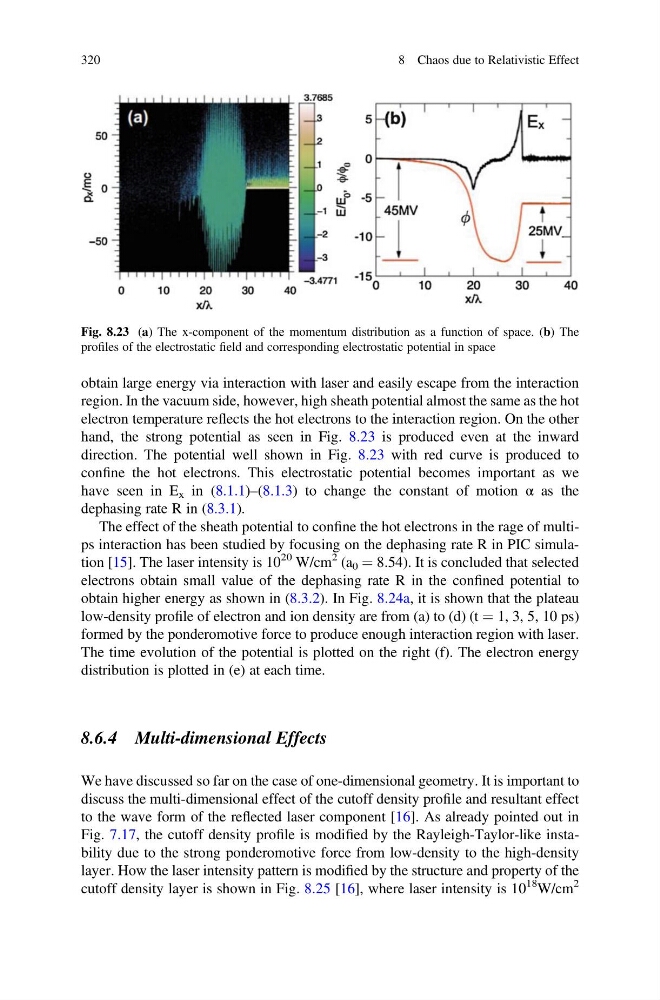
hand, the strong potential as seen in Fig. 8.23 is produced even at the inward
direction. The potential well shown in Fig. 8.23 with red curve is produced to
confine the hot electrons. This electrostatic potential becomes important as we
have seen in E x in (8.1.1)–(8.1.3) to change the constant of motion α as the
dephasing rate R in (8.3.1).
The effect of the sheath potential to confine the hot electrons in the rage of multips interaction has been studied by focusing on the dephasing rate R in PIC simulation [15]. The laser intensity is 10
20 W/cm
2 (a 0 ¼ 8.54). It is concluded that selected
electrons obtain small value of the dephasing rate R in the confined potential to
obtain higher energy as shown in (8.3.2). In Fig. 8.24a, it is shown that the plateau
low-density profile of electron and ion density are from (a) to (d) (t ¼ 1, 3, 5, 10 ps)
formed by the ponderomotive force to produce enough interaction region with laser.
The time evolution of the potential is plotted on the right (f). The electron energy
distribution is plotted in (e) at each time.
8.6.4 Multi-dimensional Effects
We have discussed so far on the case of one-dimensional geometry. It is important to
discuss the multi-dimensional effect of the cutoff density profile and resultant effect
to the wave form of the reflected laser component [16]. As already pointed out in
Fig. 7.17, the cutoff density profile is modified by the Rayleigh-Taylor-like instability due to the strong ponderomotive force from low-density to the high-density
layer. How the laser intensity pattern is modified by the structure and property of the
cutoff density layer is shown in Fig. 8.25 [16], where laser intensity is 10
18 W/cm
2
Fig. 8.23 (a) The x-component of the momentum distribution as a function of space. (b) The
profiles of the electrostatic field and corresponding electrostatic potential in space
320
8 Chaos due to Relativistic Effect
region. In the vacuum side, however, high sheath potential almost the same as the hot
electron temperature reflects the hot electrons to the interaction region. On the other
hand, the strong potential as seen in Fig. 8.23 is produced even at the inward
direction. The potential well shown in Fig. 8.23 with red curve is produced to
confine the hot electrons. This electrostatic potential becomes important as we
have seen in E x in (8.1.1)–(8.1.3) to change the constant of motion α as the
dephasing rate R in (8.3.1).
The effect of the sheath potential to confine the hot electrons in the rage of multips interaction has been studied by focusing on the dephasing rate R in PIC simulation [15]. The laser intensity is 10
20 W/cm
2 (a 0 ¼ 8.54). It is concluded that selected
electrons obtain small value of the dephasing rate R in the confined potential to
obtain higher energy as shown in (8.3.2). In Fig. 8.24a, it is shown that the plateau
low-density profile of electron and ion density are from (a) to (d) (t ¼ 1, 3, 5, 10 ps)
formed by the ponderomotive force to produce enough interaction region with laser.
The time evolution of the potential is plotted on the right (f). The electron energy
distribution is plotted in (e) at each time.
8.6.4 Multi-dimensional Effects
We have discussed so far on the case of one-dimensional geometry. It is important to
discuss the multi-dimensional effect of the cutoff density profile and resultant effect
to the wave form of the reflected laser component [16]. As already pointed out in
Fig. 7.17, the cutoff density profile is modified by the Rayleigh-Taylor-like instability due to the strong ponderomotive force from low-density to the high-density
layer. How the laser intensity pattern is modified by the structure and property of the
cutoff density layer is shown in Fig. 8.25 [16], where laser intensity is 10
18 W/cm
2
Fig. 8.23 (a) The x-component of the momentum distribution as a function of space. (b) The
profiles of the electrostatic field and corresponding electrostatic potential in space
320
8 Chaos due to Relativistic Effect