

simulation results well reproduce both distributions. The computational results are
shown by black lines.
In the 2D PIC simulation, the same kind of identification of the root of accelerated
electrons was also carried out as proposed in [2]. As explained in Sect. 8.2, most of
the high-energy electrons are produced by the physical process of LIDA (loopinjected direct acceleration). The 2D PIC simulation is used to identify the contribution of such LIDA in the experiment. It is concluded that for the case with long
pulse of multi-picoseconds, not only the single cycle LIDA but also the multiple
cycles LIDA contribute substantially to producing the tail of the distribution
function [12].
8.6.3 Sheath Potential Effect
As already mentioned in Fig. 7.12, it is pointed out that the hot electron confinement
by the sheath potential is important to allow many interactions of the electrons with
laser field. Since the pulse length is long enough to expect the long low-density
plasma formation shown in Fig. 8.10. So, better coupling and cumulative acceleration are expected in the relatively long low-density plasma region.
Omega-EP laser has been used to study the pre-formed plasma effect on the hot
electron energy spectrum of the super-ponderomotive electrons [13]. The experimental data on the hot electron temperature is plotted as a function of the laser pulse
length for constant laser intensity of 4 Â 10
19 W/cm
2 for λ ¼ 1 μm. It is seen that
the hot electron temperature is 1.5 ~ 2.3 MeV for 1 ps laser pulse, depending on the
plasma condition, while it increases about 3 ~ 4 MeV at 10 ps pulse. In applying the
scaling law to time, it is roughly assumed T h ~ τ
1/3
, where τ is the pulse duration.
The importance of the sheath potential to confine the electron and increase the
coupling with lasers has been pointed out in [14] with 1D PIC simulation. Regardless of self-generated or externally produced low-density plasmas, the electrons
PIC results
1 pulse
1.2
1.0
0.8
0.6
0.4
0.2
0.0
0
1
1st
2nd
3rd
Incident pulses
4th
2
3
4
5
6
7
8
2 pulses
4 pulses
Slope Temperature [MeV]
Time [ps]
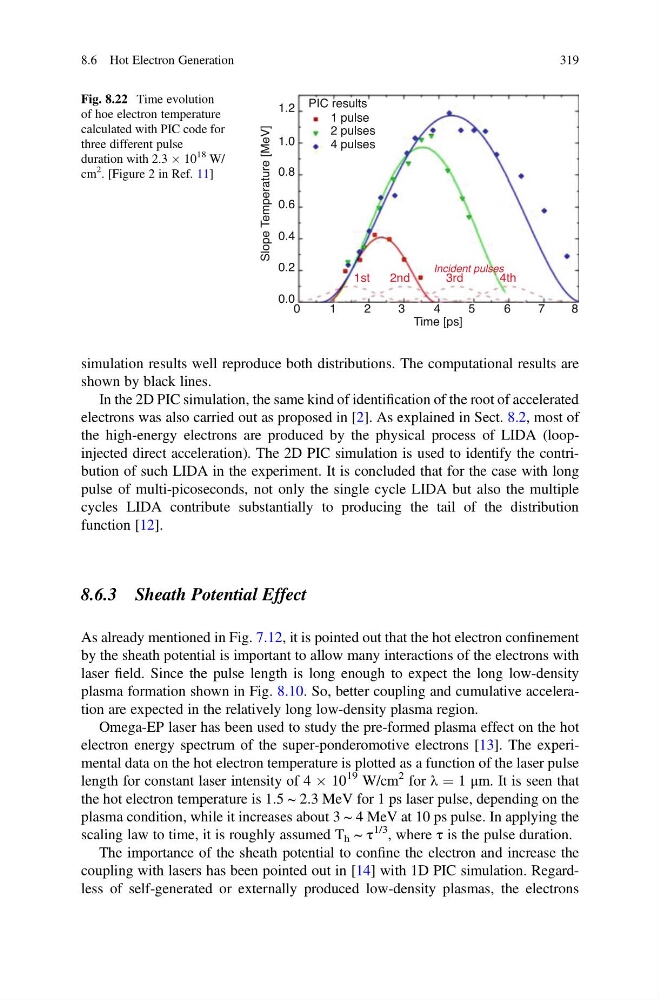
Fig. 8.22 Time evolution
of hoe electron temperature
calculated with PIC code for
three different pulse
duration with 2.3 Â 10
18 W/
cm
2
. [Figure 2 in Ref. 11]
8.6 Hot Electron Generation
319
shown by black lines.
In the 2D PIC simulation, the same kind of identification of the root of accelerated
electrons was also carried out as proposed in [2]. As explained in Sect. 8.2, most of
the high-energy electrons are produced by the physical process of LIDA (loopinjected direct acceleration). The 2D PIC simulation is used to identify the contribution of such LIDA in the experiment. It is concluded that for the case with long
pulse of multi-picoseconds, not only the single cycle LIDA but also the multiple
cycles LIDA contribute substantially to producing the tail of the distribution
function [12].
8.6.3 Sheath Potential Effect
As already mentioned in Fig. 7.12, it is pointed out that the hot electron confinement
by the sheath potential is important to allow many interactions of the electrons with
laser field. Since the pulse length is long enough to expect the long low-density
plasma formation shown in Fig. 8.10. So, better coupling and cumulative acceleration are expected in the relatively long low-density plasma region.
Omega-EP laser has been used to study the pre-formed plasma effect on the hot
electron energy spectrum of the super-ponderomotive electrons [13]. The experimental data on the hot electron temperature is plotted as a function of the laser pulse
length for constant laser intensity of 4 Â 10
19 W/cm
2 for λ ¼ 1 μm. It is seen that
the hot electron temperature is 1.5 ~ 2.3 MeV for 1 ps laser pulse, depending on the
plasma condition, while it increases about 3 ~ 4 MeV at 10 ps pulse. In applying the
scaling law to time, it is roughly assumed T h ~ τ
1/3
, where τ is the pulse duration.
The importance of the sheath potential to confine the electron and increase the
coupling with lasers has been pointed out in [14] with 1D PIC simulation. Regardless of self-generated or externally produced low-density plasmas, the electrons
PIC results
1 pulse
1.2
1.0
0.8
0.6
0.4
0.2
0.0
0
1
1st
2nd
3rd
Incident pulses
4th
2
3
4
5
6
7
8
2 pulses
4 pulses
Slope Temperature [MeV]
Time [ps]
Fig. 8.22 Time evolution
of hoe electron temperature
calculated with PIC code for
three different pulse
duration with 2.3 Â 10
18 W/
cm
2
. [Figure 2 in Ref. 11]
8.6 Hot Electron Generation
319