

v
j j
c
¼ a 0
ð1:3:10Þ
a 0
eE 0
mωc
¼
eA 0
mc
,
ð1:3:11Þ
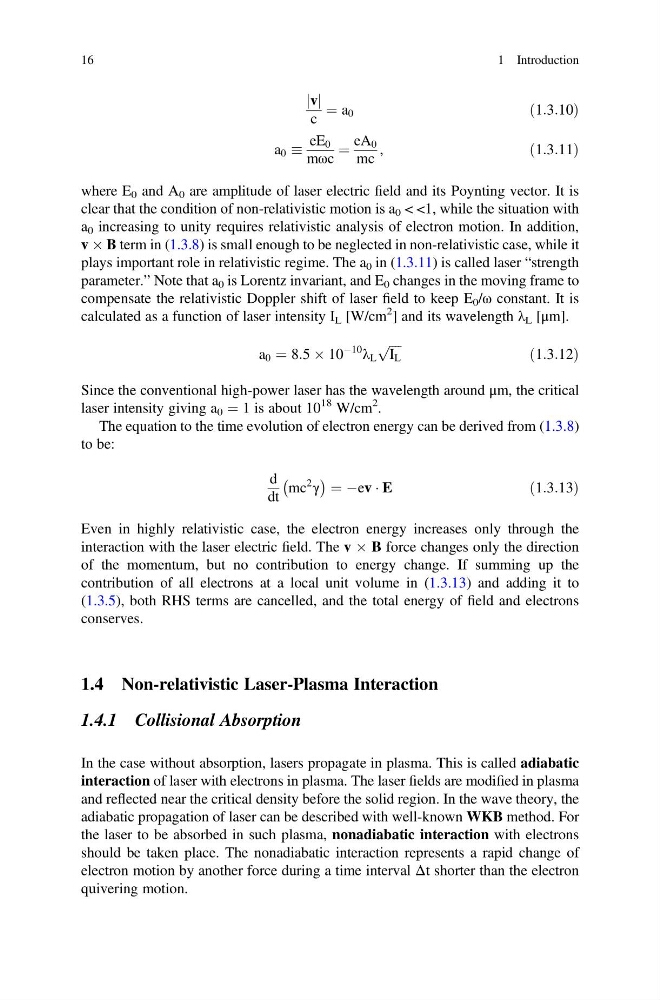
where E 0 and A 0 are amplitude of laser electric field and its Poynting vector. It is
clear that the condition of non-relativistic motion is a 0 < <1, while the situation with
a 0 increasing to unity requires relativistic analysis of electron motion. In addition,
v  B term in (1.3.8) is small enough to be neglected in non-relativistic case, while it
plays important role in relativistic regime. The a 0 in (1.3.11) is called laser “strength
parameter.” Note that a 0 is Lorentz invariant, and E 0 changes in the moving frame to
compensate the relativistic Doppler shift of laser field to keep E 0 /ω constant. It is
calculated as a function of laser intensity I L [W/cm
2 ] and its wavelength λ L [μm].
a 0 ¼ 8:5 Â 10
À10
λ L
ffiffiffiffi
I L
p
ð1:3:12Þ
Since the conventional high-power laser has the wavelength around μm, the critical
laser intensity giving a 0 ¼ 1 is about 10
18 W/cm
2 .
The equation to the time evolution of electron energy can be derived from (1.3.8)
to be:
d
dt
mc
2
γ
À
Á ¼ Àev Á E
ð1:3:13Þ
Even in highly relativistic case, the electron energy increases only through the
interaction with the laser electric field. The v  B force changes only the direction
of the momentum, but no contribution to energy change. If summing up the
contribution of all electrons at a local unit volume in (1.3.13) and adding it to
(1.3.5), both RHS terms are cancelled, and the total energy of field and electrons
conserves.
1.4 Non-relativistic Laser-Plasma Interaction
1.4.1 Collisional Absorption
In the case without absorption, lasers propagate in plasma. This is called adiabatic
interaction of laser with electrons in plasma. The laser fields are modified in plasma
and reflected near the critical density before the solid region. In the wave theory, the
adiabatic propagation of laser can be described with well-known WKB method. For
the laser to be absorbed in such plasma, nonadiabatic interaction with electrons
should be taken place. The nonadiabatic interaction represents a rapid change of
electron motion by another force during a time interval Δt shorter than the electron
quivering motion.
16
1 Introduction
j j
c
¼ a 0
ð1:3:10Þ
a 0
eE 0
mωc
¼
eA 0
mc
,
ð1:3:11Þ
where E 0 and A 0 are amplitude of laser electric field and its Poynting vector. It is
clear that the condition of non-relativistic motion is a 0 < <1, while the situation with
a 0 increasing to unity requires relativistic analysis of electron motion. In addition,
v  B term in (1.3.8) is small enough to be neglected in non-relativistic case, while it
plays important role in relativistic regime. The a 0 in (1.3.11) is called laser “strength
parameter.” Note that a 0 is Lorentz invariant, and E 0 changes in the moving frame to
compensate the relativistic Doppler shift of laser field to keep E 0 /ω constant. It is
calculated as a function of laser intensity I L [W/cm
2 ] and its wavelength λ L [μm].
a 0 ¼ 8:5 Â 10
À10
λ L
ffiffiffiffi
I L
p
ð1:3:12Þ
Since the conventional high-power laser has the wavelength around μm, the critical
laser intensity giving a 0 ¼ 1 is about 10
18 W/cm
2 .
The equation to the time evolution of electron energy can be derived from (1.3.8)
to be:
d
dt
mc
2
γ
À
Á ¼ Àev Á E
ð1:3:13Þ
Even in highly relativistic case, the electron energy increases only through the
interaction with the laser electric field. The v  B force changes only the direction
of the momentum, but no contribution to energy change. If summing up the
contribution of all electrons at a local unit volume in (1.3.13) and adding it to
(1.3.5), both RHS terms are cancelled, and the total energy of field and electrons
conserves.
1.4 Non-relativistic Laser-Plasma Interaction
1.4.1 Collisional Absorption
In the case without absorption, lasers propagate in plasma. This is called adiabatic
interaction of laser with electrons in plasma. The laser fields are modified in plasma
and reflected near the critical density before the solid region. In the wave theory, the
adiabatic propagation of laser can be described with well-known WKB method. For
the laser to be absorbed in such plasma, nonadiabatic interaction with electrons
should be taken place. The nonadiabatic interaction represents a rapid change of
electron motion by another force during a time interval Δt shorter than the electron
quivering motion.
16
1 Introduction