

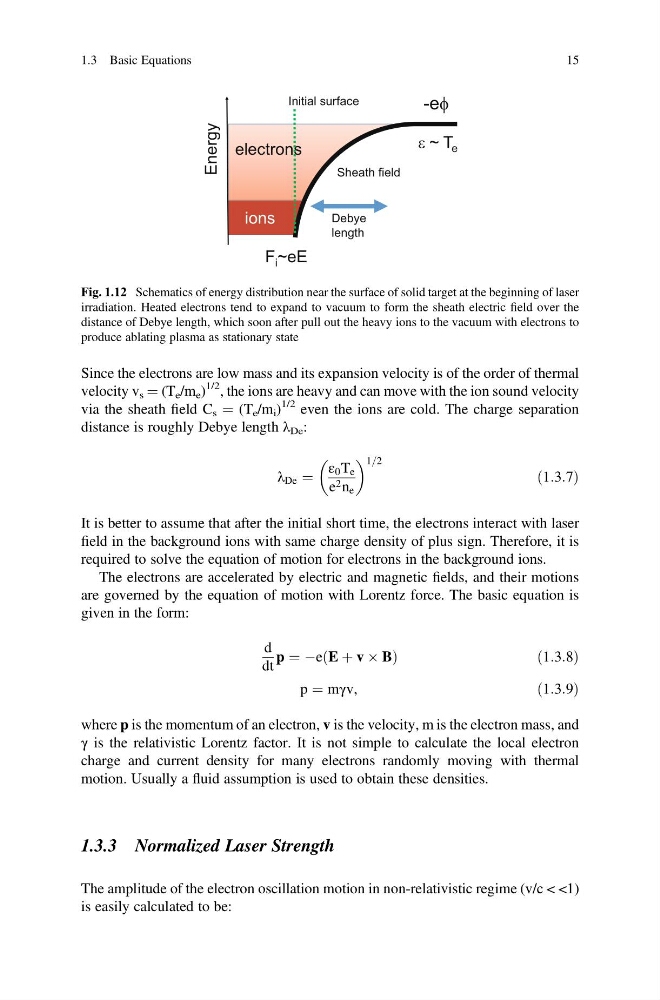
Since the electrons are low mass and its expansion velocity is of the order of thermal
velocity v s ¼ (T e /m e )
1/2 , the ions are heavy and can move with the ion sound velocity
via the sheath field C s ¼ (T e /m i )
1/2 even the ions are cold. The charge separation
distance is roughly Debye length λ De :
λ De ¼
ε 0 T e
e 2 n e
1=2
ð1:3:7Þ
It is better to assume that after the initial short time, the electrons interact with laser
field in the background ions with same charge density of plus sign. Therefore, it is
required to solve the equation of motion for electrons in the background ions.
The electrons are accelerated by electric and magnetic fields, and their motions
are governed by the equation of motion with Lorentz force. The basic equation is
given in the form:
d
dt
p ¼ Àe E þ v  B
ð
Þ
ð 1:3:8Þ
p ¼ mγv,
ð1:3:9Þ
where p is the momentum of an electron, v is the velocity, m is the electron mass, and
γ is the relativistic Lorentz factor. It is not simple to calculate the local electron
charge and current density for many electrons randomly moving with thermal
motion. Usually a fluid assumption is used to obtain these densities.
1.3.3 Normalized Laser Strength
The amplitude of the electron oscillation motion in non-relativistic regime (v/c < <1)
is easily calculated to be:
Energy
e ~ T e
ions
electrons
Debye
length
F i ~eE
Sheath field
Initial surface
-ef
Fig. 1.12 Schematics of energy distribution near the surface of solid target at the beginning of laser
irradiation. Heated electrons tend to expand to vacuum to form the sheath electric field over the
distance of Debye length, which soon after pull out the heavy ions to the vacuum with electrons to
produce ablating plasma as stationary state
1.3 Basic Equations
15
velocity v s ¼ (T e /m e )
1/2 , the ions are heavy and can move with the ion sound velocity
via the sheath field C s ¼ (T e /m i )
1/2 even the ions are cold. The charge separation
distance is roughly Debye length λ De :
λ De ¼
ε 0 T e
e 2 n e
1=2
ð1:3:7Þ
It is better to assume that after the initial short time, the electrons interact with laser
field in the background ions with same charge density of plus sign. Therefore, it is
required to solve the equation of motion for electrons in the background ions.
The electrons are accelerated by electric and magnetic fields, and their motions
are governed by the equation of motion with Lorentz force. The basic equation is
given in the form:
d
dt
p ¼ Àe E þ v  B
ð
Þ
ð 1:3:8Þ
p ¼ mγv,
ð1:3:9Þ
where p is the momentum of an electron, v is the velocity, m is the electron mass, and
γ is the relativistic Lorentz factor. It is not simple to calculate the local electron
charge and current density for many electrons randomly moving with thermal
motion. Usually a fluid assumption is used to obtain these densities.
1.3.3 Normalized Laser Strength
The amplitude of the electron oscillation motion in non-relativistic regime (v/c < <1)
is easily calculated to be:
Energy
e ~ T e
ions
electrons
Debye
length
F i ~eE
Sheath field
Initial surface
-ef
Fig. 1.12 Schematics of energy distribution near the surface of solid target at the beginning of laser
irradiation. Heated electrons tend to expand to vacuum to form the sheath electric field over the
distance of Debye length, which soon after pull out the heavy ions to the vacuum with electrons to
produce ablating plasma as stationary state
1.3 Basic Equations
15