

expected for the condition that oscillating laser field E and j are in 90 degree phase
deference. In such a case, the plasma is called reactive (lossless). If the current
induced by E has some phase difference from 90 degree, the plasma is resistive
(lossy) or active (source) resulting net energy transfer between the field and matter.
In the present book, the laser intensity which is equal to the absolute value of the
Poynting vector S is expressed as I L in the unit of [W/cm
2 ]. This unit is mixture of SI
and cgs, while we use “cm” for the unit of length according to the custom in laser
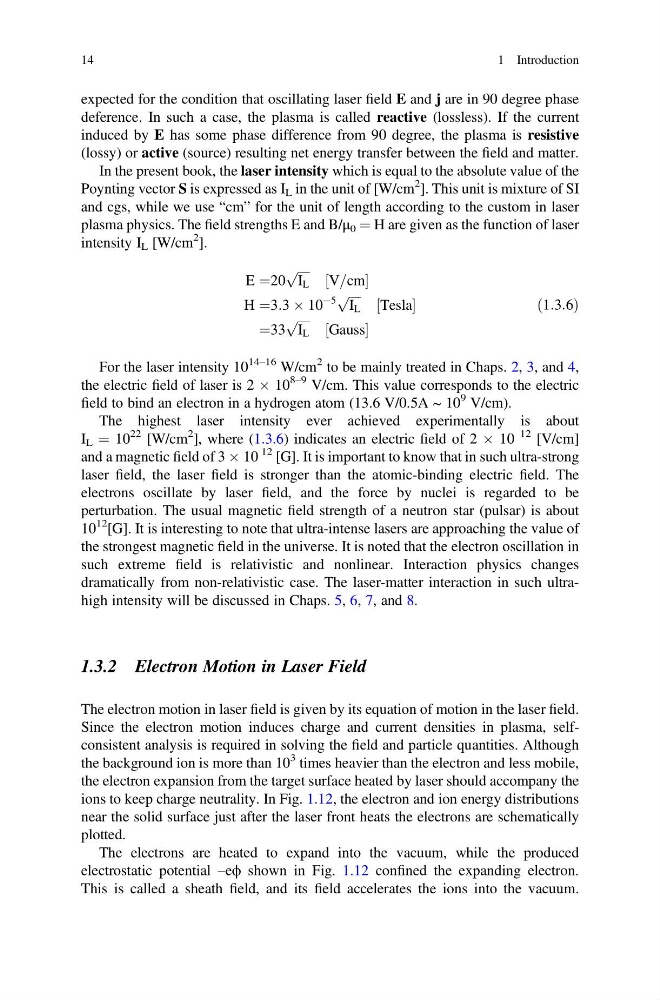
plasma physics. The field strengths E and B/μ 0 ¼ H are given as the function of laser
intensity I L [W/cm
2 ].
E ¼20
ffiffiffiffi
I L
p
V=cm
½
H ¼3:3 Â 10
À5
ffiffiffiffi
I L
p
Tesla
½
¼33
ffiffiffiffi
I L
p
Gauss
½
ð1:3:6Þ
For the laser intensity 10
14–16 W/cm
2 to be mainly treated in Chaps. 2, 3, and 4,
the electric field of laser is 2 Â 10
8–9 V/cm. This value corresponds to the electric
field to bind an electron in a hydrogen atom (13.6 V/0.5A ~ 10
9 V/cm).
The highest laser intensity ever achieved experimentally is about
I L ¼ 10
22 [W/cm
2 ], where (1.3.6) indicates an electric field of 2 Â 10
12 [V/cm]
and a magnetic field of 3 Â 10
12 [G]. It is important to know that in such ultra-strong
laser field, the laser field is stronger than the atomic-binding electric field. The
electrons oscillate by laser field, and the force by nuclei is regarded to be
perturbation. The usual magnetic field strength of a neutron star (pulsar) is about
10
12 [G]. It is interesting to note that ultra-intense lasers are approaching the value of
the strongest magnetic field in the universe. It is noted that the electron oscillation in
such extreme field is relativistic and nonlinear. Interaction physics changes
dramatically from non-relativistic case. The laser-matter interaction in such ultrahigh intensity will be discussed in Chaps. 5, 6, 7, and 8.
1.3.2 Electron Motion in Laser Field
The electron motion in laser field is given by its equation of motion in the laser field.
Since the electron motion induces charge and current densities in plasma, selfconsistent analysis is required in solving the field and particle quantities. Although
the background ion is more than 10
3 times heavier than the electron and less mobile,
the electron expansion from the target surface heated by laser should accompany the
ions to keep charge neutrality. In Fig. 1.12, the electron and ion energy distributions
near the solid surface just after the laser front heats the electrons are schematically
plotted.
The electrons are heated to expand into the vacuum, while the produced
electrostatic potential –eϕ shown in Fig. 1.12 confined the expanding electron.
This is called a sheath field, and its field accelerates the ions into the vacuum.
14
1 Introduction
deference. In such a case, the plasma is called reactive (lossless). If the current
induced by E has some phase difference from 90 degree, the plasma is resistive
(lossy) or active (source) resulting net energy transfer between the field and matter.
In the present book, the laser intensity which is equal to the absolute value of the
Poynting vector S is expressed as I L in the unit of [W/cm
2 ]. This unit is mixture of SI
and cgs, while we use “cm” for the unit of length according to the custom in laser
plasma physics. The field strengths E and B/μ 0 ¼ H are given as the function of laser
intensity I L [W/cm
2 ].
E ¼20
ffiffiffiffi
I L
p
V=cm
½
H ¼3:3 Â 10
À5
ffiffiffiffi
I L
p
Tesla
½
¼33
ffiffiffiffi
I L
p
Gauss
½
ð1:3:6Þ
For the laser intensity 10
14–16 W/cm
2 to be mainly treated in Chaps. 2, 3, and 4,
the electric field of laser is 2 Â 10
8–9 V/cm. This value corresponds to the electric
field to bind an electron in a hydrogen atom (13.6 V/0.5A ~ 10
9 V/cm).
The highest laser intensity ever achieved experimentally is about
I L ¼ 10
22 [W/cm
2 ], where (1.3.6) indicates an electric field of 2 Â 10
12 [V/cm]
and a magnetic field of 3 Â 10
12 [G]. It is important to know that in such ultra-strong
laser field, the laser field is stronger than the atomic-binding electric field. The
electrons oscillate by laser field, and the force by nuclei is regarded to be
perturbation. The usual magnetic field strength of a neutron star (pulsar) is about
10
12 [G]. It is interesting to note that ultra-intense lasers are approaching the value of
the strongest magnetic field in the universe. It is noted that the electron oscillation in
such extreme field is relativistic and nonlinear. Interaction physics changes
dramatically from non-relativistic case. The laser-matter interaction in such ultrahigh intensity will be discussed in Chaps. 5, 6, 7, and 8.
1.3.2 Electron Motion in Laser Field
The electron motion in laser field is given by its equation of motion in the laser field.
Since the electron motion induces charge and current densities in plasma, selfconsistent analysis is required in solving the field and particle quantities. Although
the background ion is more than 10
3 times heavier than the electron and less mobile,
the electron expansion from the target surface heated by laser should accompany the
ions to keep charge neutrality. In Fig. 1.12, the electron and ion energy distributions
near the solid surface just after the laser front heats the electrons are schematically
plotted.
The electrons are heated to expand into the vacuum, while the produced
electrostatic potential –eϕ shown in Fig. 1.12 confined the expanding electron.
This is called a sheath field, and its field accelerates the ions into the vacuum.
14
1 Introduction