

1.3 Basic Equations
The intense lasers irradiate a variety of solid materials located in a vacuum chamber.
The molecules or atoms are ionized by multiphoton absorption during the time scale
of femtosecond (fs) or less, where fs ¼ 10
À15 s. The dynamics of such nonlinear
atom-laser interaction cannot be solved by the standard perturbation method. The
physics is well studied by solving time dependent Schrodinger equation (TDSE)
in multidimensional space. Such computational result and experimental results with
intense lasers have verified the model equations of ionization rate by field ionization
via tunneling effect. Theoretical work has been developed for the case where the
ionization time is shorted than the laser oscillation period. These topics are briefly
discussed in Chap. 2.
1.3.1 Maxwell Equations
The subsequent intense laser photons, therefore, interact with the free electrons
produced after the ionization. For the case of ns pulse, laser interacts with the
expanding plasma with the density lower than the cut-off density (n e ~ 10
21 cm
À3 ),
about 100 times less density than the solid. Electric and magnetic fields of laser are
governed by Maxwell equation. In the present book, MKS unit is employed. The
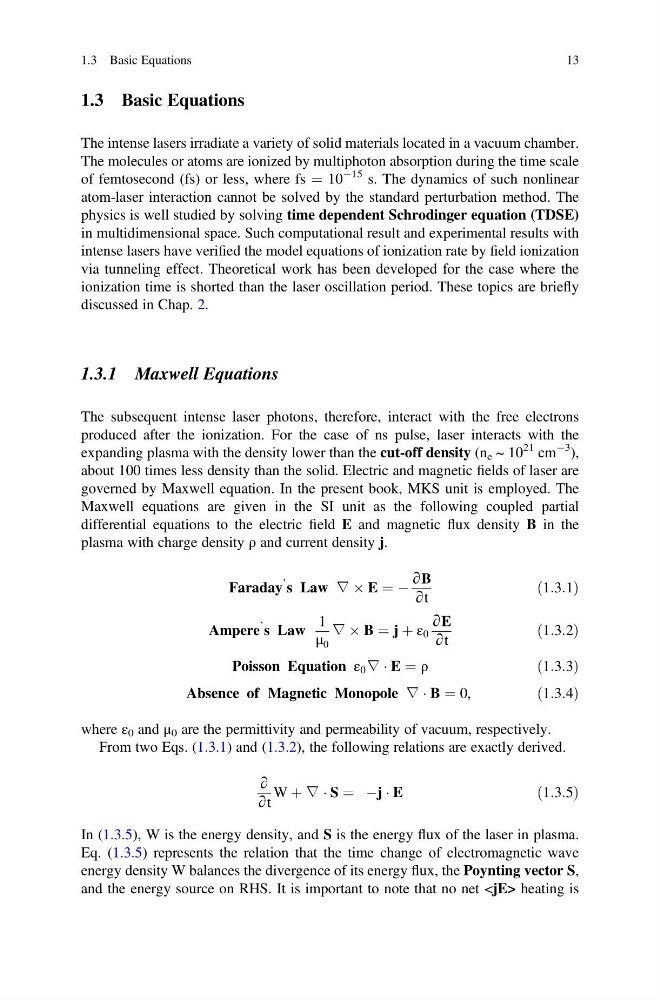
Maxwell equations are given in the SI unit as the following coupled partial
differential equations to the electric field E and magnetic flux density B in the
plasma with charge density ρ and current density j.
Faraday
’ s Law ∇ Â E ¼ À
∂B
∂t
ð1:3:1Þ
Ampere
’ s Law
1
μ 0
∇ Â B ¼ j þ ε 0
∂E
∂t
ð1:3:2Þ
Poisson Equation ε 0 ∇ Á E ¼ ρ
ð1:3:3Þ
Absence of Magnetic Monopole ∇ Á B ¼ 0,
ð1:3:4Þ
where ε 0 and μ 0 are the permittivity and permeability of vacuum, respectively.
From two Eqs. (1.3.1) and (1.3.2), the following relations are exactly derived.
∂
∂t
W þ ∇ Á S ¼ Àj Á E
ð1:3:5Þ
In (1.3.5), W is the energy density, and S is the energy flux of the laser in plasma.
Eq. (1.3.5) represents the relation that the time change of electromagnetic wave
energy density W balances the divergence of its energy flux, the Poynting vector S,
and the energy source on RHS. It is important to note that no net heating is
1.3 Basic Equations
13
The intense lasers irradiate a variety of solid materials located in a vacuum chamber.
The molecules or atoms are ionized by multiphoton absorption during the time scale
of femtosecond (fs) or less, where fs ¼ 10
À15 s. The dynamics of such nonlinear
atom-laser interaction cannot be solved by the standard perturbation method. The
physics is well studied by solving time dependent Schrodinger equation (TDSE)
in multidimensional space. Such computational result and experimental results with
intense lasers have verified the model equations of ionization rate by field ionization
via tunneling effect. Theoretical work has been developed for the case where the
ionization time is shorted than the laser oscillation period. These topics are briefly
discussed in Chap. 2.
1.3.1 Maxwell Equations
The subsequent intense laser photons, therefore, interact with the free electrons
produced after the ionization. For the case of ns pulse, laser interacts with the
expanding plasma with the density lower than the cut-off density (n e ~ 10
21 cm
À3 ),
about 100 times less density than the solid. Electric and magnetic fields of laser are
governed by Maxwell equation. In the present book, MKS unit is employed. The
Maxwell equations are given in the SI unit as the following coupled partial
differential equations to the electric field E and magnetic flux density B in the
plasma with charge density ρ and current density j.
Faraday
’ s Law ∇ Â E ¼ À
∂B
∂t
ð1:3:1Þ
Ampere
’ s Law
1
μ 0
∇ Â B ¼ j þ ε 0
∂E
∂t
ð1:3:2Þ
Poisson Equation ε 0 ∇ Á E ¼ ρ
ð1:3:3Þ
Absence of Magnetic Monopole ∇ Á B ¼ 0,
ð1:3:4Þ
where ε 0 and μ 0 are the permittivity and permeability of vacuum, respectively.
From two Eqs. (1.3.1) and (1.3.2), the following relations are exactly derived.
∂
∂t
W þ ∇ Á S ¼ Àj Á E
ð1:3:5Þ
In (1.3.5), W is the energy density, and S is the energy flux of the laser in plasma.
Eq. (1.3.5) represents the relation that the time change of electromagnetic wave
energy density W balances the divergence of its energy flux, the Poynting vector S,
and the energy source on RHS. It is important to note that no net
1.3 Basic Equations
13