

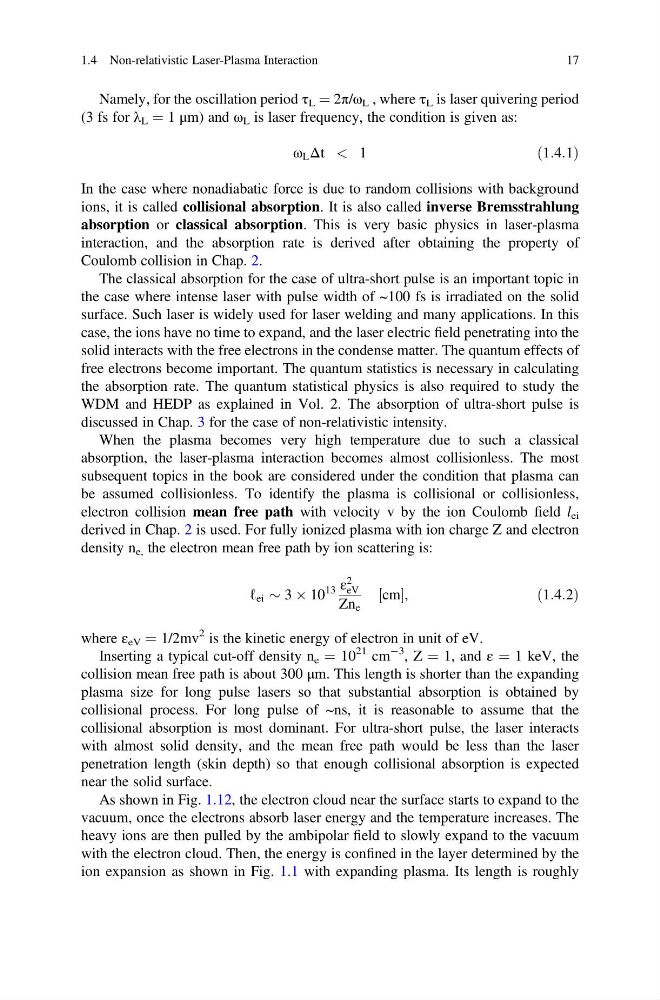
Namely, for the oscillation period τ L ¼ 2π/ω L , where τ L is laser quivering period
(3 fs for λ L ¼ 1 μm) and ω L is laser frequency, the condition is given as:
ω L Δt < 1
ð1:4:1Þ
In the case where nonadiabatic force is due to random collisions with background
ions, it is called collisional absorption. It is also called inverse Bremsstrahlung
absorption or classical absorption. This is very basic physics in laser-plasma
interaction, and the absorption rate is derived after obtaining the property of
Coulomb collision in Chap. 2.
The classical absorption for the case of ultra-short pulse is an important topic in
the case where intense laser with pulse width of ~100 fs is irradiated on the solid
surface. Such laser is widely used for laser welding and many applications. In this
case, the ions have no time to expand, and the laser electric field penetrating into the
solid interacts with the free electrons in the condense matter. The quantum effects of
free electrons become important. The quantum statistics is necessary in calculating
the absorption rate. The quantum statistical physics is also required to study the
WDM and HEDP as explained in Vol. 2. The absorption of ultra-short pulse is
discussed in Chap. 3 for the case of non-relativistic intensity.
When the plasma becomes very high temperature due to such a classical
absorption, the laser-plasma interaction becomes almost collisionless. The most
subsequent topics in the book are considered under the condition that plasma can
be assumed collisionless. To identify the plasma is collisional or collisionless,
electron collision mean free path with velocity v by the ion Coulomb field l ei
derived in Chap. 2 is used. For fully ionized plasma with ion charge Z and electron
density n e, the electron mean free path by ion scattering is:
ℓ ei $ 3 Â 10
13 ε
2
eV
Zn e
cm
½ ,
ð1:4:2Þ
where ε eV ¼ 1/2mv
2 is the kinetic energy of electron in unit of eV.
Inserting a typical cut-off density n e ¼ 10
21 cm
À3 , Z ¼ 1, and ε ¼ 1 keV, the
collision mean free path is about 300 μm. This length is shorter than the expanding
plasma size for long pulse lasers so that substantial absorption is obtained by
collisional process. For long pulse of ~ns, it is reasonable to assume that the
collisional absorption is most dominant. For ultra-short pulse, the laser interacts
with almost solid density, and the mean free path would be less than the laser
penetration length (skin depth) so that enough collisional absorption is expected
near the solid surface.
As shown in Fig. 1.12, the electron cloud near the surface starts to expand to the
vacuum, once the electrons absorb laser energy and the temperature increases. The
heavy ions are then pulled by the ambipolar field to slowly expand to the vacuum
with the electron cloud. Then, the energy is confined in the layer determined by the
ion expansion as shown in Fig. 1.1 with expanding plasma. Its length is roughly
1.4 Non-relativistic Laser-Plasma Interaction
17
(3 fs for λ L ¼ 1 μm) and ω L is laser frequency, the condition is given as:
ω L Δt < 1
ð1:4:1Þ
In the case where nonadiabatic force is due to random collisions with background
ions, it is called collisional absorption. It is also called inverse Bremsstrahlung
absorption or classical absorption. This is very basic physics in laser-plasma
interaction, and the absorption rate is derived after obtaining the property of
Coulomb collision in Chap. 2.
The classical absorption for the case of ultra-short pulse is an important topic in
the case where intense laser with pulse width of ~100 fs is irradiated on the solid
surface. Such laser is widely used for laser welding and many applications. In this
case, the ions have no time to expand, and the laser electric field penetrating into the
solid interacts with the free electrons in the condense matter. The quantum effects of
free electrons become important. The quantum statistics is necessary in calculating
the absorption rate. The quantum statistical physics is also required to study the
WDM and HEDP as explained in Vol. 2. The absorption of ultra-short pulse is
discussed in Chap. 3 for the case of non-relativistic intensity.
When the plasma becomes very high temperature due to such a classical
absorption, the laser-plasma interaction becomes almost collisionless. The most
subsequent topics in the book are considered under the condition that plasma can
be assumed collisionless. To identify the plasma is collisional or collisionless,
electron collision mean free path with velocity v by the ion Coulomb field l ei
derived in Chap. 2 is used. For fully ionized plasma with ion charge Z and electron
density n e, the electron mean free path by ion scattering is:
ℓ ei $ 3 Â 10
13 ε
2
eV
Zn e
cm
½ ,
ð1:4:2Þ
where ε eV ¼ 1/2mv
2 is the kinetic energy of electron in unit of eV.
Inserting a typical cut-off density n e ¼ 10
21 cm
À3 , Z ¼ 1, and ε ¼ 1 keV, the
collision mean free path is about 300 μm. This length is shorter than the expanding
plasma size for long pulse lasers so that substantial absorption is obtained by
collisional process. For long pulse of ~ns, it is reasonable to assume that the
collisional absorption is most dominant. For ultra-short pulse, the laser interacts
with almost solid density, and the mean free path would be less than the laser
penetration length (skin depth) so that enough collisional absorption is expected
near the solid surface.
As shown in Fig. 1.12, the electron cloud near the surface starts to expand to the
vacuum, once the electrons absorb laser energy and the temperature increases. The
heavy ions are then pulled by the ambipolar field to slowly expand to the vacuum
with the electron cloud. Then, the energy is confined in the layer determined by the
ion expansion as shown in Fig. 1.1 with expanding plasma. Its length is roughly
1.4 Non-relativistic Laser-Plasma Interaction
17