

8.6.1 Hot Electrons by Femtosecond Lasers
1D and 2D PIC simulations have been carried out to clarify the electron heating
process when relativistic laser is irradiated on the solid surface [9]. The effect of the
standing wave by the reflected component is also paid attention. The laser is usually
assumed to be a plane wave incidenting to the solid surface in the normal direction.
In order to resolve the spatial profile in computation, 630 cells per wavelength are
used which corresponds to 10 cells per skin depth.
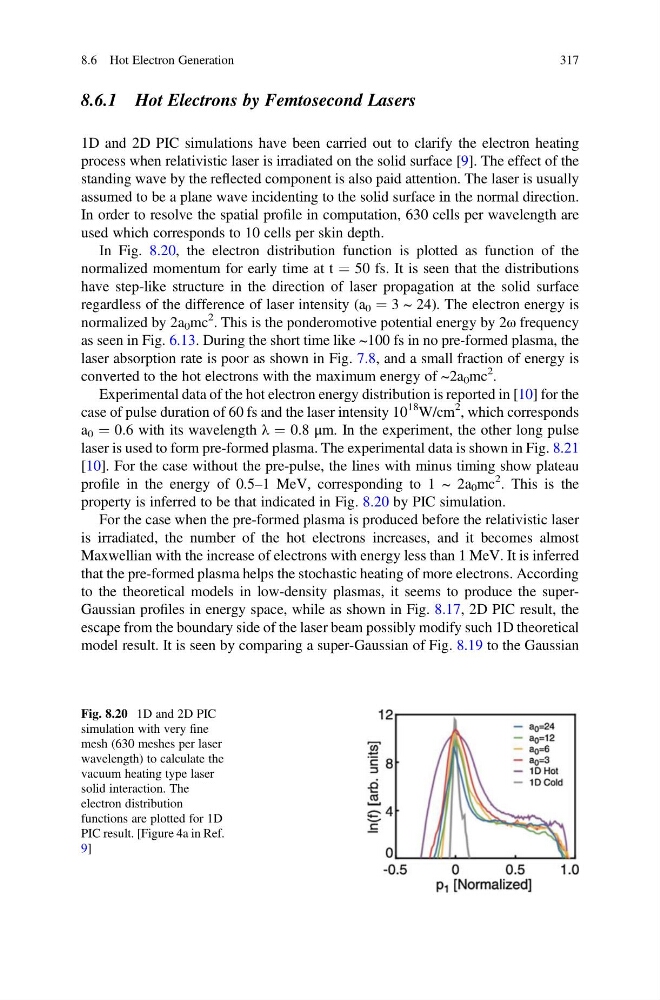
In Fig. 8.20, the electron distribution function is plotted as function of the
normalized momentum for early time at t ¼ 50 fs. It is seen that the distributions
have step-like structure in the direction of laser propagation at the solid surface
regardless of the difference of laser intensity (a 0 ¼ 3 ~ 24). The electron energy is
normalized by 2a 0 mc
2 . This is the ponderomotive potential energy by 2ω frequency
as seen in Fig. 6.13. During the short time like ~100 fs in no pre-formed plasma, the
laser absorption rate is poor as shown in Fig. 7.8, and a small fraction of energy is
converted to the hot electrons with the maximum energy of ~2a 0 mc
2 .
Experimental data of the hot electron energy distribution is reported in [10] for the
case of pulse duration of 60 fs and the laser intensity 10
18 W/cm
2
, which corresponds
a 0 ¼ 0.6 with its wavelength λ ¼ 0.8 μm. In the experiment, the other long pulse
laser is used to form pre-formed plasma. The experimental data is shown in Fig. 8.21
[10]. For the case without the pre-pulse, the lines with minus timing show plateau
profile in the energy of 0.5–1 MeV, corresponding to 1 ~ 2a 0 mc
2 . This is the
property is inferred to be that indicated in Fig. 8.20 by PIC simulation.
For the case when the pre-formed plasma is produced before the relativistic laser
is irradiated, the number of the hot electrons increases, and it becomes almost
Maxwellian with the increase of electrons with energy less than 1 MeV. It is inferred
that the pre-formed plasma helps the stochastic heating of more electrons. According
to the theoretical models in low-density plasmas, it seems to produce the superGaussian profiles in energy space, while as shown in Fig. 8.17, 2D PIC result, the
escape from the boundary side of the laser beam possibly modify such 1D theoretical
model result. It is seen by comparing a super-Gaussian of Fig. 8.19 to the Gaussian
Fig. 8.20 1D and 2D PIC
simulation with very fine
mesh (630 meshes per laser
wavelength) to calculate the
vacuum heating type laser
solid interaction. The
electron distribution
functions are plotted for 1D
PIC result. [Figure 4a in Ref.
9]
8.6 Hot Electron Generation
317
1D and 2D PIC simulations have been carried out to clarify the electron heating
process when relativistic laser is irradiated on the solid surface [9]. The effect of the
standing wave by the reflected component is also paid attention. The laser is usually
assumed to be a plane wave incidenting to the solid surface in the normal direction.
In order to resolve the spatial profile in computation, 630 cells per wavelength are
used which corresponds to 10 cells per skin depth.
In Fig. 8.20, the electron distribution function is plotted as function of the
normalized momentum for early time at t ¼ 50 fs. It is seen that the distributions
have step-like structure in the direction of laser propagation at the solid surface
regardless of the difference of laser intensity (a 0 ¼ 3 ~ 24). The electron energy is
normalized by 2a 0 mc
2 . This is the ponderomotive potential energy by 2ω frequency
as seen in Fig. 6.13. During the short time like ~100 fs in no pre-formed plasma, the
laser absorption rate is poor as shown in Fig. 7.8, and a small fraction of energy is
converted to the hot electrons with the maximum energy of ~2a 0 mc
2 .
Experimental data of the hot electron energy distribution is reported in [10] for the
case of pulse duration of 60 fs and the laser intensity 10
18 W/cm
2
, which corresponds
a 0 ¼ 0.6 with its wavelength λ ¼ 0.8 μm. In the experiment, the other long pulse
laser is used to form pre-formed plasma. The experimental data is shown in Fig. 8.21
[10]. For the case without the pre-pulse, the lines with minus timing show plateau
profile in the energy of 0.5–1 MeV, corresponding to 1 ~ 2a 0 mc
2 . This is the
property is inferred to be that indicated in Fig. 8.20 by PIC simulation.
For the case when the pre-formed plasma is produced before the relativistic laser
is irradiated, the number of the hot electrons increases, and it becomes almost
Maxwellian with the increase of electrons with energy less than 1 MeV. It is inferred
that the pre-formed plasma helps the stochastic heating of more electrons. According
to the theoretical models in low-density plasmas, it seems to produce the superGaussian profiles in energy space, while as shown in Fig. 8.17, 2D PIC result, the
escape from the boundary side of the laser beam possibly modify such 1D theoretical
model result. It is seen by comparing a super-Gaussian of Fig. 8.19 to the Gaussian
Fig. 8.20 1D and 2D PIC
simulation with very fine
mesh (630 meshes per laser
wavelength) to calculate the
vacuum heating type laser
solid interaction. The
electron distribution
functions are plotted for 1D
PIC result. [Figure 4a in Ref.
9]
8.6 Hot Electron Generation
317