

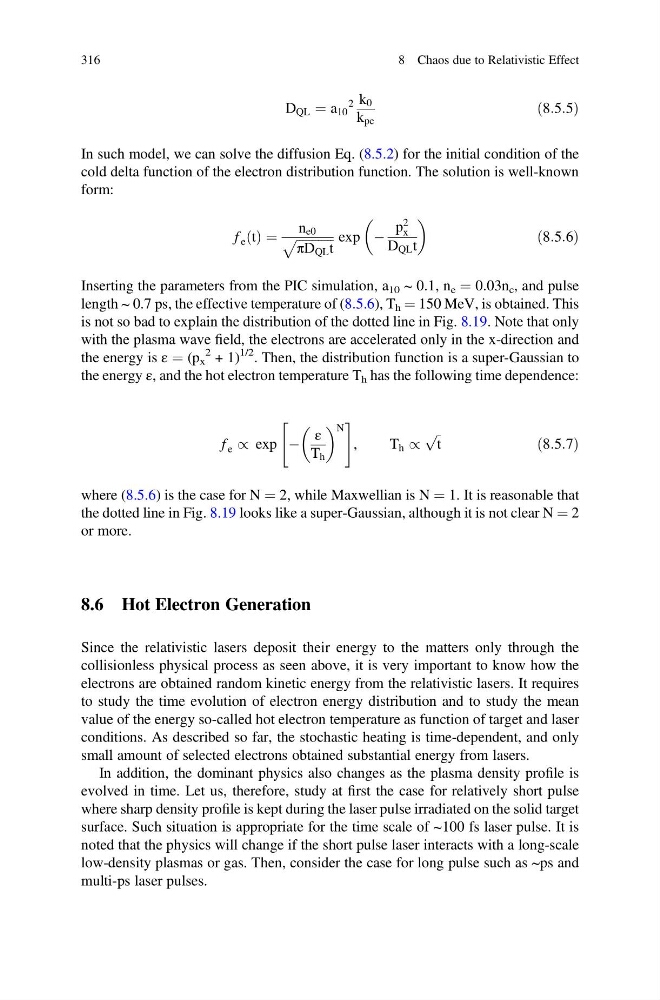
D QL ¼ a 10
2 k 0
k pe
ð8:5:5Þ
In such model, we can solve the diffusion Eq. (8.5.2) for the initial condition of the
cold delta function of the electron distribution function. The solution is well-known
form:
f e t
ð Þ ¼
n e0
ffiffiffiffiffiffiffiffiffiffiffiffi
πD QL t
p
exp À
p
2
x
D QL t
ð8:5:6Þ
Inserting the parameters from the PIC simulation, a 10 ~ 0.1, n e ¼ 0.03n c , and pulse
length ~ 0.7 ps, the effective temperature of (8.5.6), T h ¼ 150 MeV, is obtained. This
is not so bad to explain the distribution of the dotted line in Fig. 8.19. Note that only
with the plasma wave field, the electrons are accelerated only in the x-direction and
the energy is ε ¼ (p x
2 + 1)
1/2 . Then, the distribution function is a super-Gaussian to
the energy ε, and the hot electron temperature T h has the following time dependence:
f e / exp À
ε
T h
N
"
#
,
T h /
ffi ffi
t
p
ð8:5:7Þ
where (8.5.6) is the case for N ¼ 2, while Maxwellian is N ¼ 1. It is reasonable that
the dotted line in Fig. 8.19 looks like a super-Gaussian, although it is not clear N ¼ 2
or more.
8.6 Hot Electron Generation
Since the relativistic lasers deposit their energy to the matters only through the
collisionless physical process as seen above, it is very important to know how the
electrons are obtained random kinetic energy from the relativistic lasers. It requires
to study the time evolution of electron energy distribution and to study the mean
value of the energy so-called hot electron temperature as function of target and laser
conditions. As described so far, the stochastic heating is time-dependent, and only
small amount of selected electrons obtained substantial energy from lasers.
In addition, the dominant physics also changes as the plasma density profile is
evolved in time. Let us, therefore, study at first the case for relatively short pulse
where sharp density profile is kept during the laser pulse irradiated on the solid target
surface. Such situation is appropriate for the time scale of ~100 fs laser pulse. It is
noted that the physics will change if the short pulse laser interacts with a long-scale
low-density plasmas or gas. Then, consider the case for long pulse such as ~ps and
multi-ps laser pulses.
316
8 Chaos due to Relativistic Effect
2 k 0
k pe
ð8:5:5Þ
In such model, we can solve the diffusion Eq. (8.5.2) for the initial condition of the
cold delta function of the electron distribution function. The solution is well-known
form:
f e t
ð Þ ¼
n e0
ffiffiffiffiffiffiffiffiffiffiffiffi
πD QL t
p
exp À
p
2
x
D QL t
ð8:5:6Þ
Inserting the parameters from the PIC simulation, a 10 ~ 0.1, n e ¼ 0.03n c , and pulse
length ~ 0.7 ps, the effective temperature of (8.5.6), T h ¼ 150 MeV, is obtained. This
is not so bad to explain the distribution of the dotted line in Fig. 8.19. Note that only
with the plasma wave field, the electrons are accelerated only in the x-direction and
the energy is ε ¼ (p x
2 + 1)
1/2 . Then, the distribution function is a super-Gaussian to
the energy ε, and the hot electron temperature T h has the following time dependence:
f e / exp À
ε
T h
N
"
#
,
T h /
ffi ffi
t
p
ð8:5:7Þ
where (8.5.6) is the case for N ¼ 2, while Maxwellian is N ¼ 1. It is reasonable that
the dotted line in Fig. 8.19 looks like a super-Gaussian, although it is not clear N ¼ 2
or more.
8.6 Hot Electron Generation
Since the relativistic lasers deposit their energy to the matters only through the
collisionless physical process as seen above, it is very important to know how the
electrons are obtained random kinetic energy from the relativistic lasers. It requires
to study the time evolution of electron energy distribution and to study the mean
value of the energy so-called hot electron temperature as function of target and laser
conditions. As described so far, the stochastic heating is time-dependent, and only
small amount of selected electrons obtained substantial energy from lasers.
In addition, the dominant physics also changes as the plasma density profile is
evolved in time. Let us, therefore, study at first the case for relatively short pulse
where sharp density profile is kept during the laser pulse irradiated on the solid target
surface. Such situation is appropriate for the time scale of ~100 fs laser pulse. It is
noted that the physics will change if the short pulse laser interacts with a long-scale
low-density plasmas or gas. Then, consider the case for long pulse such as ~ps and
multi-ps laser pulses.
316
8 Chaos due to Relativistic Effect