

spectrum of Fig. 8.17, in addition, it is found that the profiles of the hot electron
energy distributions are different. It is pointed out that the difference is mainly due to
the escape of electrons in 2D PIC simulation, while it should be noted that the
distribution function looks evolving constantly to higher energy region in 1D model
calculation. This would be important to compare the electron spectrum including
geometry effect.
8.5.2 Quasi-linear Diffusion
In the case only with the turbulent plasma waves, the stochastic acceleration of
electrons is well modeled by so-called quasi-linear diffusion model to be well
explained in Volume 3. The quasi-linear model has been used in Sect. 2.6 to calculate
the classical absorption rate. It is easily extended to the case with many longitudinal
plasma waves without the effect by the laser field. In Ref. [8], the formulation is given.
There is shown that the interaction of electrons with the plasma waves can be
described as a diffusion term by use of the quasi-linear theory. The time change of
the electron distribution function by the plasma waves is formulated as
df
dt
¼
∂
∂p x
D QL
∂f
∂p x
ð8:5:2Þ
D QL ¼ π
e
m
2X
k
W k δ ω À kv x
ð
Þ
ð 8:5:3Þ
W k ¼ E k
j j
2
ð8:5:4Þ
where d is delta function showing that an electron traveling with the phase velocity
of the plasma wave obtains or gives energy to each other. In Ref. [8], the quasi-linear
diffusion coefficient D QL is obtained as
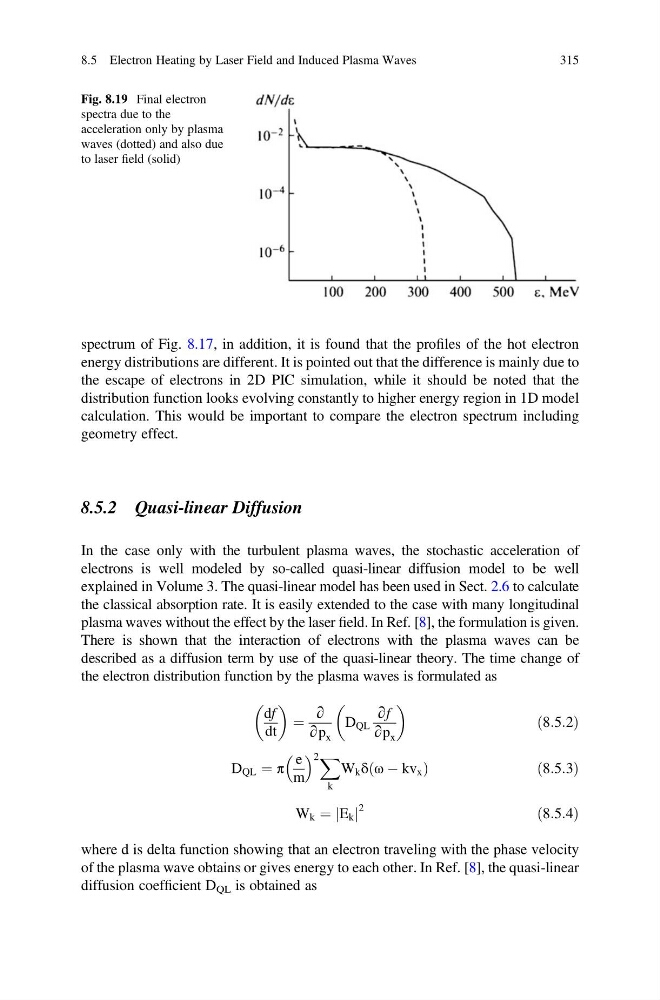
Fig. 8.19 Final electron
spectra due to the
acceleration only by plasma
waves (dotted) and also due
to laser field (solid)
8.5 Electron Heating by Laser Field and Induced Plasma Waves
315
energy distributions are different. It is pointed out that the difference is mainly due to
the escape of electrons in 2D PIC simulation, while it should be noted that the
distribution function looks evolving constantly to higher energy region in 1D model
calculation. This would be important to compare the electron spectrum including
geometry effect.
8.5.2 Quasi-linear Diffusion
In the case only with the turbulent plasma waves, the stochastic acceleration of
electrons is well modeled by so-called quasi-linear diffusion model to be well
explained in Volume 3. The quasi-linear model has been used in Sect. 2.6 to calculate
the classical absorption rate. It is easily extended to the case with many longitudinal
plasma waves without the effect by the laser field. In Ref. [8], the formulation is given.
There is shown that the interaction of electrons with the plasma waves can be
described as a diffusion term by use of the quasi-linear theory. The time change of
the electron distribution function by the plasma waves is formulated as
df
dt
¼
∂
∂p x
D QL
∂f
∂p x
ð8:5:2Þ
D QL ¼ π
e
m
2X
k
W k δ ω À kv x
ð
Þ
ð 8:5:3Þ
W k ¼ E k
j j
2
ð8:5:4Þ
where d is delta function showing that an electron traveling with the phase velocity
of the plasma wave obtains or gives energy to each other. In Ref. [8], the quasi-linear
diffusion coefficient D QL is obtained as
Fig. 8.19 Final electron
spectra due to the
acceleration only by plasma
waves (dotted) and also due
to laser field (solid)
8.5 Electron Heating by Laser Field and Induced Plasma Waves
315