

dγ
2
dt
¼ 2p y
∂a
∂t
ð8:4:14Þ
Inserting (8.2.2) to (8.4.14), the energy of electron cannot increase over long time
more than a quarter of the oscillation period. However, we can expect some selected
electrons which obtain the energy from laser field continuously, because of only luck
in random kicks to keep RHS of (8.4.14) positive.
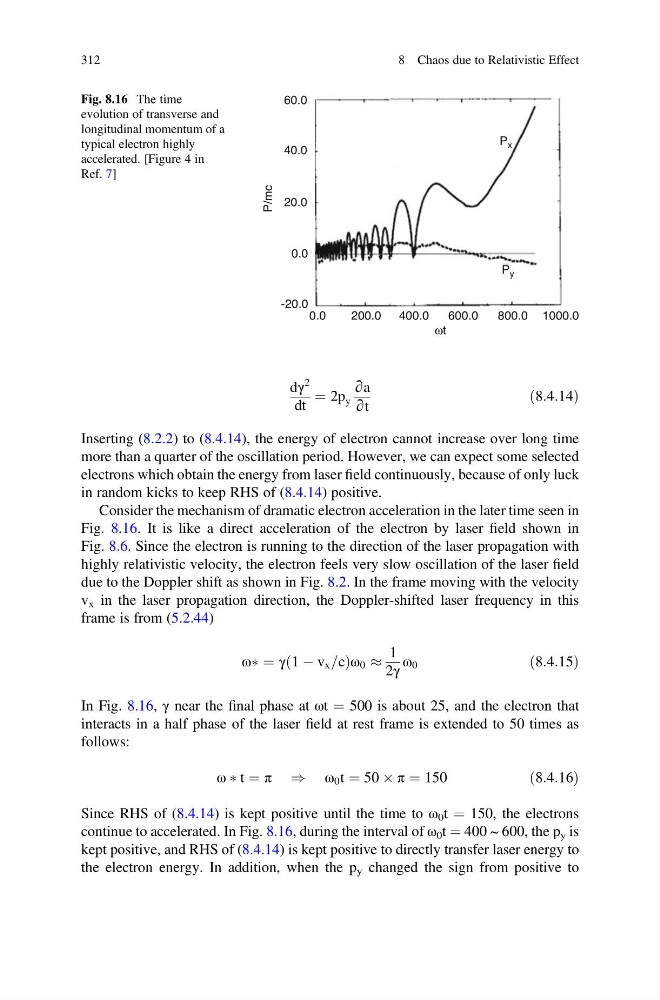
Consider the mechanism of dramatic electron acceleration in the later time seen in
Fig. 8.16. It is like a direct acceleration of the electron by laser field shown in
Fig. 8.6. Since the electron is running to the direction of the laser propagation with
highly relativistic velocity, the electron feels very slow oscillation of the laser field
due to the Doppler shift as shown in Fig. 8.2. In the frame moving with the velocity
v x in the laser propagation direction, the Doppler-shifted laser frequency in this
frame is from (5.2.44)
ωà ¼ γ 1 À v x =c
ð
Þ ω 0 %
1
2γ
ω 0
ð8:4:15Þ
In Fig. 8.16, γ near the final phase at ωt ¼ 500 is about 25, and the electron that
interacts in a half phase of the laser field at rest frame is extended to 50 times as
follows:
ω Ã t ¼ π ) ω 0 t ¼ 50 Â π ¼ 150
ð8:4:16Þ
Since RHS of (8.4.14) is kept positive until the time to ω 0 t ¼ 150, the electrons
continue to accelerated. In Fig. 8.16, during the interval of ω 0 t ¼ 400 ~ 600, the p y is
kept positive, and RHS of (8.4.14) is kept positive to directly transfer laser energy to
the electron energy. In addition, when the p y changed the sign from positive to
60.0
40.0
20.0
ωt
P x
P y
P/mc
0.0
-20.0
0.0
200.0 400.0
600.0
800.0 1000.0
Fig. 8.16 The time
evolution of transverse and
longitudinal momentum of a
typical electron highly
accelerated. [Figure 4 in
Ref. 7]
312
8 Chaos due to Relativistic Effect
2
dt
¼ 2p y
∂a
∂t
ð8:4:14Þ
Inserting (8.2.2) to (8.4.14), the energy of electron cannot increase over long time
more than a quarter of the oscillation period. However, we can expect some selected
electrons which obtain the energy from laser field continuously, because of only luck
in random kicks to keep RHS of (8.4.14) positive.
Consider the mechanism of dramatic electron acceleration in the later time seen in
Fig. 8.16. It is like a direct acceleration of the electron by laser field shown in
Fig. 8.6. Since the electron is running to the direction of the laser propagation with
highly relativistic velocity, the electron feels very slow oscillation of the laser field
due to the Doppler shift as shown in Fig. 8.2. In the frame moving with the velocity
v x in the laser propagation direction, the Doppler-shifted laser frequency in this
frame is from (5.2.44)
ωà ¼ γ 1 À v x =c
ð
Þ ω 0 %
1
2γ
ω 0
ð8:4:15Þ
In Fig. 8.16, γ near the final phase at ωt ¼ 500 is about 25, and the electron that
interacts in a half phase of the laser field at rest frame is extended to 50 times as
follows:
ω Ã t ¼ π ) ω 0 t ¼ 50 Â π ¼ 150
ð8:4:16Þ
Since RHS of (8.4.14) is kept positive until the time to ω 0 t ¼ 150, the electrons
continue to accelerated. In Fig. 8.16, during the interval of ω 0 t ¼ 400 ~ 600, the p y is
kept positive, and RHS of (8.4.14) is kept positive to directly transfer laser energy to
the electron energy. In addition, when the p y changed the sign from positive to
60.0
40.0
20.0
ωt
P x
P y
P/mc
0.0
-20.0
0.0
200.0 400.0
600.0
800.0 1000.0
Fig. 8.16 The time
evolution of transverse and
longitudinal momentum of a
typical electron highly
accelerated. [Figure 4 in
Ref. 7]
312
8 Chaos due to Relativistic Effect