

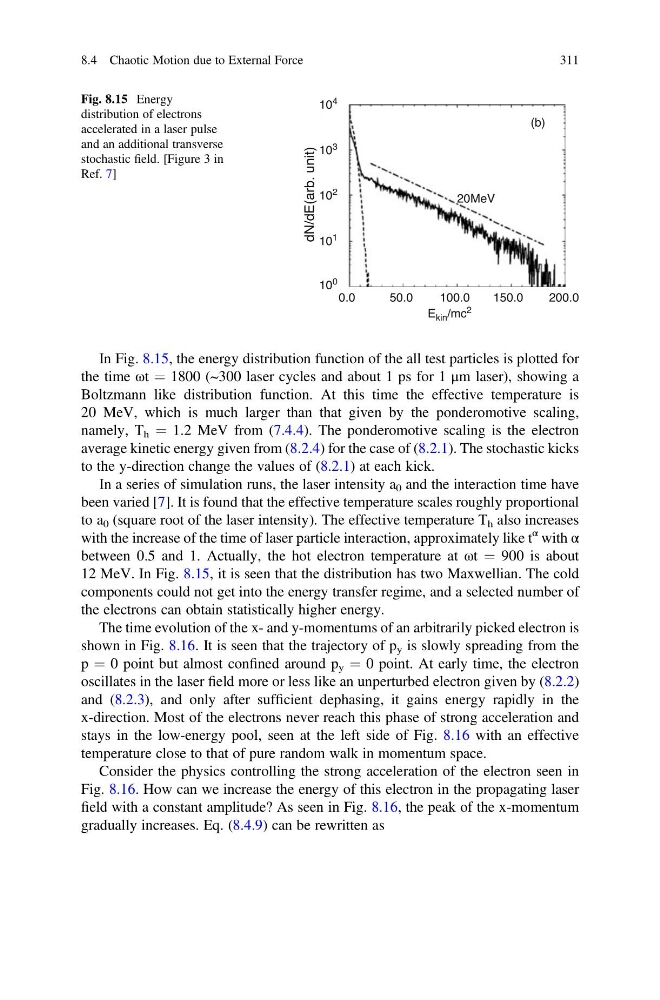
In Fig. 8.15, the energy distribution function of the all test particles is plotted for
the time ωt ¼ 1800 (~300 laser cycles and about 1 ps for 1 μm laser), showing a
Boltzmann like distribution function. At this time the effective temperature is
20 MeV, which is much larger than that given by the ponderomotive scaling,
namely, T h ¼ 1.2 MeV from (7.4.4). The ponderomotive scaling is the electron
average kinetic energy given from (8.2.4) for the case of (8.2.1). The stochastic kicks
to the y-direction change the values of (8.2.1) at each kick.
In a series of simulation runs, the laser intensity a 0 and the interaction time have
been varied [7]. It is found that the effective temperature scales roughly proportional
to a 0 (square root of the laser intensity). The effective temperature T h also increases
with the increase of the time of laser particle interaction, approximately like t
α with α
between 0.5 and 1. Actually, the hot electron temperature at ωt ¼ 900 is about
12 MeV. In Fig. 8.15, it is seen that the distribution has two Maxwellian. The cold
components could not get into the energy transfer regime, and a selected number of
the electrons can obtain statistically higher energy.
The time evolution of the x- and y-momentums of an arbitrarily picked electron is
shown in Fig. 8.16. It is seen that the trajectory of p y is slowly spreading from the
p ¼ 0 point but almost confined around p y ¼ 0 point. At early time, the electron
oscillates in the laser field more or less like an unperturbed electron given by (8.2.2)
and (8.2.3), and only after sufficient dephasing, it gains energy rapidly in the
x-direction. Most of the electrons never reach this phase of strong acceleration and
stays in the low-energy pool, seen at the left side of Fig. 8.16 with an effective
temperature close to that of pure random walk in momentum space.
Consider the physics controlling the strong acceleration of the electron seen in
Fig. 8.16. How can we increase the energy of this electron in the propagating laser
field with a constant amplitude? As seen in Fig. 8.16, the peak of the x-momentum
gradually increases. Eq. (8.4.9) can be rewritten as
10
4
10
3
10
2
10 1
10
0
0.0
50.0
100.0
150.0
20MeV
dN/dE(arb. unit)
E kin /mc
2
(b)
200.0
Fig. 8.15 Energy
distribution of electrons
accelerated in a laser pulse
and an additional transverse
stochastic field. [Figure 3 in
Ref. 7]
8.4 Chaotic Motion due to External Force
311
the time ωt ¼ 1800 (~300 laser cycles and about 1 ps for 1 μm laser), showing a
Boltzmann like distribution function. At this time the effective temperature is
20 MeV, which is much larger than that given by the ponderomotive scaling,
namely, T h ¼ 1.2 MeV from (7.4.4). The ponderomotive scaling is the electron
average kinetic energy given from (8.2.4) for the case of (8.2.1). The stochastic kicks
to the y-direction change the values of (8.2.1) at each kick.
In a series of simulation runs, the laser intensity a 0 and the interaction time have
been varied [7]. It is found that the effective temperature scales roughly proportional
to a 0 (square root of the laser intensity). The effective temperature T h also increases
with the increase of the time of laser particle interaction, approximately like t
α with α
between 0.5 and 1. Actually, the hot electron temperature at ωt ¼ 900 is about
12 MeV. In Fig. 8.15, it is seen that the distribution has two Maxwellian. The cold
components could not get into the energy transfer regime, and a selected number of
the electrons can obtain statistically higher energy.
The time evolution of the x- and y-momentums of an arbitrarily picked electron is
shown in Fig. 8.16. It is seen that the trajectory of p y is slowly spreading from the
p ¼ 0 point but almost confined around p y ¼ 0 point. At early time, the electron
oscillates in the laser field more or less like an unperturbed electron given by (8.2.2)
and (8.2.3), and only after sufficient dephasing, it gains energy rapidly in the
x-direction. Most of the electrons never reach this phase of strong acceleration and
stays in the low-energy pool, seen at the left side of Fig. 8.16 with an effective
temperature close to that of pure random walk in momentum space.
Consider the physics controlling the strong acceleration of the electron seen in
Fig. 8.16. How can we increase the energy of this electron in the propagating laser
field with a constant amplitude? As seen in Fig. 8.16, the peak of the x-momentum
gradually increases. Eq. (8.4.9) can be rewritten as
10
4
10
3
10
2
10 1
10
0
0.0
50.0
100.0
150.0
20MeV
dN/dE(arb. unit)
E kin /mc
2
(b)
200.0
Fig. 8.15 Energy
distribution of electrons
accelerated in a laser pulse
and an additional transverse
stochastic field. [Figure 3 in
Ref. 7]
8.4 Chaotic Motion due to External Force
311