

equations, it is found that the oscillating motion in y-direction induces the JxB force
in the x-direction. For the case of non-relativistic laser, the coupling of x and y
motions is negligible and no chaotic motion is expected. In addition, it is obvious
from (8.4.9) that any motion in x-direction provides energy transfer from laser to
electron and vice versa. Only some phase mismatching of electron orbit from the
laser electric field results energy transfer.
Let us treat a simple model with random momentum change in y-direction in
(8.4.7). In order for energy change by laser field, some unexpected change of β y or a
is required as clear in (8.4.9). Note that the direct energy transfer from laser to
electrons is not expected for the case with the random force only in x-direction, say
longitudinal waves. In this case, the energy transfer happens indirectly, because the
change of v x changes the phase in the laser filed ξ in (8.1.11).
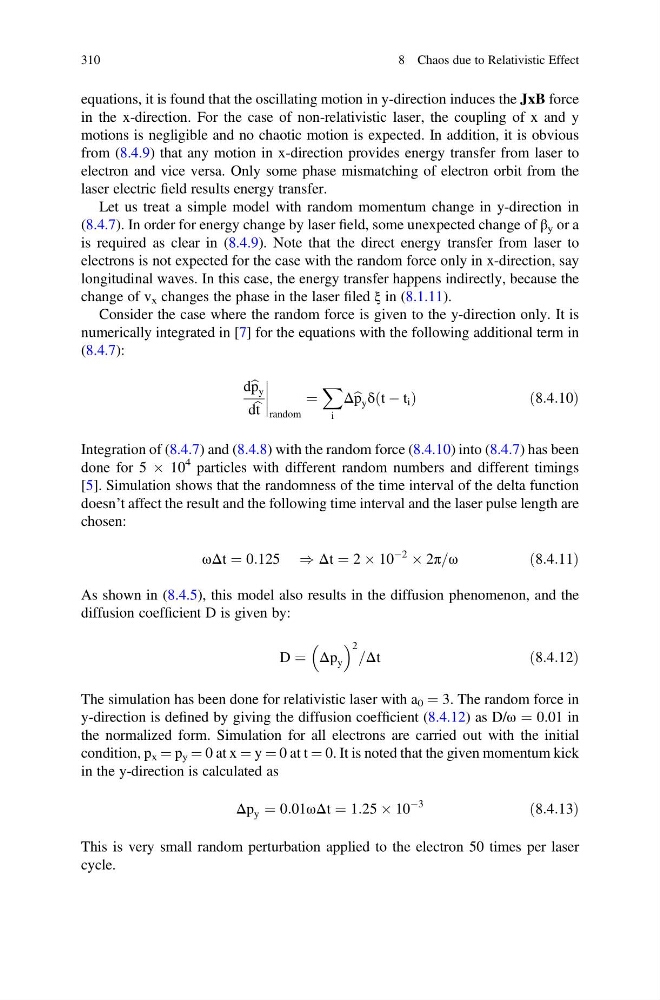
Consider the case where the random force is given to the y-direction only. It is
numerically integrated in [7] for the equations with the following additional term in
(8.4.7):
db p y
d b t
random
¼
X
i
Δb p y δ t À t i
ð
Þ
ð8:4:10Þ
Integration of (8.4.7) and (8.4.8) with the random force (8.4.10) into (8.4.7) has been
done for 5 Â 10
4 particles with different random numbers and different timings
[5]. Simulation shows that the randomness of the time interval of the delta function
doesn’t affect the result and the following time interval and the laser pulse length are
chosen:
ωΔt ¼ 0:125 ) Δt ¼ 2 Â 10
À2
 2π=ω
ð8:4:11Þ
As shown in (8.4.5), this model also results in the diffusion phenomenon, and the
diffusion coefficient D is given by:
D ¼ Δp y
2 =Δt
ð8:4:12Þ
The simulation has been done for relativistic laser with a 0 ¼ 3. The random force in
y-direction is defined by giving the diffusion coefficient (8.4.12) as D/ω ¼ 0.01 in
the normalized form. Simulation for all electrons are carried out with the initial
condition, p x ¼ p y ¼ 0 at x ¼ y ¼ 0 at t ¼ 0. It is noted that the given momentum kick
in the y-direction is calculated as
Δp y ¼ 0:01ωΔt ¼ 1:25 Â 10
À3
ð8:4:13Þ
This is very small random perturbation applied to the electron 50 times per laser
cycle.
310
8 Chaos due to Relativistic Effect
in the x-direction. For the case of non-relativistic laser, the coupling of x and y
motions is negligible and no chaotic motion is expected. In addition, it is obvious
from (8.4.9) that any motion in x-direction provides energy transfer from laser to
electron and vice versa. Only some phase mismatching of electron orbit from the
laser electric field results energy transfer.
Let us treat a simple model with random momentum change in y-direction in
(8.4.7). In order for energy change by laser field, some unexpected change of β y or a
is required as clear in (8.4.9). Note that the direct energy transfer from laser to
electrons is not expected for the case with the random force only in x-direction, say
longitudinal waves. In this case, the energy transfer happens indirectly, because the
change of v x changes the phase in the laser filed ξ in (8.1.11).
Consider the case where the random force is given to the y-direction only. It is
numerically integrated in [7] for the equations with the following additional term in
(8.4.7):
db p y
d b t
random
¼
X
i
Δb p y δ t À t i
ð
Þ
ð8:4:10Þ
Integration of (8.4.7) and (8.4.8) with the random force (8.4.10) into (8.4.7) has been
done for 5 Â 10
4 particles with different random numbers and different timings
[5]. Simulation shows that the randomness of the time interval of the delta function
doesn’t affect the result and the following time interval and the laser pulse length are
chosen:
ωΔt ¼ 0:125 ) Δt ¼ 2 Â 10
À2
 2π=ω
ð8:4:11Þ
As shown in (8.4.5), this model also results in the diffusion phenomenon, and the
diffusion coefficient D is given by:
D ¼ Δp y
2 =Δt
ð8:4:12Þ
The simulation has been done for relativistic laser with a 0 ¼ 3. The random force in
y-direction is defined by giving the diffusion coefficient (8.4.12) as D/ω ¼ 0.01 in
the normalized form. Simulation for all electrons are carried out with the initial
condition, p x ¼ p y ¼ 0 at x ¼ y ¼ 0 at t ¼ 0. It is noted that the given momentum kick
in the y-direction is calculated as
Δp y ¼ 0:01ωΔt ¼ 1:25 Â 10
À3
ð8:4:13Þ
This is very small random perturbation applied to the electron 50 times per laser
cycle.
310
8 Chaos due to Relativistic Effect