

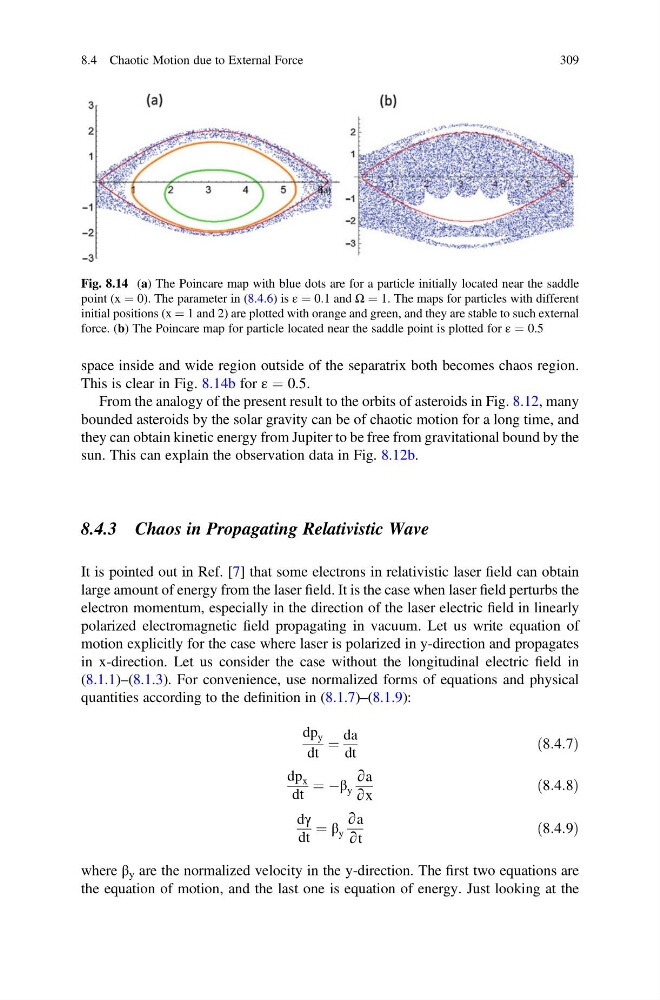
space inside and wide region outside of the separatrix both becomes chaos region.
This is clear in Fig. 8.14b for ε ¼ 0.5.
From the analogy of the present result to the orbits of asteroids in Fig. 8.12, many
bounded asteroids by the solar gravity can be of chaotic motion for a long time, and
they can obtain kinetic energy from Jupiter to be free from gravitational bound by the
sun. This can explain the observation data in Fig. 8.12b.
8.4.3 Chaos in Propagating Relativistic Wave
It is pointed out in Ref. [7] that some electrons in relativistic laser field can obtain
large amount of energy from the laser field. It is the case when laser field perturbs the
electron momentum, especially in the direction of the laser electric field in linearly
polarized electromagnetic field propagating in vacuum. Let us write equation of
motion explicitly for the case where laser is polarized in y-direction and propagates
in x-direction. Let us consider the case without the longitudinal electric field in
(8.1.1)–(8.1.3). For convenience, use normalized forms of equations and physical
quantities according to the definition in (8.1.7)–(8.1.9):
dp y
dt
¼
da
dt
ð8:4:7Þ
dp x
dt
¼ Àβ y
∂a
∂x
ð8:4:8Þ
dγ
dt
¼ β y
∂a
∂t
ð8:4:9Þ
where β y are the normalized velocity in the y-direction. The first two equations are
the equation of motion, and the last one is equation of energy. Just looking at the
Fig. 8.14 (a) The Poincare map with blue dots are for a particle initially located near the saddle
point (x ¼ 0). The parameter in (8.4.6) is ε ¼ 0.1 and Ω ¼ 1. The maps for particles with different
initial positions (x ¼ 1 and 2) are plotted with orange and green, and they are stable to such external
force. (b) The Poincare map for particle located near the saddle point is plotted for ε ¼ 0.5
8.4 Chaotic Motion due to External Force
309
This is clear in Fig. 8.14b for ε ¼ 0.5.
From the analogy of the present result to the orbits of asteroids in Fig. 8.12, many
bounded asteroids by the solar gravity can be of chaotic motion for a long time, and
they can obtain kinetic energy from Jupiter to be free from gravitational bound by the
sun. This can explain the observation data in Fig. 8.12b.
8.4.3 Chaos in Propagating Relativistic Wave
It is pointed out in Ref. [7] that some electrons in relativistic laser field can obtain
large amount of energy from the laser field. It is the case when laser field perturbs the
electron momentum, especially in the direction of the laser electric field in linearly
polarized electromagnetic field propagating in vacuum. Let us write equation of
motion explicitly for the case where laser is polarized in y-direction and propagates
in x-direction. Let us consider the case without the longitudinal electric field in
(8.1.1)–(8.1.3). For convenience, use normalized forms of equations and physical
quantities according to the definition in (8.1.7)–(8.1.9):
dp y
dt
¼
da
dt
ð8:4:7Þ
dp x
dt
¼ Àβ y
∂a
∂x
ð8:4:8Þ
dγ
dt
¼ β y
∂a
∂t
ð8:4:9Þ
where β y are the normalized velocity in the y-direction. The first two equations are
the equation of motion, and the last one is equation of energy. Just looking at the
Fig. 8.14 (a) The Poincare map with blue dots are for a particle initially located near the saddle
point (x ¼ 0). The parameter in (8.4.6) is ε ¼ 0.1 and Ω ¼ 1. The maps for particles with different
initial positions (x ¼ 1 and 2) are plotted with orange and green, and they are stable to such external
force. (b) The Poincare map for particle located near the saddle point is plotted for ε ¼ 0.5
8.4 Chaotic Motion due to External Force
309