

For simplicity, try to model this problem with the following one-dimensional
motion, where the binding by the sun is modeled with sine force and the periodic
perturbation is modeled by a periodic external force:
d
2 x
dt
2
¼ Àsinx þ εsin Ωt
ð Þ
ð8:4:6Þ
where ε and Ω are constants. When ε ¼ 0, these equations become second order, and
such system is called autonomous system, and the energy is conserved. However,
inclusion of the external force changes the property and permits chaotic solutions.
This property depends on the nonlinearity of the potential; the term sin(x) in (8.4.6).
(8.4.6) is a very simple equation, while we can find chaotic motion in general with a
finite value of ε. Assume that ε is small enough and the force is perturbation.
According to the position in the phase space, the time-integrated velocity changed
by the external force is different.
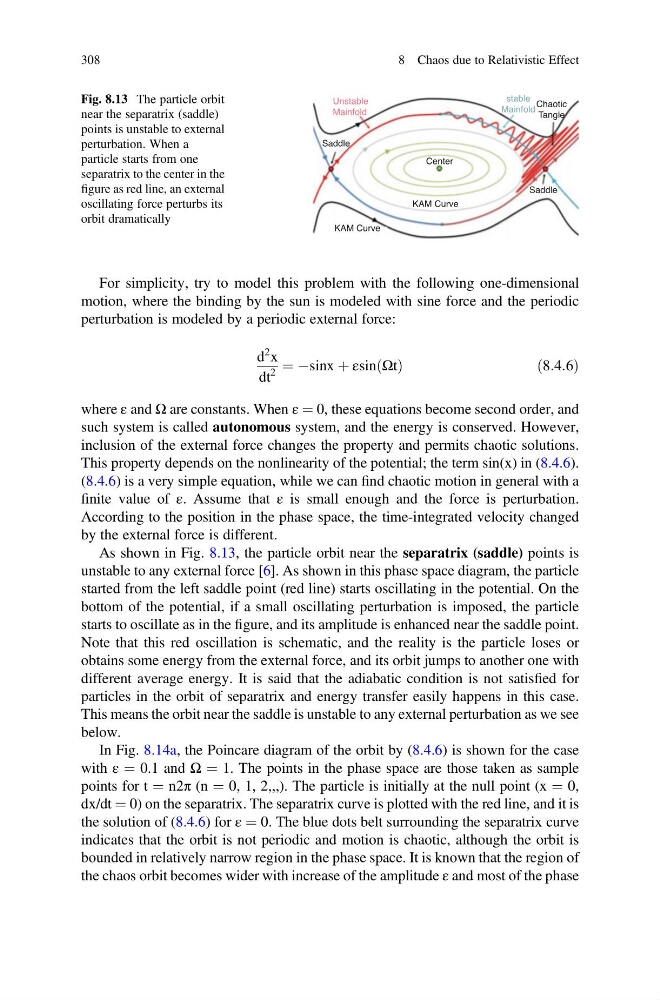
As shown in Fig. 8.13, the particle orbit near the separatrix (saddle) points is
unstable to any external force [6]. As shown in this phase space diagram, the particle
started from the left saddle point (red line) starts oscillating in the potential. On the
bottom of the potential, if a small oscillating perturbation is imposed, the particle
starts to oscillate as in the figure, and its amplitude is enhanced near the saddle point.
Note that this red oscillation is schematic, and the reality is the particle loses or
obtains some energy from the external force, and its orbit jumps to another one with
different average energy. It is said that the adiabatic condition is not satisfied for
particles in the orbit of separatrix and energy transfer easily happens in this case.
This means the orbit near the saddle is unstable to any external perturbation as we see
below.
In Fig. 8.14a, the Poincare diagram of the orbit by (8.4.6) is shown for the case
with ε ¼ 0.1 and Ω ¼ 1. The points in the phase space are those taken as sample
points for t ¼ n2π (n ¼ 0, 1, 2,,,). The particle is initially at the null point (x ¼ 0,
dx/dt ¼ 0) on the separatrix. The separatrix curve is plotted with the red line, and it is
the solution of (8.4.6) for ε ¼ 0. The blue dots belt surrounding the separatrix curve
indicates that the orbit is not periodic and motion is chaotic, although the orbit is
bounded in relatively narrow region in the phase space. It is known that the region of
the chaos orbit becomes wider with increase of the amplitude ε and most of the phase
Unstable
Mainfold
stable
Mainfold
Saddle
Saddle
Center
KAM Curve
KAM Curve
Chaotic
Tangle
Fig. 8.13 The particle orbit
near the separatrix (saddle)
points is unstable to external
perturbation. When a
particle starts from one
separatrix to the center in the
figure as red line, an external
oscillating force perturbs its
orbit dramatically
308
8 Chaos due to Relativistic Effect
motion, where the binding by the sun is modeled with sine force and the periodic
perturbation is modeled by a periodic external force:
d
2 x
dt
2
¼ Àsinx þ εsin Ωt
ð Þ
ð8:4:6Þ
where ε and Ω are constants. When ε ¼ 0, these equations become second order, and
such system is called autonomous system, and the energy is conserved. However,
inclusion of the external force changes the property and permits chaotic solutions.
This property depends on the nonlinearity of the potential; the term sin(x) in (8.4.6).
(8.4.6) is a very simple equation, while we can find chaotic motion in general with a
finite value of ε. Assume that ε is small enough and the force is perturbation.
According to the position in the phase space, the time-integrated velocity changed
by the external force is different.
As shown in Fig. 8.13, the particle orbit near the separatrix (saddle) points is
unstable to any external force [6]. As shown in this phase space diagram, the particle
started from the left saddle point (red line) starts oscillating in the potential. On the
bottom of the potential, if a small oscillating perturbation is imposed, the particle
starts to oscillate as in the figure, and its amplitude is enhanced near the saddle point.
Note that this red oscillation is schematic, and the reality is the particle loses or
obtains some energy from the external force, and its orbit jumps to another one with
different average energy. It is said that the adiabatic condition is not satisfied for
particles in the orbit of separatrix and energy transfer easily happens in this case.
This means the orbit near the saddle is unstable to any external perturbation as we see
below.
In Fig. 8.14a, the Poincare diagram of the orbit by (8.4.6) is shown for the case
with ε ¼ 0.1 and Ω ¼ 1. The points in the phase space are those taken as sample
points for t ¼ n2π (n ¼ 0, 1, 2,,,). The particle is initially at the null point (x ¼ 0,
dx/dt ¼ 0) on the separatrix. The separatrix curve is plotted with the red line, and it is
the solution of (8.4.6) for ε ¼ 0. The blue dots belt surrounding the separatrix curve
indicates that the orbit is not periodic and motion is chaotic, although the orbit is
bounded in relatively narrow region in the phase space. It is known that the region of
the chaos orbit becomes wider with increase of the amplitude ε and most of the phase
Unstable
Mainfold
stable
Mainfold
Saddle
Saddle
Center
KAM Curve
KAM Curve
Chaotic
Tangle
Fig. 8.13 The particle orbit
near the separatrix (saddle)
points is unstable to external
perturbation. When a
particle starts from one
separatrix to the center in the
figure as red line, an external
oscillating force perturbs its
orbit dramatically
308
8 Chaos due to Relativistic Effect