

negative, the laser field direction changed to the opposite direction, so fortunately the
electron is accelerated dramatically by the DC interaction with the laser field.
8.5 Electron Heating by Laser Field and Induced
Plasma Waves
When a relativistic laser is irradiated to low-density plasma such as gas, largeamplitude plasma waves are generated by the Raman scattering as explained in
Chap. 6. The induced plasma waves are used to accelerate electrons in the early
research stage of the laser acceleration. Then, the forward Raman scattering is
expected to be induced predominantly in such parametric instability scheme. From
the view point of the present physics, however, not only the induced plasma waves
but also the nonlinearity of relativistic laser can also accelerate the electrons;
consequently the stochastic acceleration is not avoidable.
Stochastic acceleration in such regime has been studied by 2D3V PIC simulation
and corresponding model [8]. The simulation condition assumes a Gaussian laser of
pulse length ~ 0.7 ps, focused on low-density plasma [~n e ¼ (0.02 ~ 0.07)n c ] at the
intensity 5 Â 10
19 W/cm
2 (a 0 ¼ 6), focused with its spot size of (4–6)λ, where λ the
laser wavelength. The simulation zone is varied in the range [L x xL y] ¼ [(1000–1500)
λ x[(60–200) λ].
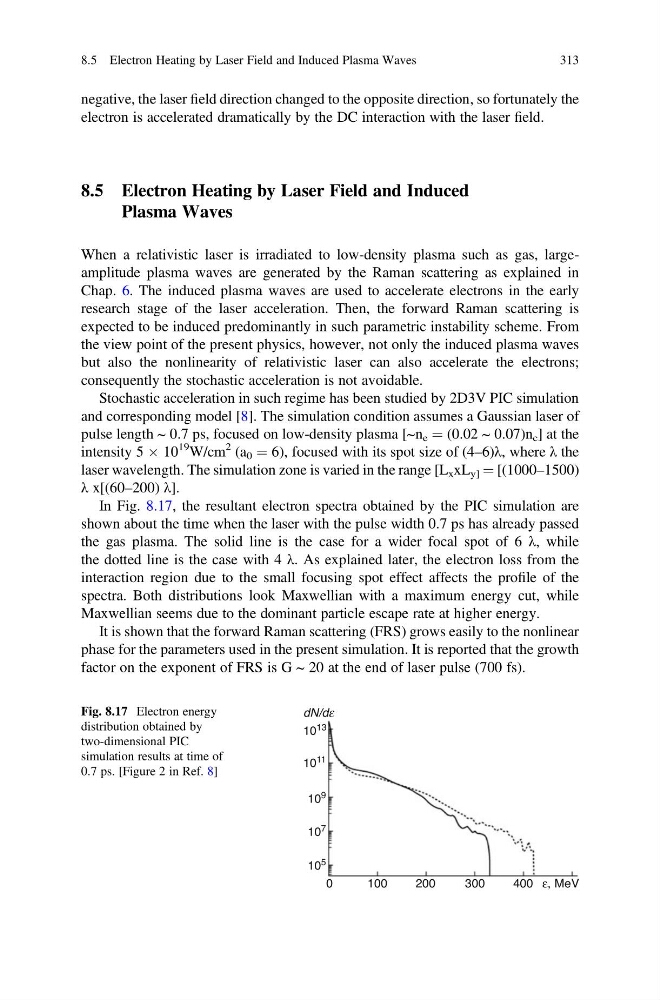
In Fig. 8.17, the resultant electron spectra obtained by the PIC simulation are
shown about the time when the laser with the pulse width 0.7 ps has already passed
the gas plasma. The solid line is the case for a wider focal spot of 6 λ, while
the dotted line is the case with 4 λ. As explained later, the electron loss from the
interaction region due to the small focusing spot effect affects the profile of the
spectra. Both distributions look Maxwellian with a maximum energy cut, while
Maxwellian seems due to the dominant particle escape rate at higher energy.
It is shown that the forward Raman scattering (FRS) grows easily to the nonlinear
phase for the parameters used in the present simulation. It is reported that the growth
factor on the exponent of FRS is G ~ 20 at the end of laser pulse (700 fs).
10
13
dN/dε
10
11
10
9
10
7
10
5
0
100
200
300
400
MeV
ε,
Fig. 8.17 Electron energy
distribution obtained by
two-dimensional PIC
simulation results at time of
0.7 ps. [Figure 2 in Ref. 8]
8.5 Electron Heating by Laser Field and Induced Plasma Waves
313
electron is accelerated dramatically by the DC interaction with the laser field.
8.5 Electron Heating by Laser Field and Induced
Plasma Waves
When a relativistic laser is irradiated to low-density plasma such as gas, largeamplitude plasma waves are generated by the Raman scattering as explained in
Chap. 6. The induced plasma waves are used to accelerate electrons in the early
research stage of the laser acceleration. Then, the forward Raman scattering is
expected to be induced predominantly in such parametric instability scheme. From
the view point of the present physics, however, not only the induced plasma waves
but also the nonlinearity of relativistic laser can also accelerate the electrons;
consequently the stochastic acceleration is not avoidable.
Stochastic acceleration in such regime has been studied by 2D3V PIC simulation
and corresponding model [8]. The simulation condition assumes a Gaussian laser of
pulse length ~ 0.7 ps, focused on low-density plasma [~n e ¼ (0.02 ~ 0.07)n c ] at the
intensity 5 Â 10
19 W/cm
2 (a 0 ¼ 6), focused with its spot size of (4–6)λ, where λ the
laser wavelength. The simulation zone is varied in the range [L x xL y] ¼ [(1000–1500)
λ x[(60–200) λ].
In Fig. 8.17, the resultant electron spectra obtained by the PIC simulation are
shown about the time when the laser with the pulse width 0.7 ps has already passed
the gas plasma. The solid line is the case for a wider focal spot of 6 λ, while
the dotted line is the case with 4 λ. As explained later, the electron loss from the
interaction region due to the small focusing spot effect affects the profile of the
spectra. Both distributions look Maxwellian with a maximum energy cut, while
Maxwellian seems due to the dominant particle escape rate at higher energy.
It is shown that the forward Raman scattering (FRS) grows easily to the nonlinear
phase for the parameters used in the present simulation. It is reported that the growth
factor on the exponent of FRS is G ~ 20 at the end of laser pulse (700 fs).
10
13
dN/dε
10
11
10
9
10
7
10
5
0
100
200
300
400
MeV
ε,
Fig. 8.17 Electron energy
distribution obtained by
two-dimensional PIC
simulation results at time of
0.7 ps. [Figure 2 in Ref. 8]
8.5 Electron Heating by Laser Field and Induced Plasma Waves
313