

relatively wide beam. In addition, plasma is relatively one-dimensional structure so
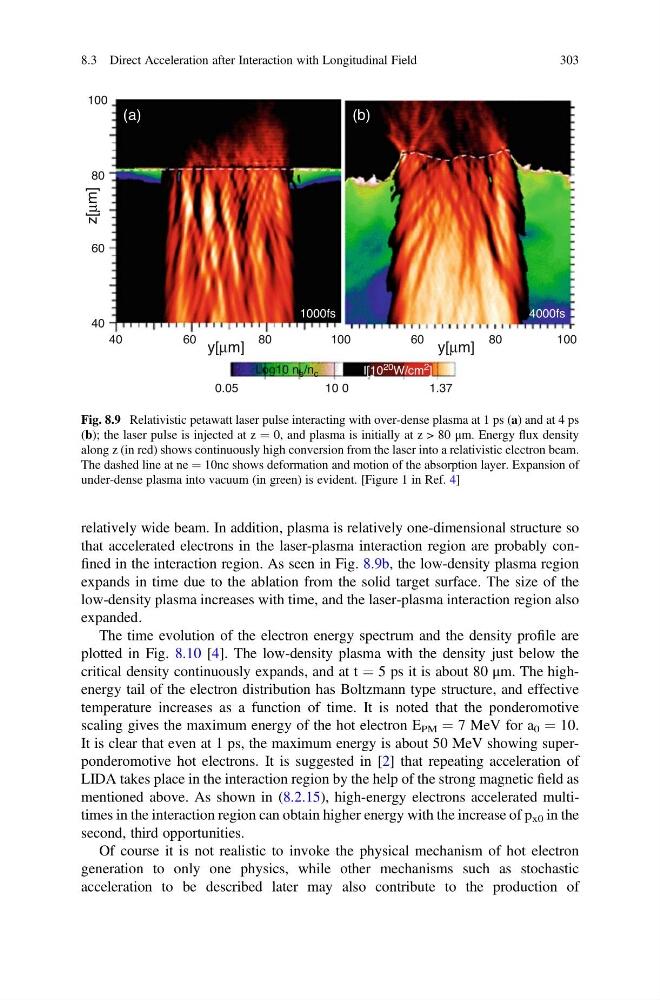
that accelerated electrons in the laser-plasma interaction region are probably confined in the interaction region. As seen in Fig. 8.9b, the low-density plasma region
expands in time due to the ablation from the solid target surface. The size of the
low-density plasma increases with time, and the laser-plasma interaction region also
expanded.
The time evolution of the electron energy spectrum and the density profile are
plotted in Fig. 8.10 [4]. The low-density plasma with the density just below the
critical density continuously expands, and at t ¼ 5 ps it is about 80 μm. The highenergy tail of the electron distribution has Boltzmann type structure, and effective
temperature increases as a function of time. It is noted that the ponderomotive
scaling gives the maximum energy of the hot electron E PM ¼ 7 MeV for a 0 ¼ 10.
It is clear that even at 1 ps, the maximum energy is about 50 MeV showing superponderomotive hot electrons. It is suggested in [2] that repeating acceleration of
LIDA takes place in the interaction region by the help of the strong magnetic field as
mentioned above. As shown in (8.2.15), high-energy electrons accelerated multitimes in the interaction region can obtain higher energy with the increase of p x0 in the
second, third opportunities.
Of course it is not realistic to invoke the physical mechanism of hot electron
generation to only one physics, while other mechanisms such as stochastic
acceleration to be described later may also contribute to the production of
100
80
60
z[μm]
y[μm]
y[μm]
40
40
60
80
0.05
10 0
1.37
60
80
100
100
Log10 n e /n c
I[10
20 W/cm
2 ]
1000fs
(b)
(a)
4000fs
Fig. 8.9 Relativistic petawatt laser pulse interacting with over-dense plasma at 1 ps (a) and at 4 ps
(b); the laser pulse is injected at z ¼ 0, and plasma is initially at z > 80 μm. Energy flux density
along z (in red) shows continuously high conversion from the laser into a relativistic electron beam.
The dashed line at ne ¼ 10nc shows deformation and motion of the absorption layer. Expansion of
under-dense plasma into vacuum (in green) is evident. [Figure 1 in Ref. 4]
8.3 Direct Acceleration after Interaction with Longitudinal Field
303
that accelerated electrons in the laser-plasma interaction region are probably confined in the interaction region. As seen in Fig. 8.9b, the low-density plasma region
expands in time due to the ablation from the solid target surface. The size of the
low-density plasma increases with time, and the laser-plasma interaction region also
expanded.
The time evolution of the electron energy spectrum and the density profile are
plotted in Fig. 8.10 [4]. The low-density plasma with the density just below the
critical density continuously expands, and at t ¼ 5 ps it is about 80 μm. The highenergy tail of the electron distribution has Boltzmann type structure, and effective
temperature increases as a function of time. It is noted that the ponderomotive
scaling gives the maximum energy of the hot electron E PM ¼ 7 MeV for a 0 ¼ 10.
It is clear that even at 1 ps, the maximum energy is about 50 MeV showing superponderomotive hot electrons. It is suggested in [2] that repeating acceleration of
LIDA takes place in the interaction region by the help of the strong magnetic field as
mentioned above. As shown in (8.2.15), high-energy electrons accelerated multitimes in the interaction region can obtain higher energy with the increase of p x0 in the
second, third opportunities.
Of course it is not realistic to invoke the physical mechanism of hot electron
generation to only one physics, while other mechanisms such as stochastic
acceleration to be described later may also contribute to the production of
100
80
60
z[μm]
y[μm]
y[μm]
40
40
60
80
0.05
10 0
1.37
60
80
100
100
Log10 n e /n c
I[10
20 W/cm
2 ]
1000fs
(b)
(a)
4000fs
Fig. 8.9 Relativistic petawatt laser pulse interacting with over-dense plasma at 1 ps (a) and at 4 ps
(b); the laser pulse is injected at z ¼ 0, and plasma is initially at z > 80 μm. Energy flux density
along z (in red) shows continuously high conversion from the laser into a relativistic electron beam.
The dashed line at ne ¼ 10nc shows deformation and motion of the absorption layer. Expansion of
under-dense plasma into vacuum (in green) is evident. [Figure 1 in Ref. 4]
8.3 Direct Acceleration after Interaction with Longitudinal Field
303